Dental clinics and laboratories evaluating 3D technology often ask the same practical questions. Below are straightforward answers to the ten most common ones, based on real clinical and laboratory requirements in 2026.
1. How accurate do dental 3D printers and scanners need to be?
For most dental applications (models, surgical guides, temporary restorations, occlusal appliances), scanner accuracy of ≤10 μm (full arch) and printer accuracy under 0.05 mm are considered clinically reliable.
Aident AI-30 intraoral scanner delivers ≤10 μm full-arch accuracy. Aident Ai-C60 and Ai220 printers achieve accuracy <0.03 mm. These levels support high-quality fits and low remake rates when the full digital chain is properly managed.
2. What is the difference between a closed system and an open system?
Closed systems restrict you to one manufacturer's scanners, design software, printers and materials. Open systems export standard file formats (STL, PLY, OBJ) and accept a wide range of resins and CAD software.
Open systems give greater flexibility, lower long-term material costs and easier collaboration with external labs or different design platforms. Aident equipment is fully open.
3. Can I really do same-day dentistry with 3D printing?
Yes, for many indications. A typical chairside workflow (scan → design → print) can produce temporary crowns, surgical guides, models or certain appliances within a single visit or the same day. Permanent high-strength materials may still require additional processing, but the digital process dramatically shortens overall treatment time compared with traditional methods.
The combination of a fast intraoral scanner (AI-30) and a reliable chairside printer (Ai-C60) is designed to support efficient same-day protocols.
4. How difficult is it for staff to learn these systems?
Modern systems with simplified interfaces can be learned quickly. Many clinics report that dental assistants become productive with scanning software within 1–2 days of focused training. Printer operation and basic maintenance are straightforward once standard protocols are established.
Aident's scanning software (AIDENT lScan) is designed for ease of use, with lifetime free upgrades and multi-language support.
5. What resins can I use? Am I locked into one brand?
It depends on whether the printer is open or closed. Open printers accept a wide range of certified dental resins (model resins, surgical guide resins, temporary crown resins, night-guard/splint resins, etc.), provided the resin is compatible with the printer's light source and the correct settings are used.
Aident printers are open systems and work with both Aident resins and many third-party certified materials.
6. How important is the intraoral scanner's weight and tip design?
Very important for daily clinical use. A lightweight scanner (under 200 g) and well-balanced tip reduce operator fatigue and improve patient comfort, especially during full-arch scans or when working with children and patients who have limited opening. Powder-free operation further improves the experience.
The AI-30 weighs 156–198 g and features a powder-free design with intelligent anti-fog.
7. Do I need both a chairside printer and a laboratory printer?
Not necessarily at the beginning. Many clinics start with one versatile printer (such as the Ai-C60) for models, temporaries and guides. High-volume laboratories often add a larger-build printer (Ai220) for batch production. The decision depends on case volume, indication mix and whether you prefer to keep more work in-house.
8. What are the most common reasons for print failures?
The majority of failures relate to:
Incorrect platform leveling
Improper exposure settings or resin temperature
Poor support design or model orientation
Contaminated or damaged release film
Unrepaired STL mesh errors
Most of these issues are preventable with basic training and a simple pre-print checklist. Reliable hardware with auto-leveling and temperature control (features of Aident printers) reduces the frequency of these problems.
9. How does digital workflow improve ROI for a clinic or lab?
Typical benefits include:
Reduced chair time and fewer patient visits
Lower remake rates
Ability to offer new services (same-day temporaries, in-house guides, custom appliances)
Faster turnaround for laboratory partners
Digital archiving that simplifies remakes and future treatment
Exact returns vary by case mix and utilization, but practices that fully adopt the Scan → Design → Print chain commonly report meaningful efficiency and revenue gains.
10. What should I look for when choosing dental 3D equipment in 2026?
Priority criteria:
Proven clinical accuracy
Open file formats and material flexibility
Real-world ease of use and training support
Reliable hardware features (auto-leveling, temperature control, anti-fog, etc.)
Strong after-sales support and software update policy
Total cost of ownership rather than only initial purchase price
Aident positions its solutions around these exact requirements: accurate open-system scanners and printers, practical chairside and laboratory performance, and lifetime software upgrades.
Summary
Dental 3D equipment is no longer experimental. When chosen and implemented correctly, intraoral scanners and 3D printers deliver measurable improvements in precision, efficiency and patient experience. The key is selecting open, reliable systems that fit your clinical workflow and growth plans rather than forcing your workflow to fit a closed ecosystem.
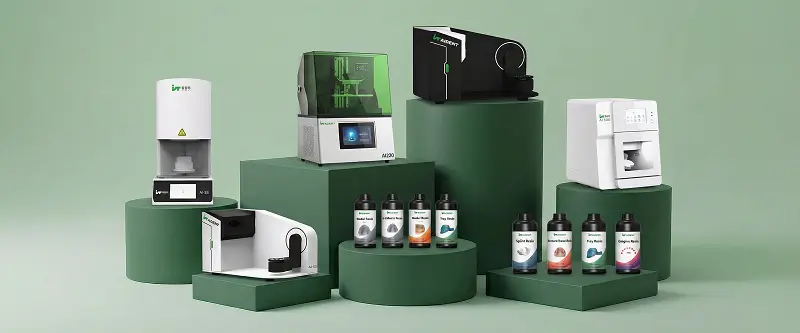
Aident3D offers a complete one-stop digital dentistry solution - Intraoral Scanner + Dental Lab Scanner + Dental 3D Printer + Resin - built on open architecture and practical performance.
Have more specific questions about equipment selection or workflow setup?
Contact us for a personalized consultation:
→ https://www.aident3d.com/inquiry
WhatsApp: +86 19311417410
Email: dongjiahao@aident.cc
Clear answers. Confident decisions.