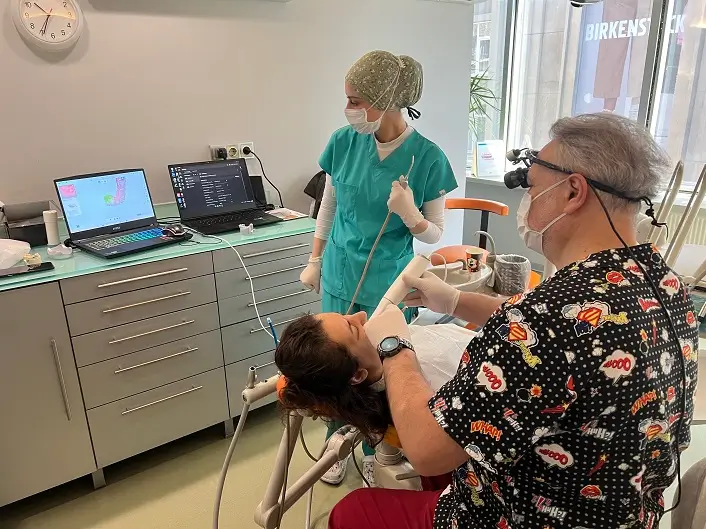
How can the accuracy of an intraoral scanner be objectively evaluated? The International Organization for Standardization has established relevant standards. ISO 12836 is the core standard for testing the accuracy of digital impression devices.
Overview of ISO 12836
The full title of the standard is Dentistry - Test methods for assessing accuracy of digitizing devices. It specifies the standard procedures, reference models, measurement methods, and evaluation metrics for accuracy testing of both intraoral scanners and model scanners.
Standard Test Model
The standard requires the use of a standard dental arch model with known high-accuracy reference data (typically calibrated by an industrial-grade high-precision scanner or a coordinate measuring machine). The model includes:
A complete dentition (including anterior and posterior teeth)
Prepared abutment teeth (full-crown preparation morphology)
Implant analogs and scan bodies
Different margin designs (supragingival, equigingival, subgingival)
Interproximal contact areas
Evaluation Metrics
Trueness: The deviation between the test scan result and the reference model, expressed as root-mean-square error (RMSE) or mean deviation.
Precision: The consistency among multiple repeated scan results, expressed as the deviation obtained by pairwise comparison of the repeated scans.
Measurement range: Accuracy is reported separately for different spans such as single crowns, short-span fixed bridges, and full arches.
Test Conditions
Controlled ambient temperature (23 ± 2 °C)
Device calibrated according to the manufacturer's instructions
Scanning performed by a skilled operator
Multiple repeated scans under each condition (typically 10 or more)
Three-dimensional deviations calculated after best-fit alignment
Clinical Significance
The ISO standard provides a unified evaluation framework that makes accuracy data from different brands comparable.
However, manufacturer-claimed accuracy figures may report only the results obtained under optimal conditions (for example, single-crown accuracy). Buyers should pay attention to full-arch accuracy.
In-vitro testing on a standard model does not equal true intraoral accuracy-factors such as saliva, patient movement, and operator angulation reduce precision in clinical use.
It is recommended to request accuracy reports issued by third-party testing institutions in accordance with ISO 12836.
In addition to ISO 12836, intraoral scanners must also comply with standards such as IEC 60601 (medical electrical safety), ISO 10993 (biocompatibility), and IEC 62304 (software life-cycle processes).
At Aident Technology, the AI-30 intraoral scanner series is engineered for reliable clinical performance. With ≥30 frames per second, ≤10 μm full-arch accuracy, powder-free true-color scanning, intelligent anti-fog heating, and an ultra-lightweight 156–198 g design, the AI-30 supports accurate digital impressions for modern chairside and laboratory workflows.
Explore our solutions:
Contact Aident for OEM/ODM collaboration, wholesale pricing, or a live demonstration and experience how rigorously validated accuracy supports digital dentistry.