Looking for an affordable intraoral scanner does not mean choosing the cheapest option available. The real goal is to find the best value - a scanner that delivers reliable clinical performance, low ongoing costs, and strong return on investment without unnecessary premium pricing or restrictive subscriptions.
This 2026 guide explains how to evaluate affordable intraoral scanners intelligently and avoid common pitfalls.
Quick Answer: What "Best Value" Really Means
The best-value intraoral scanner combines:
Clinically acceptable accuracy for everyday restorative and implant cases
Comfortable, efficient handling (especially weight)
Open system with free or low-cost software updates
Minimal mandatory subscriptions or hidden fees
Reliable support and reasonable consumable costs
Competitive initial purchase price
A low sticker price is only part of the equation. High subscription fees, closed ecosystems, or frequent tip replacements can erase the initial savings within 1–2 years.
1. Understand Total Cost of Ownership (TCO)
When comparing scanners, calculate beyond the initial price:
| Cost Element | What to Check |
|---|---|
| Hardware price | Initial purchase or financing cost |
| Software / subscription | Mandatory annual or monthly fees? |
| Tips / consumables | Price per tip and expected lifespan (autoclavable vs single-use) |
| Training & support | Included or extra cost? |
| Warranty & repairs | Coverage length and out-of-warranty costs |
| Lab compatibility | Open files vs proprietary export fees or friction |
| Future upgrades | Cost of software improvements or new features |
Scanners that advertise a low entry price but require expensive ongoing subscriptions often end up more costly than a moderately priced open system with free updates.
2. Key Features That Deliver Real Value
Not every premium feature is necessary for strong clinical results. Prioritize these value drivers:
Accuracy sufficient for daily cases
Most modern mid-tier scanners deliver excellent results for crowns, bridges, and single implants. Full-arch performance in the ≤10–20 μm range (under proper conditions) is generally more than adequate for the majority of clinics.
Lightweight design
A lighter handpiece (ideally under 200 g) reduces fatigue and improves adoption by the whole team. This has a bigger daily impact than marginal accuracy differences.
Powder-free operation
Improves patient comfort and speeds up the workflow. Almost all competitive scanners now offer this.
Open system (STL/PLY/OBJ)
Avoids laboratory friction and preserves your freedom to choose design software and production partners.
No mandatory high subscription
Lifetime free software upgrades or very low optional fees protect long-term affordability.
Good depth of field and anti-fog
Reduces rescans and frustration during real clinical use.
3. Price Tiers in 2026 (General Market Overview)
While exact prices vary by region, configuration, and negotiation, the market roughly divides into:
Entry / Budget - Lower price, often acceptable for basic cases, but may compromise on weight, software maturity, support, or longevity.
Best-Value / Mid-Tier - Strong balance of accuracy, ergonomics, open architecture, and reasonable price. This is where most clinics find the optimal ROI.
Premium - Highest brand prestige, advanced ecosystem features, and usually higher ongoing costs.
For the majority of general practices, the best-value tier offers the most rational combination of performance and cost control.
4. Common Mistakes When Buying an "Affordable" Scanner
Focusing only on the lowest price without checking subscription terms
Ignoring handpiece weight (leads to low daily usage)
Choosing a closed system that limits laboratory options
Underestimating the importance of local or responsive support
Buying without a proper demonstration or trial on real cases
Assuming all "10 μm" claims are equal without understanding test conditions
5. How the Aident AI-30 Positions for Best Value
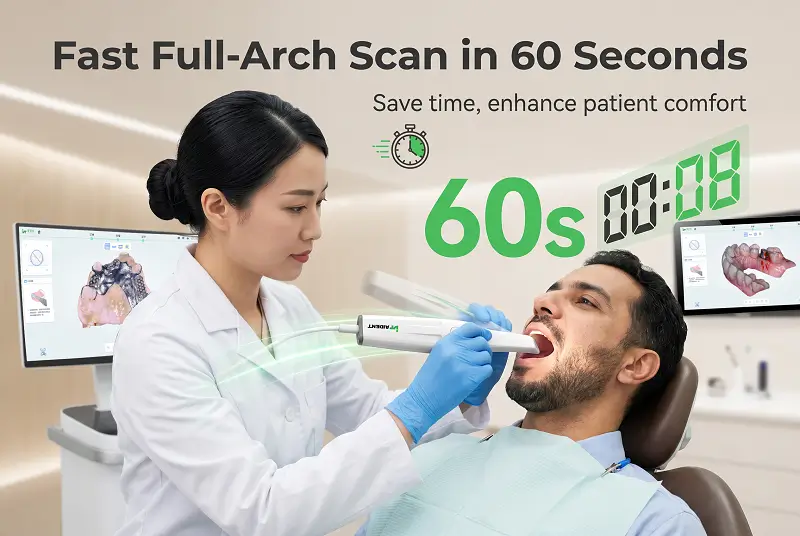
The Aident AI-30 is designed as a practical high-value option for clinics that want strong clinical performance without premium-brand pricing or mandatory software fees.
Verified characteristics:
Full-arch accuracy ≤10 μm (manufacturer specification)
Lightweight handpiece (198 g range)
Powder-free scanning with intelligent anti-fog
Depth of field 0–25 mm
Scanning speed ≥30 fps
Fully open system (STL / PLY / OBJ export)
Lifetime free software upgrades
CE certified + China Class II medical device qualifications
These features target the core needs of everyday restorative, implant, and orthodontic scanning while keeping long-term ownership costs predictable.
6. Practical Buying Recommendations
Define your main case types (single crowns, bridges, implants, ortho, full arch).
Set a realistic total budget that includes tips and potential fees for 3–5 years.
Prioritize open architecture and low or zero mandatory subscriptions.
Test weight and handling in person if possible.
Request clear written information on software policy, warranty, and support.
Compare at least 2–3 options on total cost of ownership, not just initial price.
Consider the manufacturer's stability and ability to provide long-term parts and updates.
FAQ
What is a realistic budget for a reliable affordable intraoral scanner?
It varies widely by market and configuration. Focus on total cost of ownership rather than a single number. Many clinics find the best ROI in the mid-tier value segment rather than the absolute cheapest devices.
Are cheap intraoral scanners accurate enough?
Some entry-level scanners perform adequately for basic single-unit work. However, lower-priced devices may compromise on ergonomics, software maturity, support quality, or consistency on more demanding cases.
Do I need the most expensive scanner for good results?
No. For the majority of general practice cases, a well-designed mid-tier open-system scanner delivers excellent clinical outcomes at a much better total cost.
How important is an open system for value?
Very important. Open systems reduce laboratory friction and protect you from being locked into one vendor's pricing and software fees.
Is the Aident AI-30 considered an affordable / best-value option?
Yes. It is positioned to deliver high clinical utility (accuracy, low weight, powder-free, open architecture, free updates) at a competitive investment level compared with premium closed or high-subscription systems.
Next Step
The smartest "affordable" choice is the scanner that delivers reliable daily performance, low ongoing costs, and workflow freedom - not simply the one with the lowest initial price tag.
Want to evaluate a high-value open-system intraoral scanner?
Request current pricing, specifications, or a demonstration of the Aident AI-30:
Inquiry form: https://www.aident3d.com/inquiry
WhatsApp: +86 19311417410
Email: dongjiahao@aident.cc
Tell us your clinic size, main case types, and budget expectations. We will provide transparent information and help you assess whether the AI-30 offers the best value for your practice or distribution needs.