Artificial intelligence is no longer a distant concept in digital dentistry. In 2026 it is already delivering measurable improvements in scanning reliability, design efficiency, and production consistency. The most valuable applications are not science-fiction automation, but practical tools that reduce errors, shorten learning curves, and make daily workflows more predictable for clinics and laboratories.
Current Practical AI Applications in Intraoral Scanning
Modern intraoral scanners use AI primarily to improve data quality and operator experience in real time:
Intelligent missing-area detection and guided rescanning
The system highlights incomplete regions and helps the operator capture them quickly instead of discovering gaps only after the scan is finished.
AI-assisted soft-tissue and artifact filtering
Reduces noise from the tongue, cheeks, or saliva, producing cleaner models with less manual editing.
Edge and margin enhancement
Helps define preparation margins more clearly, which is especially useful for restorative and implant cases.
Anti-fog and real-time optimization support
Combined with hardware heating, software algorithms maintain consistent image quality during longer scans.
These features directly address the most common clinical frustrations: incomplete scans, the need for multiple retakes, and time spent cleaning up data before design.
On the laboratory side, AI-supported desktop scanners offer intelligent rescan functions and automated recognition of implant scan bodies or hole-closing tools, further reducing manual intervention.
AI Support in the Design and 3D Printing Stages
Once a clean digital impression exists, AI contributes in several practical ways:
Automated or semi-automated design suggestions
Preliminary crown, bridge, or appliance proposals that technicians can refine, speeding up routine cases.
Nesting and orientation optimization for 3D printing
Algorithms suggest efficient part placement and support strategies to improve success rates and reduce resin use.
Print parameter recommendations
Matched profiles for specific resins and printers help maintain dimensional accuracy and surface quality across batches.
Quality prediction and anomaly alerts
Early detection of potential issues such as insufficient supports or risk of warpage before the print starts.
The result is higher first-time success rates and more consistent output - critical for both chairside same-day work and high-volume laboratory production.
Near-Term Prospects (Next 2–3 Years)
The most realistic near-term developments focus on deeper integration rather than fully autonomous "lights-out" dentistry:
Tighter scan-to-design continuity
Better automatic transfer of AI-detected margins and anatomical features into design software, reducing manual marking.
Smarter multi-indication recognition
Scanners and software that more reliably distinguish between restorative, orthodontic, implant, and edentulous cases and apply appropriate processing.
Closed-loop feedback from print results
Systems that learn from successful and failed prints to refine future nesting and parameter choices.
Improved cross-device consistency
AI tools that help maintain the same data quality standards whether the scan originates from a clinic or a laboratory scanner.
Accessible AI for smaller clinics
Features that lower the skill threshold so less experienced operators can produce reliable scans and simple designs.
Fully autonomous diagnosis or completely hands-free printing remain longer-term possibilities. The immediate value lies in making existing digital workflows faster, more accurate, and easier to adopt.
What This Means for Clinics and Laboratories
Shorter scanning and design times
Fewer incomplete scans and remakes
More consistent results across different operators
Lower training burden for new staff
Better utilization of 3D printers through higher success rates
Clinics and labs that already use open digital systems are best positioned to benefit, because AI tools can be added or upgraded without being locked into a single proprietary ecosystem.
Aident's Practical Approach to AI-Assisted Workflows
Aident focuses on AI features that deliver daily clinical and laboratory value:
Intelligent rescan and missing-area guidance on scanning devices
AI-assisted processing in the scanning software (filtering, edge support)
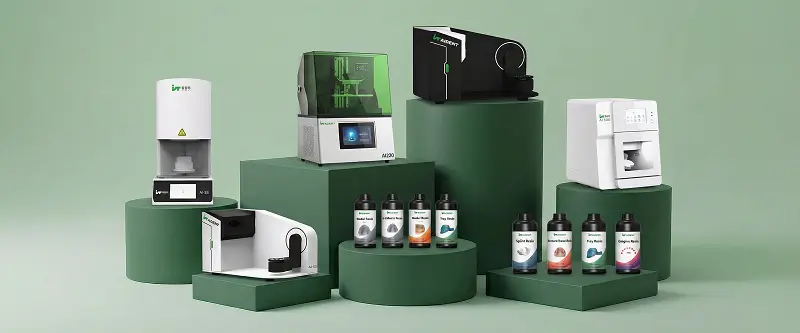
Stable, open hardware platforms (AI-30 intraoral scanner, lab scanners, Ai-C60 / Ai220 printers) that work with evolving software tools
Fully open STL / PLY / OBJ output so clinics and labs retain freedom to adopt new AI design or nesting solutions as they mature
The goal is not to promise fully autonomous dentistry, but to make the Scan → Design → Print chain more reliable and efficient with practical AI assistance.
Moving Forward
AI in oral scanning and 3D printing is already useful and will become more deeply integrated over the next few years. The clinics and laboratories that gain the most will be those that treat AI as a practical productivity layer on top of accurate, open, and easy-to-use hardware - rather than waiting for perfect autonomy.
To explore current AI-assisted scanning and printing solutions that fit real clinical and laboratory needs, contact Aident.
WhatsApp: +86 19311417410
Email: dongjiahao@aident.cc
Inquiry: https://www.aident3d.com/inquiry
Practical AI is already here. The advantage goes to those who apply it inside a reliable digital workflow.