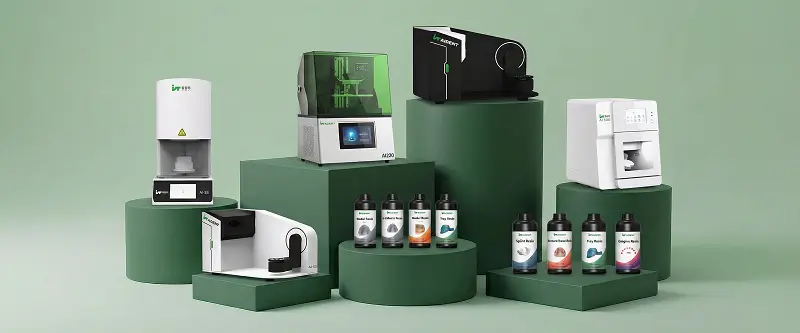
Many dental clinics and laboratories still face recurring frustrations: surgical guides arriving late before implant procedures, physical impressions getting damaged or lost during shipping, patients waiting several days for temporary restorations, and rising costs from remakes or external lab fees.
Traditional subtractive manufacturing has long been the standard, but it often involves longer processing times, material waste, and design limitations. Dental 3D printing offers a practical digital alternative. Through additive manufacturing, clinics and labs can produce accurate surgical guides, temporary restorations, diagnostic models, and orthodontic appliances more efficiently.
Faster Turnaround
Time remains one of the biggest constraints in daily practice. Conventional lab workflows frequently require days for models, temps, or guides.
With digital scanning followed by 3D printing, many of these items can be produced during a single appointment or within the same day. The typical flow is straightforward:
Capture the patient's oral data digitally
Design the restoration or appliance in CAD software
Print the final piece on a dental 3D printer
Surgical guides, models, splints, and provisional restorations no longer need to wait for external production. Faster case movement allows clinics to schedule more procedures without compromising quality, while laboratories can increase daily output.
Improved Precision and Consistency
In dentistry, small deviations matter. Digital scans combined with 3D printing reduce common sources of error such as impression distortion, shipping damage, or manual adjustments.
High-resolution printing helps restorations and guides fit more predictably on the first try. This consistency lowers remake rates and improves clinical predictability for crowns, bridges, implant guides, and models.
Cost Efficiency Over Time
Additive manufacturing uses only the material required for each part, significantly reducing waste compared with milling. Over time, practices also see savings from:
Lower reliance on external labs for routine models and temporary restorations
Reduced labor time for fabrication and adjustments
Fewer remakes
These efficiencies accumulate across hundreds of cases and contribute directly to better margins.
Seamless Digital Workflow Integration
A 3D printer delivers the most value when it forms part of a complete digital chain. Data flows from intraoral or model scanning into CAD design and then directly to printing. This reduces interruptions, improves communication between clinicians and technicians, and supports remote collaboration when needed.
Digital files can be reviewed and modified before printing, minimizing guesswork and improving planning accuracy-especially useful for implant cases that combine CBCT and scan data.
Better Patient Experience
Patients notice comfort, fewer visits, and clearer communication. Digital scanning is generally more comfortable than traditional impressions. Same-day or next-day solutions reduce the number of appointments. Visual treatment planning helps patients understand the proposed outcomes, which often increases acceptance and trust.
These improvements tend to support higher patient retention and stronger reviews.
Enhanced Competitiveness
Offering faster, more predictable services such as same-day temporary restorations or precise surgical guides helps practices differentiate themselves. Clinics and labs can handle a wider range of cases more efficiently while maintaining quality.
Convenient Digital Storage
Physical plaster models take up space and are prone to damage. Digital records can be stored securely and reprinted on demand. If a patient loses a retainer, the existing file can simply be reprinted-no new impression required.
Is Dental 3D Printing Worth It?
For many practices the answer is increasingly yes. The technology saves waiting time, reduces certain lab and material costs, and opens the door to higher-value services. Faster turnaround also makes it possible to accept more cases without proportional increases in overhead.
Smaller clinics benefit from handling everyday needs (models, temps, guides, splints) in-house. Larger laboratories gain capacity and consistency for high-volume production.
Looking Ahead
Dental 3D printing continues to mature and is becoming a standard part of modern digital workflows rather than an optional add-on. Practices that integrate reliable scanning and printing capability position themselves to deliver faster, more predictable care.
The key is choosing equipment that fits real clinical or laboratory needs-accuracy, ease of use, material flexibility, and smooth integration with existing design software-so the technology supports daily work rather than complicating it.
If you are evaluating how 3D printing could fit into your current workflow, focusing on practical applications (models, temporary restorations, surgical guides, and orthodontic appliances) is usually the most effective starting point.