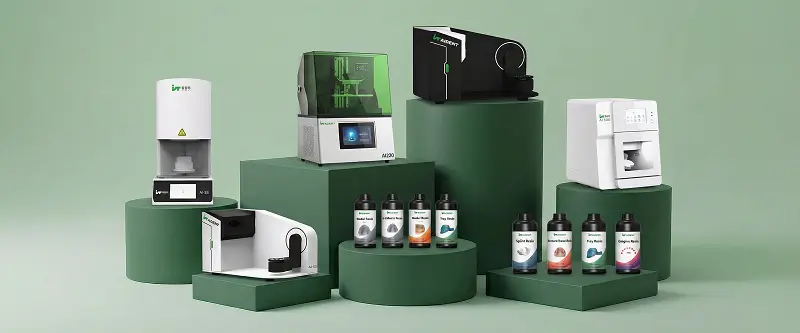
Orthodontic models are one of the highest-volume applications in digital dentistry. Clear aligner models, study models, and retainer models require consistent dimensional accuracy, good surface quality for thermoforming, and efficient batch production. Labs and clinics searching for the best dental 3D printer for orthodontic models 2026 need a machine that can handle daily quantity without sacrificing fit or increasing rework.
This guide answers the practical question: what is the best dental 3D printer for orthodontic models in 2026, and how to choose based on volume, accuracy, and workflow type.
What Matters Most for Orthodontic Model Printing
When evaluating the best 3D printer for orthodontic models, the key factors are:
Dimensional accuracy and stability across the full platform
Smooth surface quality suitable for thermoforming
High nest density for efficient batch production
Consistent results from the center to the edges of the build plate
Resin cost and compatibility
Reliable daily operation with low failure rates
A true high volume 3D printer for orthodontic models must deliver usable models at scale, not just high resolution on a single test print.
Category Comparison for Orthodontic Model Production
| Category | Representative Systems | Strengths for Orthodontic Models | Common Limitations |
|---|---|---|---|
| Premium MSLA | Formlabs Form 4B class | Excellent surface quality and reliability | Higher cost per model at scale |
| Dental-focused DLP | SprintRay Pro series | Strong validation for model workflows | Platform size and ecosystem preference |
| Large open DLP | Asiga Pro 4K class | Large platforms and material flexibility | Higher investment |
| Production open systems | Aident Ai220 class | Large build volume, parallel light uniformity, open files | Less brand recognition in some markets |
| Compact chairside | Aident Ai-C60 class | Fast single models, simple operation | Limited batch capacity |
| Budget large LCD | Phrozen / Anycubic large-format | Low hardware cost and high resolution | More parameter management required |
Labs and clinics asking which 3D printer is best for printing orthodontic models usually find that nest density and platform consistency matter more than the highest theoretical resolution.
Matching Printer Type to Orthodontic Model Volume
Low to medium volume (clinics and small labs)
For practices or small labs producing limited daily orthodontic models, a compact and easy-to-operate machine is often sufficient. The Aident Ai-C60 offers ±0.03 mm accuracy, factory-calibrated operation, full-arch models in approximately 25 minutes, and an open system. It works well as a practical option when daily volume remains modest and space is limited.
Higher volume (production orthodontic labs)
When daily model counts rise, batch efficiency becomes critical. The Aident Ai220 provides a 220 × 125 × 150 mm build volume, AI LED parallel light source, and ±0.03 mm accuracy class. In one documented laboratory case that included orthodontic models, daily output increased from 30+ to 70+ models, with batch sizes rising to 6–8 full-arch models per run. The larger platform and parallel light design support more consistent results across multi-model plates, which is especially relevant for clear aligner model production.
Importance of an Open System 3D Printer for Orthodontic Models
Many orthodontic labs prefer an open system 3D printer for orthodontic models because it offers:
Freedom to choose cost-effective model resins optimized for thermoforming
Ability to fine-tune parameters for different model types (aligner models, study models, retainers)
Standard STL compatibility with existing scanners and design software
Better long-term control over material costs at high volume
Both the Ai-C60 and Ai220 are designed as open systems supporting standard STL/CTB files and a wide range of model resins.
How to Choose the Right Printer for Orthodontic Models
To identify the most suitable option, use this framework:
Track your average and peak daily orthodontic model count.
Identify the main model types (clear aligner models, study models, retainers, or mixed).
Decide whether the printer will operate in a clinical or full laboratory environment.
Evaluate the importance of resin cost versus validated material ecosystems.
Test real model geometries from your design software whenever possible.
Calculate total cost per usable model, including failed prints and labor time.
Final Perspective
There is no single universal winner for the best dental 3D printer for orthodontic models 2026. Premium ecosystem machines deliver strong surface quality and reliability. Large open DLP systems provide material flexibility and high nesting capacity. Compact chairside printers prioritize speed and simplicity for lower volumes. Production-oriented open systems such as the Ai220 class focus on large build volume and platform uniformity for high-volume orthodontic model work.
The most effective choice is the machine that matches your actual daily model volume, delivers consistent dimensional accuracy for thermoforming, and aligns with your resin and cost strategy. For orthodontic models, batch efficiency and platform consistency usually deliver more value than the highest resolution specification alone.
If you share your approximate daily orthodontic model volume, primary model types (aligner models vs. study models), and whether the work is mainly clinical or laboratory-based, a more precise category recommendation can be refined.