Surgical guides demand higher precision and reliability than standard diagnostic models. A poorly printed guide can affect implant positioning, increase chairside adjustments, or compromise the surgical plan. Clinics and labs searching for the best dental 3D printer for surgical guides 2026 need a machine that consistently delivers accurate, dimensionally stable, and clinically usable results.
This guide answers the practical question: what is the best dental 3D printer for surgical guides in 2026, and how to choose based on accuracy, resin compatibility, and production volume.
What Matters Most When Printing Surgical Guides
When evaluating the best 3D printer for surgical guides, the critical factors are:
High dimensional accuracy and stability (typically ±0.03 mm class or better)
Excellent detail reproduction for drill sleeves, fixation pins, and support structures
Compatibility with biocompatible surgical guide resins
Consistent results across the build platform
Reliable temperature and light control to minimize warpage
Ease of use and low failure rate for clinical or laboratory workflows
A true high accuracy 3D printer for dental surgical guides must perform reliably with the specific resins used for implantology.
Category Comparison for Surgical Guide Production
| Category | Representative Systems | Strengths for Surgical Guides | Common Limitations |
|---|---|---|---|
| Premium MSLA | Formlabs Form 4B class | Strong accuracy claims and validated materials | Higher cost and larger footprint |
| Dental-focused DLP | SprintRay Pro series | Good validation for guide workflows | Ecosystem preference |
| Large open DLP | Asiga Pro 4K class | Large platforms and material flexibility | Higher investment |
| Production open systems | Aident Ai220 class | Large build volume, parallel light uniformity, open resin support | Less brand recognition in some markets |
| Compact chairside | Aident Ai-C60 class | Fast single guides, simple operation, small footprint | Limited batch capacity |
| Budget open LCD | Large-format consumer printers | Low hardware cost | More parameter tuning and variable consistency |
Labs and clinics asking which 3D printer is best for printing dental surgical guides usually find that accuracy consistency and biocompatible resin performance matter more than maximum resolution specifications.
Matching Printer Type to Surgical Guide Workflow
Clinic and low-volume use
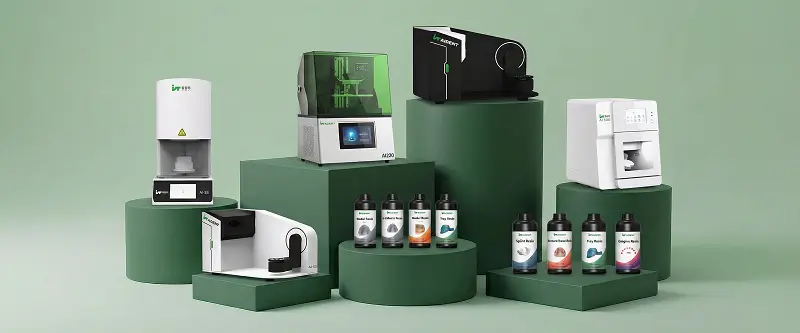
For practices printing occasional or same-day surgical guides, a compact and easy-to-operate machine is often preferred. The Aident Ai-C60 offers ±0.03 mm accuracy, a factory-calibrated platform, full-arch capability in approximately 25 minutes, and an open system that supports biocompatible guide resins. Its compact 12 kg design and built-in curing light make it suitable for clinical environments where space and simplicity are priorities.
Laboratory and higher-volume production
When multiple guides are produced daily, platform uniformity and nest density become important. The Aident Ai220 provides a 220 × 125 × 150 mm build volume, AI LED parallel light source, and ±0.03 mm accuracy class. The parallel light design helps maintain consistent curing across larger plates, which is relevant when printing several guides in one run. Both machines are designed as open systems, allowing labs to use a range of biocompatible surgical guide resins.
Importance of an Open System 3D Printer for Surgical Guides
Many users prefer an open system 3D printer for surgical guides because it provides:
Freedom to select validated biocompatible resins from different manufacturers
Ability to optimize exposure and support parameters for specific guide designs
Better long-term control over material costs
Compatibility with existing scanners and CAD software via standard STL files
Both the Ai-C60 and Ai220 accept standard STL/CTB files and are compatible with mainstream biocompatible guide resins when proper parameters are applied.
How to Choose the Right Printer for Surgical Guides
To identify the most suitable option, follow this practical framework:
Determine your average and peak weekly guide volume.
Confirm the biocompatible resins you plan to use and check printer compatibility.
Decide whether guides will be printed in a clinical or laboratory setting.
Evaluate the importance of single-guide speed versus multi-guide batch capacity.
Test actual guide designs from your planning software whenever possible.
Assess total process reliability, including wash, cure, and fit verification.
Final Perspective
There is no single universal winner for the best dental 3D printer for surgical guides 2026. Premium ecosystem machines offer strong validation and surface quality. Large open DLP systems provide material flexibility and high nesting capacity. Compact chairside printers prioritize speed and simplicity for lower volumes. Production-oriented open systems such as the Ai220 class focus on platform uniformity and batch efficiency for laboratory guide production.
The most effective choice is the machine that consistently delivers accurate, stable guides with the biocompatible resins you use, matches your daily or weekly volume, and integrates cleanly with your existing digital workflow. For surgical guides, dimensional reliability and process consistency usually matter more than the highest theoretical resolution.
If you share your typical weekly guide volume, whether the work is mainly clinical or laboratory-based, and the resin types you prefer, a more precise category recommendation can be refined.