Disclaimer: All prices quoted are publicly available online reference figures only and do not represent actual selling prices. Confirm current pricing, packages, and terms with authorized dealers.
The previous articles in this series examined accuracy thresholds, accuracy degradation, full-arch ceilings, and the speed–accuracy trade-off. If you have reached this final installment, you are likely ready to purchase. Selecting the right intraoral scanner is far more complex than comparing a single accuracy number.
Market prices range from roughly $10,000 to more than $45,000. Flagship systems (iTero, TRIOS, Primescan), strong value contenders (Medit, Aoralscan), and emerging options differ not only in stated accuracy but also in subscription models, wired vs wireless design, tip consumables, and five-year total cost of ownership (TCO). The wrong choice creates sunk cost and under-used equipment; the right choice becomes the foundation of a clinic's digital infrastructure for the next 5–10 years.
This closing article places independent 2025 in-vivo accuracy data side-by-side for leading scanners, then maps five clinical scenarios to clear selection paths so you can distinguish "sufficient," "premium," and "high-ROI for the next three years."
Part 1 | First Question: What Will You Actually Scan?
The first question is not "Which scanner is most accurate?" but "What do I need to scan?"
Different clinical scenarios tolerate very different accuracy levels:
| Clinical Scenario | Accuracy Threshold | Scanner Margin | Selection Priority |
|---|---|---|---|
| Single crowns / veneers / inlays | 50–100 μm | Generous | Entry-level fully sufficient |
| 3–5 unit short-span bridges | 50–100 μm | Narrowing | Mid-range more reliable |
| 7–9 unit long-span restorations | Approaching 100 μm | Critical | Flagship required |
| Full-arch implant restorations | <150 μm (passive fit) | Borderline | Flagship + IPG photogrammetry |
| Orthodontic full-arch records | 100–200 μm | Generous | Entry-level + ecosystem fit |
| Completely edentulous arches | Not suitable | Exceeded | Do not use intraoral scanner alone |
Thresholds derive from the ADA clinical acceptability range for marginal fit (50–120 μm) and consensus statements on digital intraoral scanning.
Conclusion: Your case mix dictates the required performance tier. If 80 % of scans are single crowns, short bridges, or orthodontic records, an entry- or mid-level open scanner is adequate. If full-arch implant and All-on-X cases dominate, flagship hardware plus photogrammetry becomes essential. Decide the clinical demand first; choose the device second.
Part 2 | Accuracy Ranking from Independent 2025 In-Vivo Data
Manufacturer claims are marketing; independent in-vivo testing is decisive. A 2025 Journal of Prosthetic Dentistry study (Ender et al.) compared six major scanners and conventional impressions on complete-arch scans from 10 patients:
| Device | Trueness (μm, median ± SD) | Precision (μm, median ± SD) | Tier |
|---|---|---|---|
| Conventional impression (reference) | - | 21 ± 4 | Reference |
| Dentsply Sirona Primescan | 41 ± 10 | 28 ± 11 | First tier |
| Dentsply Sirona Primescan 2 | 42 ± 11 | 28 ± 12 | First tier |
| Medit i900 | 47 ± 9 | 28 ± 7 | First tier |
| SHINING 3D Aoralscan 3 | 55 ± 15 | 35 ± 10 | Second tier |
| 3Shape TRIOS 5 | 61 ± 17 | 41 ± 16 | Second tier |
| Planmeca Emerald S | 96 ± 29 | 82 ± 38 | Third tier |
Key findings:
All mainstream scanners achieved Trueness <100 μm-well inside the clinical acceptability window for single crowns and short bridges. "Insufficient accuracy" is no longer a realistic objection for routine restorative work in 2025–2026.
Primescan, Primescan 2, and Medit i900 form a statistically indistinguishable first tier (41–47 μm). Differences among them lie in price, software, and workflow rather than raw accuracy.
Conventional impressions retain the best precision (21 ± 4 μm). Scanner precision remains 1.3–4× higher, so repeated scans (orthodontic monitoring, implant follow-up) still require attention to consistency.
Laboratory "out-of-box" numbers almost always look better than real chairside performance; expect a practical discount of 20–30 %.
Part 3 | Nine Leading Scanners - Full Parameter Overview
Accuracy is only one dimension. The table below consolidates reference price, trueness, weight, wireless capability, subscription model, and core strengths (2025–2026 U.S. market reference prices in USD):
| Device | Reference Price (USD) | Trueness | Weight | Wireless | Subscription / Consumables | Core Strengths |
|---|---|---|---|---|---|---|
| 3Shape TRIOS 6 | ~$27,900 | Flagship | 299 g | Yes | Dx Plus ~$199/mo (optional) | Newest generation, AI features |
| 3Shape TRIOS 5 | ~$25,900 | 61 ± 17 μm | 299 g | Yes | TRIOS Care from year 2 | ScanAssist, calibration-free |
| Dentsply Primescan 2 | $24,995 | 42 ± 11 μm | 542 g | Yes (cloud) | DS Core mandatory | Cloud-native, caries detection |
| Aoralscan Elite Wireless | $23,999 | Not published | 194 g | Yes | None | Built-in IPG photogrammetry, 2-in-1 |
| Align iTero Lumina | ~$45,000 | Manufacturer claim | 260 g | No | $380/mo + ~$3/scan | Large FOV, deep Invisalign integration |
| Medit i900 | $18,999 | 47 ± 9 μm | 165 g | No | None | Lightest performance-class scanner |
| Medit i700 Wireless | $15,500 | Lab claim 10.9 μm | 328 g | Yes | None | Open ecosystem, high frame rate |
| Medit i700 (wired) | $13,500 | Lab claim 10.9 μm | 245 g | No | None | Strong value |
| Aoralscan 3 Wireless | ~$12,999 | 55 ± 15 μm | 240 g | Yes | None | Solid entry wireless option |
| Medit i600 | $10,500 | Lab claim 10.9 μm | 245 g | No | None | Lightweight entry point |
| Aoralscan ELF | $11,999 | Not published | 106 g | - | None | Ultra-light, optional IPG |
| Planmeca Emerald S | ~$15,000 | 96 ± 29 μm | 229 g | No | None | Caries transillumination |
Notes: Prices are public reference figures and can vary substantially by region, package, and negotiation. Trueness figures for Primescan series, Medit i900, Aoralscan 3, TRIOS 5, and Emerald S come from the 2025 Ender in-vivo study; other numbers are manufacturer or lab claims and are not directly comparable to full-arch in-vivo results. Weight differences matter for long full-arch sessions-Primescan 2 at 542 g is the heaviest wireless unit; Medit i900 at 165 g is currently the lightest performance-class option.
Part 4 | Five Scenario-Based Selection Paths
Path 1 - Predominantly single crowns, veneers, inlays
Accuracy need: 50–100 μm (all mainstream scanners meet it).
Preferred: Medit i700 (wired), Medit i600, Aoralscan 3 Wireless, or equivalent open no-subscription scanners.
Upgrade option: TRIOS 5 or similar for smoother AI-assisted workflows.
Avoid if pure restorative: high-subscription systems whose ongoing cost is difficult to justify.
Path 2 - 3–5 unit short-span bridges and mixed restorative work
Accuracy need still 50–100 μm but with less margin.
Preferred: Medit i700 Wireless or Medit i900 (first-tier accuracy, no subscription, strong value).
Upgrade: Primescan series for maximum accuracy ceiling.
Caution: second-tier accuracy devices require careful technique on continuous 4-unit spans.
Path 3 - 7–9 unit long-span or full-arch fixed restorations
Accuracy approaches the critical 100 μm line.
Preferred: Primescan / Primescan 2 (leading in-vivo trueness) or iTero Lumina (large field of view reduces stitching).
Possible: latest TRIOS generation.
Avoid: devices whose full-arch trueness sits near or above 90–100 μm.
Path 4 - Implant restorations and All-on-X
Passive fit requirements are stricter (<150 μm clinical, ideally far tighter). Conventional intraoral scanning alone is often only marginally adequate on multi-implant spans.
Preferred: scanners with integrated photogrammetry (currently Aoralscan Elite series) or a high-end scanner + dedicated photogrammetry unit.
Do not rely solely on a standard intraoral scanner for multi-implant full-arch cases.
Path 5 - Orthodontic full-arch records / Invisalign-heavy practices
Accuracy tolerance is wider (100–200 μm). Ecosystem integration becomes the dominant factor.
Invisalign-focused: iTero Lumina (deep platform integration).
Other clear-aligner or conventional orthodontics: any open-STL scanner (Medit series, TRIOS, Aoralscan, etc.).
Part 5 | Looking Beyond the Sticker Price: Five-Year Total Cost of Ownership
Hardware price is only the entry ticket. A realistic five-year model (1,000 scans per year) reveals large differences:
| Device | Hardware | 5-Year Subscription | 5-Year Consumables | Approx. 5-Year TCO | Cost per Scan |
|---|---|---|---|---|---|
| iTero Lumina | $45,000 | $22,800 | $15,000 | $82,800+ | $16.6 |
| Primescan 2 | $24,995 | ~$15,000 | $17,500 | $57,500+ | $11.5 |
| TRIOS 6 | $27,900 | $11,940 | $3,500 | $43,340 | $8.7 |
| TRIOS 5 | $25,900 | ~$5,000 | $3,500 | $34,400 | $6.9 |
| Aoralscan Elite Wireless | $23,999 | $0 | $3,500 | $27,499 | $5.5 |
| Medit i900 | $18,999 | $0 | $2,500 | $21,499 | $4.3 |
| Medit i700 (wired) | $13,500 | $0 | $2,500 | $16,000 | $3.2 |
| Aoralscan 3 Wireless | $12,999 | $0 | $3,500 | $16,499 | $3.3 |
| Medit i600 | $10,500 | $0 | $2,500 | $13,000 | $2.6 |
Subscription and single-use tip costs can exceed the original hardware price over five years. "No subscription" is therefore a genuine economic advantage, not marketing language.
Part 6 | Quick Decision Tables and Pre-Purchase Checklist
Scenario × Budget Quick Reference
| Primary Clinical Focus | Value Range | Mid Range | Higher Range | Premium Range |
|---|---|---|---|---|
| Single crowns / veneers | Medit i600 / Aoralscan 3 | Medit i700 / Aoralscan 3 Wireless | Medit i900 | TRIOS 5 |
| Short-span bridges | Aoralscan 3 | Medit i700 Wireless | Medit i900 | Primescan 2 / TRIOS 6 |
| Full-arch fixed | - | - | Medit i900 + careful technique | Primescan 2 / iTero Lumina / TRIOS 6 |
| Implant / All-on-X | - | - | - | Aoralscan Elite (built-in IPG) |
| Orthodontics / Invisalign | Open scanners / AngelScanner | Medit i700 | Medit i900 | iTero Lumina |
Ten-Question Pre-Purchase Checklist
What is the actual case mix (single crowns / short bridges / full-arch / implant / ortho percentages)?
Approximate monthly scan volume?
Will the clinical focus change in the next 3–5 years (e.g., adding implant or All-on-X)?
How deep is the commitment to a closed ecosystem (Invisalign, CEREC, etc.)?
Is open STL/PLY/OBJ export required?
Which CAD software does the preferred laboratory use?
Operator hand size, grip preference, and length of continuous scanning sessions?
Clinic layout, power/network constraints, multi-operatory sharing needs?
Hard budget for hardware versus five-year TCO ceiling?
Local dealer service response time and warranty terms?
Answering these ten questions usually narrows the field to one or two realistic candidates.
Closing Perspective
Do not start with "Which scanner is the most accurate?" The top three are statistically similar for most restorative work.
Do not start with "Which is the cheapest?" Five-year cost per scan can differ by a factor of five or more.
Start with three questions:
What do I primarily need to scan? (determines accuracy tier)
Am I willing to accept ongoing subscription costs for ecosystem benefits?
Will my case mix in three to five years still match today's choice? (especially relevant for implant/All-on-X or Invisalign volume)
Clear answers produce clear recommendations: single-crown and short-bridge practices with no subscription preference → open no-subscription mid-range scanners; full-arch restorative priority → current flagship accuracy leaders; All-on-X long-term focus → integrated photogrammetry solutions; heavy Invisalign volume → ecosystem-native platforms.
Open-system options expand practical choice
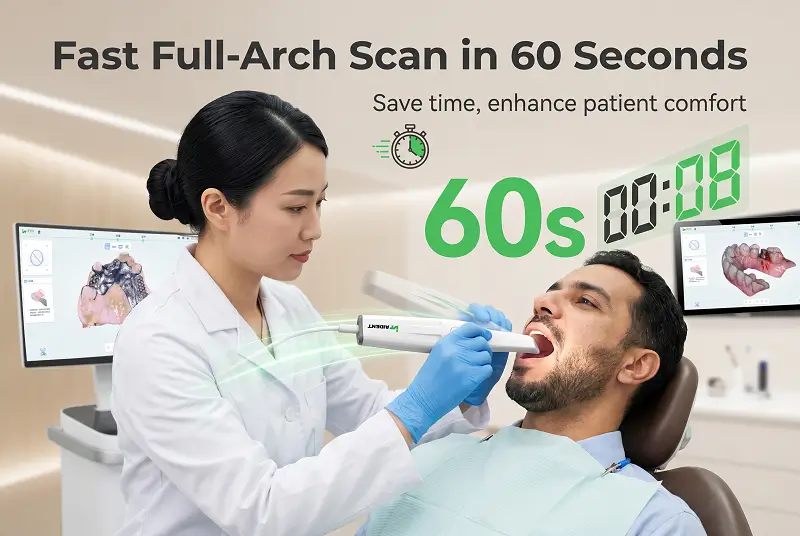
Fully open intraoral scanners that export clean STL/PLY/OBJ files, carry no mandatory software subscription, and integrate with any major CAD platform (exocad, 3Shape, etc.) give clinics maximum flexibility and lower five-year TCO. The Aident AI-30 is designed precisely for this profile: lightweight, powder-free, open-format output, and no ongoing software fees-making it a strong candidate for single-crown, short-bridge, and orthodontic-record workflows while preserving the ability to route complex cases externally or upgrade later.
Review current open-scanner specifications, compatibility details, and complete Scan → Design → Print workflows at aident3d.com. Contact the team for a side-by-side comparison against your case mix and five-year volume projections.