Previous articles established that an intraoral scanner is the non-negotiable starting point, while chairside milling is a volume-dependent decision. The most common remaining question from clinics is: "If I do not want a milling machine at all, is there still a viable third path?"
The answer is yes. Chairside digitization does not equal chairside milling. Once the focus shifts away from the mill, three practical routes become visible: 3D printing is rapidly capturing the intermediate layer of temporaries, models, and surgical guides; cloud-based design services remove the need for the clinician to act as a full-time CAD designer; and a simple "scan-then-send" workflow allows even small practices to capture the full benefits of digital impressions.
This article maps three lightweight chairside-digital pathways that complete the scan–design–delivery chain without requiring an in-house mill.
Part 1 | Redefining "Chairside Digitization"
Chairside digitization is fundamentally "digital impression capture + a functioning data flow," not "a mill sitting in the clinic." The complete chain consists of four links:
Acquisition: intraoral scanner (mandatory).
Design: local CAD software, AI-assisted design, or cloud design service (can be fully outsourced).
Manufacturing: milling machine, 3D printer, or external laboratory (any one of the three is sufficient).
Delivery: same-day, next-day, or three-day turnaround-all remain forms of chairside digitization.
Milling is therefore only one manufacturing option. Once the digital file exists, the final step can be handled by a 3D printer or a cloud-connected laboratory.
3D printing is already absorbing the high-volume intermediate layer. Industry data show the global dental 3D-printing market reaching approximately $4.28 billion in 2026 and projected to grow to $12.25 billion by 2031 (CAGR 23.41 %). More than 12,000 North American practices and over 5,000 Korean clinics already operate at least one chairside 3D printer. This is the clearest market signal that a second manufacturing path now exists alongside traditional milling.
Part 2 | Path A: Intraoral Scanner + Cloud Design + External Laboratory
This is the lightest and fastest-ROI route for most small and medium clinics: digitize the impression with a scanner and fully outsource both design and manufacturing.
Typical workflow:
Clinic scans the arch in 5–10 minutes.
Encrypted STL/PLY file is uploaded to a cloud platform or partner laboratory.
Platform assigns a CAD designer (human + AI); single-crown design is typically returned for preview within 1–4 hours.
Clinician reviews and approves the design in a web browser (many platforms support real-time 2D/3D preview).
Laboratory mills, prints, or finishes the restoration and ships it back within 24–48 hours.
Patient returns for delivery.
The decisive advantage is that every step outside the chair is outsourced. No in-house CAD designer, no mill, no furnace-only a scanner is required. Mature international and domestic platforms already support this model (design-only services, full cloud design-to-print pipelines, and "time-zone relay" laboratories that turn U.S. evening uploads into next-morning deliverables).
Clinic-side economics:
Capital outlay: one intraoral scanner (entry-level systems now commonly under $3,000–$4,000).
Per-unit external cost (design + manufacture + shipping): typically $11–$28.
Eliminated costs: chairside CAD time (15–40 minutes per unit), equipment maintenance, training, and consumable management.
Industry analyses report that fully digital workflows can reduce direct treatment costs by approximately 18 % and laboratory labor costs by 49 % relative to conventional analog processes-savings realized through cloud coordination rather than through ownership of every machine.
Part 3 | Path B: Intraoral Scanner + Chairside 3D Printing (No Mill)
Milling remains strongest for definitive zirconia crowns and multi-unit bridges. 3D printing dominates the high-frequency, lower-unit-cost category: temporary crowns, models, surgical guides, night guards, and custom trays.
Three practical advantages have already materialized:
Material cost per unit has fallen to single-digit or low-double-digit dollars. Public calculations from leading resin-printer manufacturers show temporary crowns in the $0.15–$0.70 material range, surgical guides $0.55–$1.10, and night guards $0.70–$1.40. Fully loaded cost (including depreciation, post-processing, and occasional failures) typically settles at $1.40–$4.20 per unit-far below external laboratory fees.
Material utilization improves dramatically. Additive manufacturing can reduce material waste by up to 90 % compared with subtractive milling. Published comparisons place the fully loaded cost of a digitally printed denture base-plus-teeth set at roughly $5.95 versus approximately $43 for a milled equivalent.
Equipment entry cost has dropped into the low-thousands. 2026 desktop chairside 3D-printer price bands:
| Tier | Representative Systems | Price Range (USD) | Primary Use Cases |
|---|---|---|---|
| Entry | Compact resin printers | $900–$1,800 | Trial use, custom trays, models |
| Mid-range | Dedicated dental desktop systems | $3,000–$7,000 | Models, guides, temporaries, night guards |
| Higher | High-throughput validated systems | $7,500–$13,000 | Multi-unit same-day production, certified permanent materials |
Compared with imported chairside milling packages ($21,000–$83,000) or domestic milling packages ($21,000–$49,000), the 3D-printing entry barrier is one-third to one-fifteenth the cost. For the majority of small and medium clinics, the highest-volume, fastest-ROI items are precisely the "small chairside pieces" that printers handle best.
Proven chairside-printable categories include:
Surgical guides (FDA/ISO 10993-cleared resins).
Diagnostic models and thermoforming templates for retainers or clear aligners.
Temporary crowns and bridges (multi-unit certified resins now available).
Night guards, sports mouthguards, and custom impression trays.
Digitally printed complete dentures (base + teeth), whose combined material and labor cost is already significantly lower than milled alternatives.
Part 4 | Decision Framework: Choosing the Right Lightweight Path
Removing the mill from the "must-have" list opens three realistic options:
| Path | Clinic Must Purchase | Fully Loaded Cost per Unit | Turnaround | Best Suited For |
|---|---|---|---|---|
| A. Scanner + cloud design + external lab | Scanner + platform subscription/fee | $11–$28 | 24–72 hours | Every small/medium clinic's lowest-risk starting point |
| B. Scanner + chairside 3D printer | Scanner + entry/mid-range printer (~$1,000–$7,000) | $1.40–$4.20 material-driven | Same day (30–60 min) | Clinics needing temporaries, guides, models, night guards |
| C. Scanner + chairside milling (full loop) | Scanner + mill + furnace + software ($21k–$83k) | $5.50–$17 + design time | Same day | Practices with >150 restorations/month and dedicated CAD staff |
One-sentence decision rules:
Want digital impressions only, no manufacturing responsibility → Path A.
Want same-day delivery of high-volume small items → Path B.
Monthly restorative volume stably above 150 units and dedicated CAD capacity → Path C.
The most common realistic combination for ~70 % of small and medium clinics today is A + B: definitive crowns and bridges go external; temporaries, guides, and models are printed in-house.
Closing Perspective
Chairside digitization is not defined by the presence of a milling machine. It is defined by digital impression capture and a functioning data flow. Milling is only one manufacturing choice; 3D printing and cloud-connected laboratories are equally legitimate-and often lighter-alternatives.
The most practical evolution path for a small or medium clinic is sequential:
Acquire an open intraoral scanner and begin running digital files.
Capture immediate digital benefits through cloud design + external manufacturing.
Add a desktop 3D printer to bring high-frequency small items back in-house.
Only when monthly restorative volume is solidly above 150 units consider a mill.
Each step is lower-risk and higher-ROI than attempting a full closed-loop milling investment from day one.
Open systems make the lightweight path straightforward
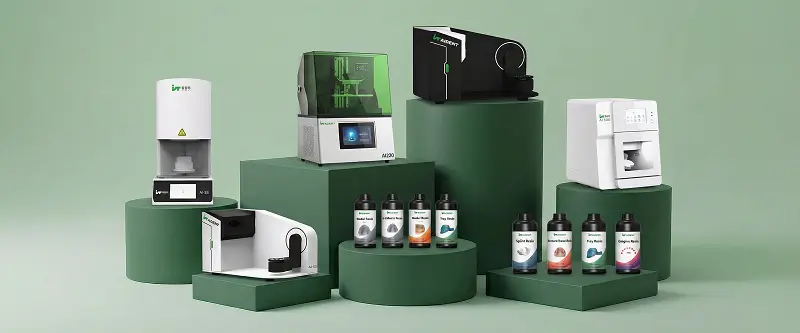
Fully open intraoral scanners that export clean STL/PLY/OBJ files with no mandatory software subscription integrate seamlessly with any cloud design platform or 3D printer. The Aident AI-30 delivers reliable, powder-free, lightweight scanning at an accessible entry point, while the Ai-C60 chairside 3D printer is purpose-built for the exact high-volume categories-models, surgical guides, temporaries, and night guards-that Path B addresses. Together they enable the hybrid A + B workflow that most small and medium clinics find most practical in 2026.
Explore complete open Scan → Cloud Design / Print solutions, current pricing, and workflow examples at aident3d.com. Contact the team for a tailored recommendation based on your monthly case volume and existing equipment.