The most loudly marketed claim of chairside CAD/CAM is "same-day delivery." Yet the clinical risk behind those four words varies dramatically-one anterior veneer and a three-unit posterior bridge can both be delivered the same day, but their long-term risk profiles are not comparable. The real question for chairside immediate restoration is not "Can it be done?" but "Will it last?"
This article does not rank equipment or re-argue the value of chairside digital workflows. It maps the clinical boundaries by restoration type-single crowns, inlays/onlays, veneers, fixed bridges, and implant crowns-stating clearly what is routinely indicated, what should be avoided, and how material choice shifts the edge of that boundary.
Part 1 | Defining "Same-Day Delivery" Precisely
The 2022 Chinese Stomatological Association group standard Technical Guidelines for Chairside CAD/CAM All-Ceramic Restorations (T/CHSA 014-2022) provides a clear definition:
Digital impressions are obtained by intraoral scanning, restorations are designed with computer-aided design software, and fabricated by computer-numerical-control milling technology, usually completed in the clinic. For suitable cases, restorative treatment can be finished in a single visit.
Three limiting phrases matter:
"CNC milling technology" - the guideline excludes 3D-printed all-ceramic restorations. Chairside-printed zirconia or glass-ceramic remains immature; all restorations discussed here assume subtractive milling.
"Suitable cases" - not every clinical situation qualifies for same-day delivery. Mapping those cases is the purpose of this article.
"Single visit" - the core value proposition. Patients avoid a second appointment and temporary restorations; clinics gain efficiency. The 2017 Peking University controlled study quantified the difference: chairside immediate implant restorations averaged 131.9 ± 5.0 minutes versus 205.2 ± 6.3 minutes for conventional protocols (≈40 % time saving in one visit).
Part 2 | Overview Table: Survival Rates and Feasibility by Restoration Type
A 2026 meta-analysis (25 studies: 13 RCTs + 12 cohort studies; moderate GRADE quality) reported pooled RCT survival rates by type:
| Restoration Type | Pooled RCT Survival | Chairside Feasibility |
|---|---|---|
| Veneer | 100% | ★★★ (routine) |
| Full crown | 96% | ★★★ (core indication) |
| Partial denture / short-span bridge | 96% | ★★ (span-limited) |
| Inlay / Onlay | 92% | ★★★ (routine) |
| Endocrown / post-and-core | 82.3% | ★ (elevated risk) |
Long-term perspective: Otto et al. (2017) followed 200 CEREC 1 inlays/onlays (Vita Mark I feldspar ceramic) for 27 years and reported 87.5 % survival-evidence that properly indicated chairside restorations are durable, not provisional compromises.
Part 3 | Boundaries by Restoration Type
1. Inlays / Onlays - the original and broadest chairside indication
CEREC's first clinical restorations in 1985 were inlays; the evidence base remains the strongest. Meta-analytic data show ≈96.7 % survival at 9 years; 5-year survival 92–95 % (5,811 adhesively cemented units) and 10-year survival ≈91 % (2,154 units).
Indications: carious or defective restorations, cusp coverage (onlays), primarily posterior teeth.
Boundary notes: Three-surface (MOD) inlays carry significantly higher failure risk than one-, two-, or four-surface designs (P < 0.05). Premolars outperform molars (Otto 2017). Large MOD preparations therefore favor lithium disilicate or hybrid ceramics over pure feldspar.
2. Veneers - highest survival, most demanding esthetics
The 2026 meta-analysis recorded 100 % pooled RCT survival for veneers-the highest single category. Survival alone, however, understates the challenge: tooth preparation, bonding, and optical layering must be precise. Wiedhahn et al. (2005) reported 94 % survival at 9 years for CAD/CAM ceramic veneers.
Indications (CSA 2022 Table 1): localized defects, malformed or microdont teeth, diastemas, mild-to-moderate discoloration, mild malalignment.
Caution (explicitly named in CSA 2022): severe discoloration-veneer thickness (typically 0.3–0.5 mm) is often insufficient for complete masking. Low-translucency or bleach-shade blocks, or conversion to full crowns, are preferable.
Chairside-specific note: esthetic zones frequently require incisal cut-back and layering. Current CAD software supports finger-like incisal designs, yet true layered porcelain still benefits from laboratory collaboration or an additional crystallization furnace. Multi-unit anterior esthetic cases are therefore better routed to the laboratory.
3. Full crowns - the core high-volume indication
Full crowns show the most stable data set in private-practice chairside use:
2026 meta-analysis: 96 % pooled RCT survival
Wittneben et al. (2009): 91.6 % at 5 years (1,957 single-unit restorations)
Reich prospective series: 94.7 % at 5 years, 85.7 % at 10 years (308 CEREC restorations)
Indications: essentially all single-unit anterior, premolar, and molar crowns.
Material differentiation is critical:
Anterior esthetics → lithium disilicate (300–420 MPa flexural strength; optical properties closest to natural enamel)
Premolar / molar → zirconia (>800 MPa) for strength priority
Anterior zirconia full crowns require caution-lower translucency often compromises esthetics relative to glass-ceramics
Material-specific survival from the same 2026 meta-analysis: hybrid ceramics 99 %, lithium disilicate 98 %, zirconia 95 %, resin 92 %.
4. Fixed bridges - the indication most frequently over-extended
Three constraints define the boundary:
Span length dictates material choice (see CSA 2022 Table 3 below).
Milling-machine bur diameter imposes a physical lower limit on connector cross-section; longer spans and smaller connectors concentrate stress.
Feldspar and leucite-reinforced ceramics are explicitly not recommended for bridges (CSA 2022).
Manufacturer documentation (e.g., 3M Lava Esthetic) is more conservative still: one pontic only between two abutment crowns; cantilevers discouraged, especially in molar and canine regions; maximum continuous anterior pontics ≤4, posterior ≤2 for spans beyond 8 units.
5. Implant crowns - 1T1T protocols are expanding the envelope
Lambert et al. (2021) "One-tooth one-time" series remains a landmark: 10 posterior single implants immediately scanned and restored chairside with PICN definitive restorations under full occlusion. Two-year implant survival 100 %, restoration survival 90 % (one abutment debond), mean chairside time 175 minutes.
Peking University 2017 prospective comparison (13 single implants): lithium-disilicate chairside group 131.9 ± 5.0 minutes versus conventional temporary 205.2 ± 6.3 minutes; patient satisfaction significantly higher; 3–6-month implant survival 100 % with equivalent white-esthetic scores.
Hard constraints for immediate loading:
Insertion torque ≥35 Ncm and ISQ ≥70
Deliberate occlusal clearance designed in software to protect early osseointegration
Posterior sites (lower esthetic demand, higher load) accept PICN, lithium disilicate, or zirconia
Anterior esthetic zone still favors laboratory layering for complex multi-unit cases
Part 4 | Material–Restoration Matrix (CSA 2022 Guideline Table 3)
| Material / Restoration | Veneer | Inlay | Onlay | Full Crown | Fixed Bridge |
|---|---|---|---|---|---|
| Feldspar / leucite-reinforced (100–160 MPa) | +++ | ++ | + | Anterior +++ ; Premolar ++ ; Molar – | – |
| Lithium disilicate (300–420 MPa) | +++ | +++ | +++ | Anterior/Premolar +++ ; Molar + | Anterior/Premolar 3-unit + ; molar or >3-unit – |
| Zirconia (>800 MPa) | + | + | + | Anterior + ; Premolar ++ ; Molar +++ | Non-molar ++ ; including molar +++ |
Legend: – not recommended; + usable but not preferred; ++ recommended; +++ strongly recommended.
Bridge span guidance: anterior ≤4 units, posterior ≤3 units.
The matrix encodes three non-negotiable rules:
Material mechanical properties, not clinician preference, set the outer limits.
Chairside milling has hard span ceilings (anterior ≤4, posterior ≤3 units); beyond these limits either choose high-strength zirconia within residual constraints or abandon pure chairside fabrication.
Translucency selection follows function: high-translucency for inlays/onlays (enamel-like), low-translucency or bleach shades for masking, mid- or multi-layer blocks for refined intermediate needs.
Part 5 | Hard Contraindications on the Boundary Line
Severe discoloration treated by veneers alone - insufficient thickness for masking.
Severe bruxism or clenching - elevated fracture rates; occlusal appliances first.
Long-span bridges (>4 anterior / >3 posterior units) - connector stress and milling limits.
Cantilever bridges - biomechanical contraindication explicitly stated by manufacturers.
Endocrowns / post-and-core restorations - 5-year survival only 82.3 %; thin residual walls amplify marginal risk.
Full-arch or multi-implant fixed reconstructions - cumulative scan, milling, and passive-fit error exceeds reliable chairside tolerance.
Complex multi-unit anterior esthetic combinations - external staining limits of chairside workflows; laboratory layering remains superior.
Closing Perspective
The indication map can be summarized in one sentence:
Chairside restorations have clear, evidence-based boundaries. Material choice determines how far along that boundary a case can travel; clinical judgment determines whether it should travel there at all.
Single crowns, inlays, onlays, veneers, short-span bridges, and carefully selected single implant crowns constitute the reliable core-supported by up to 27-year survival data. Long-span bridges, cantilevers, endocrowns, full-arch reconstructions, and complex multi-unit anterior esthetics remain outside the safe envelope. Crossing those lines may succeed short-term; long-term failure risk is the price.
Open digital systems expand practical reach within the safe envelope
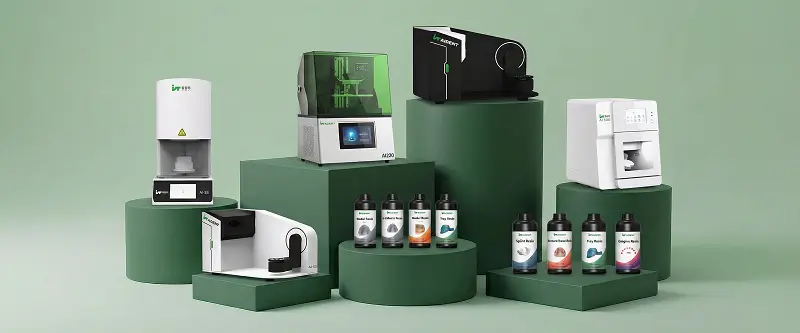
High-accuracy open intraoral scanners (Aident AI-30 and equivalent) produce clean, open-format data that import directly into any major CAD platform. Combined with open 3D printers for models, surgical guides, or temporary restorations, clinics can execute the indicated single-visit cases efficiently while retaining the freedom to route borderline or complex work to the laboratory-without proprietary lock-in or forced material restrictions.
Explore complete open Scan → Design → Mill/Print solutions, current scanner and printer configurations, and workflow examples matched to these indications at aident3d.com. Contact the team for case-selection support or an ROI discussion based on your typical restoration mix.