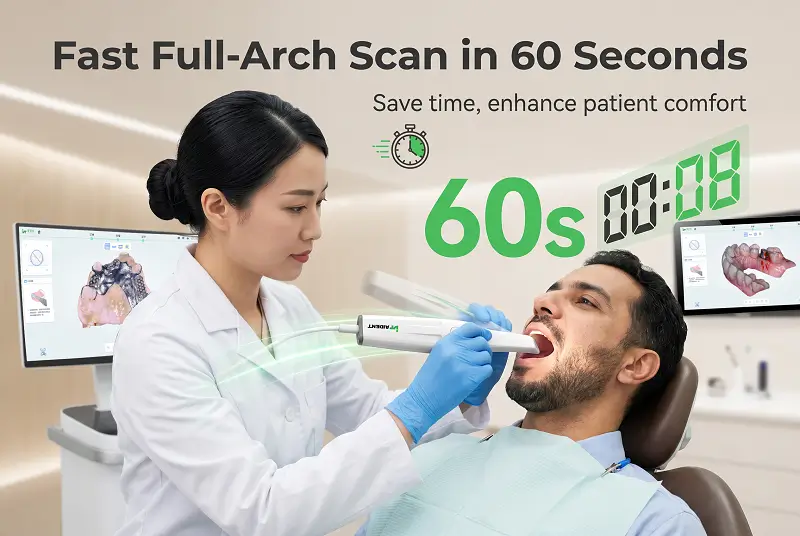
The intraoral scanner market has changed significantly in recent years. International brands such as 3Shape (TRIOS), Align (iTero), and Dentsply Sirona (Primescan) long dominated the premium segment. At the same time, a growing number of Chinese manufacturers have introduced competitive scanners that challenge traditional price and performance assumptions.
The question many clinics and laboratories now ask is straightforward: what are the real differences between Chinese intraoral scanners and established international brands - and do those differences still justify the price gap?
This guide examines the factors that matter most in daily clinical use.
1. Accuracy and Clinical Performance
Independent studies and clinical feedback show that the accuracy gap has narrowed considerably. Many current Chinese scanners deliver clinically excellent results for single units, short-span bridges, and standard full-arch applications when proper technique is used.
International premium brands still frequently lead in the most demanding full-arch and complex implant scenarios, and they often publish more extensive long-term clinical data. However, for the majority of everyday restorative and orthodontic cases, well-designed Chinese scanners now achieve results that are difficult to distinguish in practice.
Key takeaway: Operator technique, moisture control, and margin management usually have a greater impact on final outcomes than small differences between current scanner generations.
2. Software Maturity and Ecosystem
This remains one of the clearer differences.
International brands generally offer more mature software platforms, refined AI assistance, broader diagnostic tools, and deeper integration with laboratories, aligner systems, or chairside manufacturing solutions.
Chinese brands have improved rapidly. Many now provide stable scanning software, open file export, and improving user interfaces. Advanced AI features and large ecosystem marketplaces are still more developed on the leading international platforms.
If your workflow depends heavily on a specific brand's software tools or partner network, an international system may still feel more complete. If you prioritize open files and flexibility, many Chinese scanners already meet the need.
3. Price and Total Cost of Ownership
This is the most obvious and often decisive difference.
Chinese intraoral scanners typically offer a significantly lower upfront price. Many also avoid mandatory high annual software subscriptions, which can add thousands of dollars over several years with some international systems.
When calculating real cost, consider:
Hardware price
Tips and consumables
Software or service subscriptions
Training and support
Flexibility to change laboratories or bring work in-house
On total cost of ownership, strong Chinese open-system scanners frequently deliver a clear advantage.
4. Build Quality, Ergonomics, and Reliability
Premium international scanners usually set the benchmark for refined ergonomics, material finish, and long-term durability tracking. However, leading Chinese manufacturers have invested heavily in industrial design, lightweight construction, and component quality.
Weight, balance, anti-fog performance, and tip design are now competitive on many Chinese models. Reliability depends more on the specific manufacturer and quality control processes than on country of origin alone.
5. Open vs Closed Philosophy
Many Chinese scanners are designed from the start as fully open systems (standard STL/PLY/OBJ export, no forced ecosystem). Some international brands remain more closed or semi-closed, optimizing the experience within their own software and partner networks.
For clinics that value laboratory freedom and long-term flexibility, openness is a major practical advantage.
6. Support, Training, and Global Service
International brands generally have more established global service networks, local representatives, and structured training programs in many markets. Chinese manufacturers vary widely - some offer strong remote support, growing local partnerships, and responsive service, while others are still building their international infrastructure.
Before purchasing, evaluate the actual support available in your country or region, regardless of brand origin.
7. Regulatory Certifications
Reputable Chinese manufacturers targeting international markets typically hold CE, FDA (where applicable), and other required certifications. Always verify current certifications for the specific model you are considering. Regulatory compliance is manufacturer- and model-specific, not country-specific.
Summary Comparison
| Factor | Typical International Premium Brands | Typical Strong Chinese Brands |
|---|---|---|
| Accuracy (daily cases) | Excellent | Excellent / Very Good |
| Software & AI maturity | More advanced | Rapidly improving |
| Ecosystem depth | Strong | Developing / Open |
| Upfront price | Higher | Significantly lower |
| Ongoing subscriptions | Common | Often none or low |
| Open file export | Varies (some restricted) | Usually strong |
| Ergonomics | Excellent | Competitive on leading models |
| Global service network | More established | Varies by manufacturer |
| Best for | Ecosystem users, high-end features | Value, openness, cost control |
Where Aident Stands
Aident positions its AI-30 and AI50 scanners as high-performance open-system alternatives that combine competitive clinical specifications with strong cost control:
AI-30: ≤10 μm accuracy, lightweight, powder-free, intelligent anti-fog, 0–25 mm depth of field, ≥30 fps, full STL/PLY/OBJ export, lifetime free software upgrades
AI50: ≤7 μm accuracy, lighter weight (145 g with tip / 130 g without), 38 fps, same open-system advantages
Both are designed for clinics and laboratories that want reliable accuracy, modern ergonomics, and freedom from restrictive ecosystems or high recurring fees. They form part of a complete Scan → Design → Print workflow.
How to Decide
Ask yourself these questions:
How important is deep integration with a specific brand's software or aligner system?
Do I want maximum freedom to choose laboratories and design software?
What is my realistic 5-year budget, including subscriptions?
How critical are the most advanced AI or diagnostic features for my case mix?
What level of local support and training is actually available to me?
The answers will point clearly toward either a premium international ecosystem or a high-value open Chinese system.
Conclusion
The difference between Chinese intraoral scanners and international brands is no longer a simple story of "cheap versus high quality." Leading Chinese manufacturers now offer clinically capable scanners with competitive accuracy, modern features, and strong openness - often at a substantially lower total cost of ownership.
International premium brands still lead in software maturity, ecosystem depth, and refined brand experience. For many practices, however, the performance gap has become small enough that value, openness, and long-term cost have become the deciding factors.
The best scanner is the one that matches your clinical needs, workflow preferences, and budget - regardless of where it is manufactured.
Ready to evaluate a high-performance open-system scanner?
Explore Aident's AI-30 and AI50 and see how they compare on the factors that matter most at https://www.aident3d.com/, or request a detailed consultation and quotation via our inquiry page.