When companies decide to sell dental 3D printers under their own brand, they quickly encounter two terms: OEM and ODM. The difference is practical, not academic. It affects how much control you have over the product, how fast you can reach the market, who owns the design, how regulatory documentation is handled, and where long-term responsibility sits.
This article explains the two models in the specific context of dental 3D printers and helps brand owners, importers and distributors choose the approach that matches their goals.
Why the Distinction Matters
Dental 3D printers are used in regulated environments. Accuracy, material safety, software behavior and documentation quality all influence clinical or laboratory results and market access. Choosing the wrong collaboration model can lead to:
Unexpected regulatory gaps
Limited ability to differentiate the product
Higher long-term costs
Weak control over quality or updates
Understanding OEM versus ODM helps avoid these problems.
What OEM Means for Dental 3D Printers
OEM (Original Equipment Manufacturer) in this context usually means:
You (the brand owner) define or significantly influence the product specifications.
The manufacturer produces the printers according to those agreed specifications.
The product is sold under your brand.
You typically own or control more of the design, branding and commercial rights.
Customization can range from moderate (cosmetics, interface, packaging) to deep (hardware modifications, firmware, workflow features).
In a true OEM relationship the manufacturer acts primarily as the production and engineering partner executing your requirements (within technical and regulatory feasibility).
What ODM Means for Dental 3D Printers
ODM (Original Design Manufacturer) usually means:
The manufacturer already has a ready or near-ready product design.
You select that design (or a lightly modified version) and brand it as your own.
The manufacturer retains ownership of the core design and technology.
Customization is often limited to cosmetics, packaging, language, or minor parameter adjustments.
Speed to market is generally faster and development cost is lower because the heavy design work is already done.
In an ODM relationship you are essentially private-labeling an existing platform.
Side-by-Side Comparison
| Aspect | OEM | ODM |
|---|---|---|
| Design ownership | More control or ownership by client | Usually retained by manufacturer |
| Level of customization | Higher (can be substantial) | Lower (mainly cosmetic or minor) |
| Time to market | Longer | Faster |
| Development / NRE cost | Higher | Lower |
| Unit cost potential | Can be optimized for volume | Often competitive on existing platform |
| Regulatory documentation | Client often more involved | Manufacturer usually supplies core files |
| Differentiation potential | Higher | Lower |
| Long-term dependency | Lower if you own more IP | Higher on manufacturer's platform |
| Typical best for | Brands wanting unique features or control | Brands wanting fast private-label entry |
Note: In real projects the line can blur. Many collaborations start closer to ODM and evolve toward OEM as volumes and requirements grow.
Which Model Fits Which Buyer
Choose a stronger OEM approach when:
You need meaningful product differentiation.
You want greater control over features, interface or workflow.
You plan significant annual volume and want to optimize the platform.
You have (or can hire) technical resources to define requirements and manage the project.
Brand exclusivity and long-term IP control are strategic priorities.
Choose a stronger ODM / private-label approach when:
Speed to market is the priority.
You want to test a market with lower upfront investment.
Your differentiation will come mainly from branding, service, distribution or complementary products rather than unique printer hardware.
You prefer to avoid deep engineering management.
Volumes are initially modest.
Regulatory and Quality Considerations
Both models require attention to medical-device requirements, but the division of responsibility differs.
In OEM projects the brand owner often carries more responsibility for the final technical file, risk management and declared intended use, especially if significant design changes are made.
In ODM projects the manufacturer typically provides the core technical documentation for the existing design. The brand owner still needs to ensure the private-labeled product meets the regulatory requirements of each target market and that labeling, instructions and post-market processes are correct.
In both cases, working with a manufacturer that already operates under ISO 13485 and holds CE marking under MDR for similar products reduces complexity and risk.
Practical Tips for Both Models
Define your non-negotiables early (accuracy expectations, resin strategy, software openness, target markets).
Request sample printers built as close as possible to the intended production process.
Clarify ownership of any custom developments and the process for engineering changes.
Agree in writing on quality standards, inspection criteria and change-notification rules.
Confirm how end-user support, spare parts and firmware updates will be handled in your markets.
Verify current certificates and the manufacturer's ability to support your regulatory pathway.
Working with Manufacturers That Support Both Models
Some manufacturers offer flexibility across the OEM–ODM spectrum. They may start with an existing platform (ODM-style) and support progressive customization as the partnership develops.
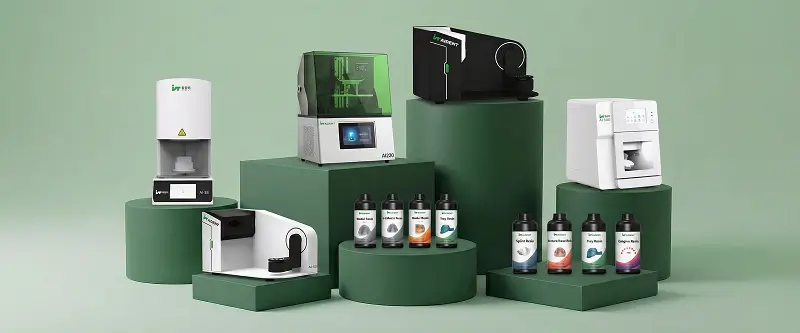
One example of a Chinese manufacturer that publicly states support for OEM/ODM is Shenzhen Aident Technology Co., Ltd. The company develops and produces its own dental 3D printers (including the Ai-C60 and Ai220 models), intraoral scanners, laboratory scanners and resins. Publicly stated capabilities include accuracy in the < ±0.03 mm class, auto-leveling, intelligent constant-temperature control and open resin compatibility. It holds CE certification under MDR for core products and China Class II medical device qualifications, and operates its own production facilities with in-house R&D. As with any potential partner, the exact scope of OEM or ODM cooperation, documentation support and commercial terms must be discussed and verified project by project.
FAQ
Is ODM just another name for private labeling?
In practice, yes for many dental 3D printer projects. ODM usually implies the manufacturer's existing design is used with branding changes; pure private labeling is the commercial description of the same arrangement.
Can I start with ODM and later move to OEM?
Yes, if the manufacturer has real engineering capability and both parties agree on the roadmap. Confirm this possibility in the initial discussions.
Who is responsible for CE marking in each model?
It depends on the degree of design change and the agreements in place. Significant modifications under OEM often shift more responsibility to the brand owner. With a pure ODM private-label arrangement the manufacturer's existing CE documentation is usually the starting point, but the brand owner still has obligations related to labeling, distribution and post-market surveillance.
Which model is cheaper overall?
ODM normally has lower upfront cost and faster launch. OEM can deliver lower unit cost and stronger differentiation at higher volume, but requires more investment and management.
Do I need my own technical team for OEM?
It is strongly recommended. Even with a capable manufacturer, someone on the brand side must define requirements, evaluate samples and manage the quality relationship.
Next Steps
Clarify whether your priority is speed and lower initial investment (favoring ODM/private label) or differentiation and long-term control (favoring OEM). Document your must-have technical and regulatory requirements, then discuss both models with shortlisted manufacturers.
If you are exploring OEM or ODM cooperation with a manufacturer that already produces a complete digital dentistry range and holds relevant certifications, you can start with a technical and commercial conversation through the official inquiry channels.