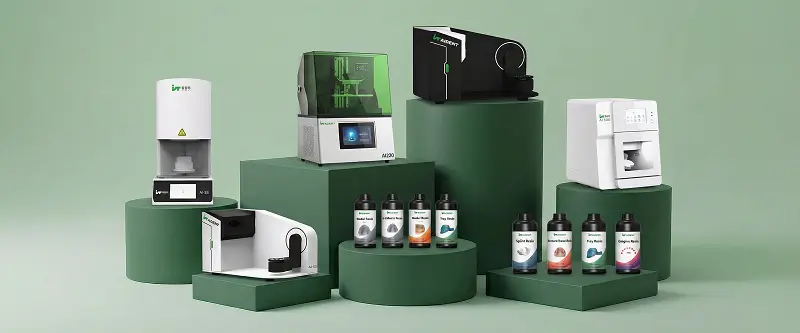
Understanding the full cost landscape is essential before making a purchase decision. This dental 3D printer price guide breaks down current market ranges from entry-level machines to full industrial systems so clinics and labs can see where different categories sit and what they typically deliver.
The goal is to answer the practical question many buyers ask: what is the dental 3D printer price guide from entry-level to industrial, and how do price tiers relate to real production needs.
Overview: Dental 3D Printer Price Range by Type (2026)
Prices below reflect approximate hardware ranges commonly observed in 2026. Actual quotes vary by region, configuration, included accessories, and current promotions. Complete packages (printer + wash + cure) are often higher.
| Tier | Typical Price Range (USD) | Typical Users | Key Characteristics |
|---|---|---|---|
| Entry-Level | $1,500 – $5,000 | Beginners, low-volume model work | Large open LCD, basic features, more manual tuning |
| Clinic / Compact Chairside | $4,000 – $12,000 | Small clinics, same-day workflows | Compact size, simpler operation, clinical speeds |
| Mid-Range Professional | $8,000 – $18,000 | Growing clinics and small labs | Better reliability, improved software or validation |
| Premium Ecosystem | $10,000 – $25,000+ | Users wanting validated workflows | Strong software, material libraries, higher support |
| Production / Large Open Systems | $15,000 – $35,000 | High-volume laboratories | Larger platforms, higher duty cycles, open resin options |
| Industrial / Automated | $25,000 – $60,000+ | Multi-shift or specialized production | Automation, continuous operation, high throughput |
This dental 3D printer price guide 2026 shows clear steps in capability and cost as you move from basic model printing to industrial-scale output.
Entry-Level Dental 3D Printer Price
The entry level dental 3D printer price typically falls between $1,500 and $5,000. These machines are usually large-format open LCD systems. They can produce acceptable dental models once parameters are dialed in, but they generally require more operator involvement, have less consistent long-term support, and are better suited to low-volume or testing environments than daily clinical or high-volume laboratory use.
Clinic and Compact Chairside Range
Most clinics looking for a practical daily machine land in the $4,000 – $12,000 range. Printers in this tier prioritize compact footprint, easier operation (often factory-calibrated or reliable auto-leveling), and print speeds suitable for temporary restorations and models. This is the most common bracket for practices focused on same-day or next-day in-office production.
Mid-Range to Premium Professional Systems
Moving into the $8,000 – $25,000+ range brings stronger reliability claims, better software ecosystems, and more extensive validated material options. Premium systems from established dental brands often sit here. These machines appeal to users who prefer tighter parameter control and brand support over maximum hardware openness or lowest entry cost.
Production and Industrial Dental 3D Printer Cost
The industrial dental 3D printer cost starts roughly in the mid-teens and can exceed $50,000–$60,000 for highly automated or specialized platforms. These systems are designed for high daily volumes, multi-shift operation, large nesting capacity, and in some cases automated resin handling or line integration. They make sense only when daily output and utilization are high enough to justify the investment.
How to Use This Price Guide When Comparing Options
When reviewing how much do different dental 3D printers cost, match the tier to your actual situation:
Calculate your realistic average and peak daily volume.
Identify primary applications (models, surgical guides, temporaries, orthodontic models, or mixed).
Decide whether the machine will operate in a clinical or laboratory environment.
Determine how important resin openness and material cost control are.
Request complete package quotes rather than base hardware prices alone.
Estimate resin and labor cost at your projected volume to understand true cost per part.
Total Cost Considerations Beyond the Sticker Price
Hardware price is only the starting point. Ongoing costs that significantly affect the real dental 3D printer price range by type include:
Resin consumption and price per liter
Failed prints and material waste
Wash and cure equipment
Replacement screens, tanks, or light sources
Training time and daily operator effort
Support and warranty terms
A higher-priced machine with lower failure rates and better resin efficiency can deliver a lower cost per usable part over time.
Final Perspective
This dental 3D printer price guide shows a clear progression: entry-level systems under $5,000 for basic model work, clinic-oriented machines typically $4,000–$12,000, professional and premium systems in the $10,000–$25,000 range, and industrial platforms from $25,000 upward.
The most effective approach is to start with your daily volume and application mix, then select the lowest tier that reliably meets those needs with acceptable operating cost. Buying more capacity than you will use increases cost without improving results; buying too little creates daily bottlenecks.
If you share your primary applications, approximate daily volume, and whether the printer will be used mainly in a clinic or laboratory setting, a more specific tier recommendation and realistic budget range can be refined for your situation.