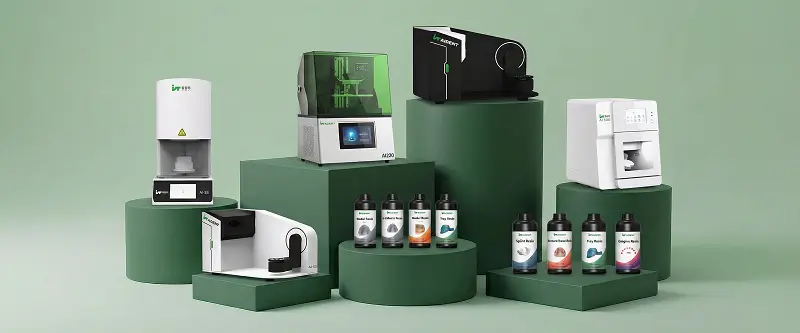
Dental 3D printing has moved from experimental to everyday production in many clinics and laboratories. The next phase of growth will be driven less by printer hardware alone and more by advances in the materials themselves. Between 2026 and 2030, resin and related material innovation is expected to focus on five practical directions that directly affect clinical performance, workflow efficiency, and cost.
1. Higher Accuracy and Lower Shrinkage / Warpage
Dimensional stability remains one of the most important requirements for models, surgical guides, and restorative patterns.
Current high-performance model resins already achieve very low warpage (examples in the market include formulations with post-curing warpage below 0.4%). The innovation trajectory points toward:
Even tighter control of polymerization shrinkage
Improved green strength so models can be handled and scanned sooner
Better long-term dimensional stability after storage
For laboratories and clinics that print verification models, implant guides, or aligner models, these improvements translate into fewer adjustments and higher first-fit rates.
2. Expanded Biocompatible and Long-Term Intraoral Materials
Surgical guide resins and temporary crown-and-bridge resins are already widely used for short- to medium-term intraoral applications. The next development stage will emphasize:
Longer indicated intraoral service times for provisional restorations
Improved mechanical properties (flexural strength, wear resistance, fracture toughness) while maintaining polishability and aesthetics
Clearer regulatory pathways and documentation for different contact durations
More options in the flexible / soft spectrum for nightguards, splints, and sports mouthguards
Clinics that want reliable same-day or short-term provisionals will benefit most from materials that combine strength, aesthetics, and validated biocompatibility.
3. Faster Printing and Easier Post-Processing
Material formulators are working on resins that support:
Higher curing speeds compatible with modern high-power LCD/DLP light sources
Reduced residual uncured resin, making washing simpler and more environmentally friendly
Lower odor and improved handling characteristics
"Water-washable" or reduced-solvent options that simplify the cleaning step
These changes matter for both chairside environments (where speed and cleanliness are critical) and high-volume laboratories (where post-processing is often the bottleneck).
4. Application-Specific and Multi-Functional Materials
Instead of one generic resin trying to cover every indication, the market is moving toward more specialized yet still practical formulations:
High-detail model resins optimized for orthodontic and diagnostic use
Castable and pattern resins with cleaner burnout
Gingiva-mask and soft-tissue simulation materials
Try-in and verification resins with appropriate optical properties
Hybrid or tougher materials that bridge temporary and longer-term needs
Open printer systems that accept a wide range of validated resins give clinics and labs the flexibility to adopt these specialized materials as they mature without changing hardware.
5. Sustainability, Traceability, and Cost Efficiency
Looking toward 2030, additional pressure will come from:
Lower environmental impact formulations and packaging
Better batch-to-batch consistency and traceability
Materials that reduce overall cost per part through higher success rates and less waste
Clearer compatibility data across different printer platforms
Laboratories running high daily volumes are especially sensitive to resin cost, yield, and reliability.
What This Means for Clinics and Laboratories
Material choice will increasingly determine clinical outcomes and production economics
Printers with open resin systems will retain an advantage as new formulations appear
Validated combinations of printer + resin will remain important for predictable results
Institutions and groups will look for suppliers that can support both current production needs and future material upgrades
Aident's Position in the Evolving Material Landscape
Aident focuses on a practical, open approach:
High-precision printers (Ai-C60 and Ai220) with accuracy <0.03 mm, auto-leveling, and stable temperature control
A growing range of application-oriented resins, including high-precision model resins (ultra-low warpage), biocompatible surgical guide resins, temporary crown-and-bridge resins, and related materials
Fully open resin compatibility so users can adopt new high-performance formulations as they become available
Emphasis on reliable daily production rather than closed material lock-in
This combination allows clinics and laboratories to benefit from current material performance while remaining ready for the next generation of dental resins.
Looking Ahead to 2030
The most impactful innovations in dental 3D printing materials between 2026 and 2030 will not be single "miracle" resins, but steady improvements in accuracy, biocompatibility, speed, ease of post-processing, and application fit. Organizations that pair reliable open hardware with a clear material strategy will be best positioned to turn these advances into shorter delivery times, higher quality, and better margins.
To discuss current high-performance dental resins, printer compatibility, or material selection for your clinic or laboratory, contact Aident.
WhatsApp: +86 19311417410
Email: dongjiahao@aident.cc
Inquiry: https://www.aident3d.com/inquiry
Material progress is accelerating. The advantage goes to those who can adopt it inside a stable, open production system.