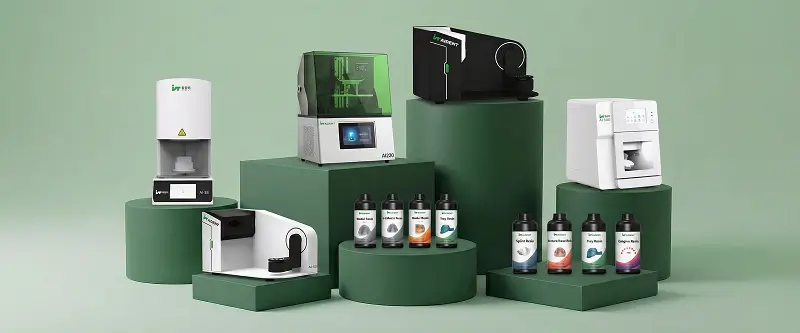
The printer gets the glory, but the resin decides the outcome. The same machine printing the same file produces a crisp die, a brittle denture base, or a failed burnout depending entirely on which resin is in the vat - and whether that resin is being handled correctly.
This guide covers every major dental 3D printing resin class, the settings each one demands, and a simple framework for matching resin to application.
The Six Resin Classes and What They're For
1. Model Resin - Your Daily Workhorse
Best for: crown & bridge models, diagnostic models, orthodontic printouts, working dies.
Model resins are engineered for one thing above all: dimensional stability. Low shrinkage, minimal water absorption, and a matte surface that pencils and scans well. Good model resin prints fast (rapid UV curing), releases cleanly, and holds ±0.03 mm-class accuracy across a full build plate.
Key specs to compare: dimensional stability over 30 days (should be near-zero drift), curing speed, and surface hardness for die work.
→ Aident Dental Model UV 3D Resin · Precision Model Resin · Model Resin (zero-warp formulation)
2. Surgical Guide Resin - Certified and Rigid
Best for: implant drilling templates, pilot guides.
The defining feature isn't a print parameter - it's biocompatibility certification (Class I/IIa). Guide resins are also formulated for high rigidity so the template doesn't flex under drilling forces. This is the one resin class where substituting a cheaper material isn't just bad practice - it's non-compliant.
→ Surgical Guide Resin · related reading: What is surgical guide resin?
3. Temporary Crown & Bridge Resin - Intraoral, Aesthetic
Best for: chairside temps, long-term provisionals (some formulations up to 12 months), try-ins.
Temporary resins trade print speed for polishability and shade stability. For chairside workflows, look for fast print cycles and low exotherm during final cure. For provisionals that survive months in the mouth, prioritize wear resistance and stain resistance.
→ Temporary Dental 3D Printing Resin
4. Castable / Burnout Resin - For Casting Workflows
Best for: crowns and frameworks destined for metal casting, pressing workflows.
Castable resins burn out clean - if you follow their specific burnout schedule. The two failure modes labs know well: ash residue (incomplete burnout) and expansion cracking (ramped too fast). Castable resin also expands on cure more than other classes, so orient rings and patterns with expansion direction in mind.
5. Gingiva Resin - Two-Component Aesthetics
Best for: implant models with simulated soft tissue, denture setup models.
Gingiva resin is typically printed in a separate pass or dual-material workflow over the model resin, giving a soft-tissue simulation labs can trim and punch. Look for tear resistance - gingiva material gets punched and probed daily.
6. Tray & Try-In Resin - Function-Specific
Best for: custom impression trays, denture try-ins.
Tray resin prioritizes rigidity plus enough flex to snap off the model without cracking; try-in resins prioritize shade and intraoral tolerability for verifying tooth arrangement before final processing.
→ Dental Tray Resin · Dental Try-In Resin
Quick Selection Framework
|
If you're printing… |
Use… |
Non-negotiable spec |
|
Crown & bridge models, dies |
Model resin |
Dimensional stability, ±0.03 mm fit |
|
Implant guides |
Surgical guide resin |
Biocompatibility cert + rigidity |
|
Chairside temporaries |
Temporary resin |
Fast cycle, polishability |
|
Metal casting patterns |
Castable resin |
Clean burnout, low ash |
|
Implant models w/ soft tissue |
Model + gingiva resin |
Tear resistance |
|
Custom trays / try-ins |
Tray / try-in resin |
Flex / shade respectively |
Print Settings That Change by Resin
Never run one exposure profile across all resins. Baselines to start from (always defer to the manufacturer's profile for your printer model):
|
Resin class |
Layer height |
Bottom exposure |
Normal exposure |
Notes |
|
Model |
50 µm |
20–30 s |
1.5–2.5 s |
Fast cure; watch tackiness |
|
Surgical guide |
25–50 µm |
25–35 s |
2–3 s |
Full cure is safety-critical |
|
Temporary |
50 µm |
25–35 s |
2–3 s |
Slightly longer for depth of cure |
|
Castable |
25–50 µm |
30–40 s |
2.5–3.5 s |
Over-cure = expansion cracking |
|
Gingiva |
50 µm |
25–35 s |
2.5–3.5 s |
More elastic, needs support tuning |
|
Tray |
50 µm |
25–35 s |
2–3 s |
Flex tuning by tray thickness |
Temperature matters more than most settings pages admit. Resin viscosity changes sharply with ambient temperature - below ~22 °C, most dental resins print with incomplete layer blending and higher failure rates. Machines with intelligent constant-temperature control (a core feature of the Aident Ai-C60 and Ai220) remove this variable entirely, which is why winter print failures mysteriously disappear after upgrading.
Handling, Storage, and Shelf Life Rules
Store: sealed, 15–25 °C, away from UV. Resin left on a sunny shelf is expired resin.
Shelf life: typically 12–24 months unopened; most opened bottles are good for 6–12 months. Write the open date on the bottle.
Stir before every pour - pigment settles, and unstirred resin prints with color drift and exposure drift.
Don't pour used resin back into the fresh bottle. Keep a "working bottle" for the vat; contamination compounds.
Cured resin waste is regular waste; uncured resin and IPA washes are chemical waste - cure liquid waste in a thin pan under UV before disposal, per local regulations.
Troubleshooting by Symptom
|
Symptom |
Probable resin-side cause |
Fix |
|
Prints fail mid-plate in winter |
Resin too cold / viscosity high |
Heated vat printer; pre-warm resin to 25 °C |
|
Tacky surface after full cure |
Expired resin, wrong wavelength |
Check open date; verify 405 nm cure unit |
|
Colors inconsistent between batches |
Pigment settling |
Stir 30–60 s before every pour |
|
Castings with pits/ash |
Burnout schedule too fast for resin |
Follow resin-specific burnout ramp |
|
Dies fit loose after 1 week |
High-drift model resin |
Switch to a stability-rated model resin |
|
Brittle guides that crack on model |
Over-cured or over-washed guide resin |
Cut cure time; shorten wash cycle |
Open Systems vs Closed: The Cost Math
Closed ecosystems lock you to one resin brand at a premium per liter; open systems let you choose certified materials at market prices. Over a lab printing 100+ bottles a year, resin choice alone often swings four figures annually - which is why open-material printers (like Aident's, compatible with mainstream certified dental resins) have become the default for cost-conscious clinics and labs in 2026.
The tradeoff: with freedom comes responsibility for profiles. Choose a printer vendor that supplies validated resin profiles for the materials they recommend - that's the middle path.
FAQ: Dental 3D Printing Resin
What's the difference between model resin and temporary resin? Model resin is optimized for dimensional stability and surface detail on bench models; temporary resin is biocompatible and optimized for intraoral use - polishability, shade stability, and wear resistance. They are not interchangeable.
How long does dental 3D printing resin last? Unopened, typically 12–24 months from manufacture; once opened, plan on 6–12 months if stored sealed and away from light and heat. Always date the bottle when opened.
Can I use one exposure setting for all resins? No. Each resin class (and usually each brand) needs its own calibrated profile. Start from the manufacturer's recommended settings for your exact printer model and adjust from test prints.
Is dental 3D printing resin safe to handle? Uncured resin is a skin sensitizer - wear nitrile gloves and eye protection, and wash any contact immediately. Once fully washed and cured per instructions, certified dental resins are safe for their intended clinical applications.
Which resin should a new dental 3D printing user buy first? Model resin - it's forgiving, fast, and covers the highest-volume application (models). Add temporary and surgical guide resin as your case mix grows.
Match Resin to Machine in One Order
Aident's resin range covers all six classes with validated profiles for the Ai-C60 chairside and Ai220 lab printers - open-system, CE-certified, and engineered for fast curing and low shrinkage.
Browse the full dental resin range
Compare dental 3D printing materials
Questions on resin for your case mix? Request a material consultation - tell us what you print and we'll send the matching resin list with machine pairing.