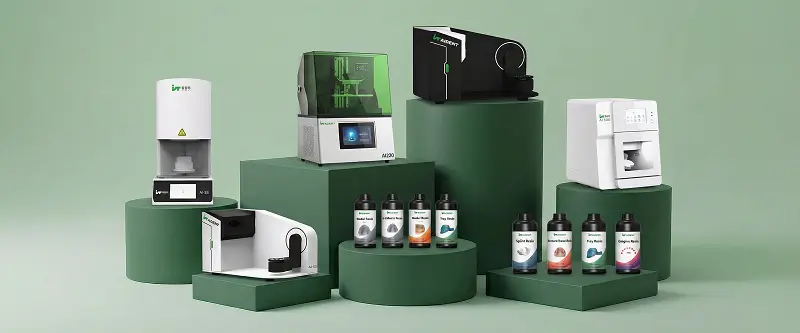
Many clinics want to adopt digital dentistry but struggle with one critical question: Where should the limited budget go first?
Buying equipment in the wrong order is one of the most common (and expensive) mistakes. A high-end closed milling system purchased before a reliable scanner often sits under-used. A well-planned, phased investment produces faster clinical benefits and clearer returns.
Here is a practical budget allocation framework designed for real dental clinics in 2026.
The Correct Investment Sequence
Follow the natural digital workflow:
1. Capture accurate data → 2. Design efficiently → 3. Fabricate reliably
This translates into clear spending priorities:
| Priority | Investment Area | Recommended Budget Share | Why It Comes First / Next |
|---|---|---|---|
| 1 | Intraoral Scanner + Training | 40–55% | Foundation of everything |
| 2 | Design capability (software/training) | 10–20% | Turns scans into plans |
| 3 | 3D Printer + basic resins | 20–35% | Enables in-house production |
| 4 | Materials, maintenance & buffer | 10–15% | Keeps the system running |
These percentages are directional. Adjust according to your clinic size, current case volume and existing equipment.
Phase 1: Intraoral Scanner (Highest Priority)
This is the single highest-ROI digital investment for most clinics.
What to look for:
Full-arch accuracy ≤10 μm
Powder-free operation
Lightweight design (ideally under 200 g)
Effective anti-fog technology
True-color rendering
Fully open file export (STL / PLY / OBJ)
Simple software that assistants can learn quickly
Aident AI-30 meets these criteria: ≤10 μm accuracy, 156–198 g, powder-free with intelligent anti-fog, true-color, open output formats, and lifetime free software upgrades. Typical full-arch scan time is 20–60 seconds.
Allocate the largest portion of your initial digital budget here.
Phase 2: Design Capability
Once you are capturing clean digital impressions daily, invest in design.
Options include:
Training your team on chairside design for simpler cases
Using open CAD software
Partnering with a reliable laboratory or remote design service
Open systems give you more choices and protect you from expensive proprietary lock-in.
Phase 3: In-House Fabrication (3D Printing)
Only after scanning and design are stable should you add a dental 3D printer.
Key printer requirements for clinics:
Accuracy <0.03–0.05 mm
Auto-leveling
Stable temperature control
Open resin compatibility
Straightforward daily operation
Aident Ai-C60 is designed for this role: accuracy <0.03 mm, auto-leveling, built-in curing light, intelligent temperature control, and fully open architecture.
Clinics with lower volume can continue working with external labs at this stage and still capture the majority of digital benefits from scanning alone.
Phase 4: Expansion
After the core Scan → Design → Print loop is running smoothly, expand into:
Additional resins for new indications
Higher-capacity printers
Advanced training
Extra scanners for multi-chair clinics
Critical Budget Rules Most Clinics Forget
Training is not optional - Under-trained staff is the leading cause of poor digital ROI.
Total cost of ownership > purchase price - Factor in resins, maintenance, updates and learning time.
Open systems reduce long-term cost and risk - Closed ecosystems often lock you into higher material prices and limited flexibility.
Start with high-frequency, lower-risk indications - Models, temporary crowns and surgical guides usually deliver faster returns than complex permanent restorations.
Keep part of the budget flexible - Technology and materials continue to evolve.
How Aident Supports Smart Budget Decisions
Aident's product line is structured to match the phased approach above:
AI-30 Intraoral Scanner - the logical first major investment
Ai-C60 Dental 3D Printer - the natural next step when you are ready for in-house production
Open STL/PLY/OBJ workflow and open resin system - protects your future flexibility
Lifetime software upgrades - lowers ongoing software costs
One-stop yet open solution - simplifies purchasing while avoiding lock-in
This allows clinics to build a complete digital capability step by step without overspending or being trapped in a closed ecosystem.
Final Recommendation
Do not start by asking "Which is the best 3D printer?"
Start by asking "What is the correct sequence for our clinic?"
Secure accurate, easy-to-use, open scanning first.
Build design capability.
Add printing when volume and clinical need justify it.
Protect budget for training and process control.
Clinics that follow this logic consistently achieve better utilization, lower frustration and stronger returns from their digital investment.
Would you like a customized budget outline based on your clinic size, current equipment and main treatment focus?
Contact us for a practical discussion:
→ https://www.aident3d.com/inquiry
WhatsApp: +86 19311417410
Email: dongjiahao@aident.cc
Right sequence. Better results.