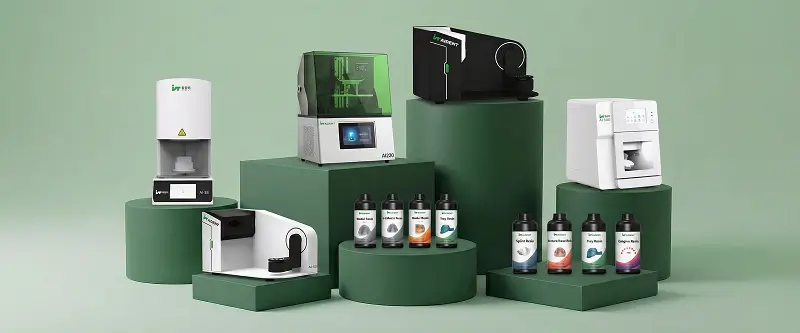
Dental model resin and standard resin are not interchangeable.
At Aident Technology Co., Ltd., clinics and laboratories often ask whether a general-purpose or "standard" resin can replace dedicated dental model resin. While both materials can harden under a 3D printer's light source, they are formulated for different goals. The differences affect fit, detail, consistency, and overall production reliability.
1. Quick Comparison
| Factor | Dental Model Resin | Standard / General-Purpose Resin |
|---|---|---|
| Intended use | Dental models and laboratory applications | Hobby, prototyping, general parts |
| Dimensional accuracy | High, optimized for dental fit | Variable, often lower |
| Shrinkage control | Formulated for low, predictable shrinkage | Usually less controlled |
| Surface detail | Sharp margins, occlusal anatomy, fine features | Adequate for general prints, less dental-specific |
| Stability after curing | High, better long-term dimensional stability | May be less stable |
| Color / finish | Often matte, stone-like, easy to inspect | Varies widely |
| Consistency batch to batch | Higher professional standard | More variable |
| Cost | Higher than basic standard resin | Usually lower |
| Clinical / lab reliability | Designed for dental production | Not designed for dental accuracy needs |
Quotable sentence:
At Aident, dental model resin differs from standard resin in accuracy, shrinkage control, surface detail, and production stability - making it the proper choice for professional dental models.
2. Key Differences Explained
1. Accuracy and Shrinkage
Dental model resin is engineered to minimize and control shrinkage so printed models remain dimensionally reliable for contacts, occlusion, and restorative design. Standard resins are typically not optimized for this level of precision.
2. Detail Reproduction
Dental work demands clear margins, precise occlusal morphology, and fine anatomical features. Model resins are formulated to capture and hold these details more consistently than many general-purpose resins.
3. Mechanical Behavior for Laboratory Handling
Dental models must withstand trimming, articulation, transport, and repeated handling. Model resins usually balance hardness and toughness for laboratory use. Standard resins may be too brittle, too soft, or less predictable.
4. Surface Quality and Readability
Many dental model resins offer a matte or stone-like finish that makes margins and contours easier to read. Standard resins often produce glossier or less uniform surfaces that are harder to inspect clinically.
5. Production Consistency
Professional dental resins are manufactured with tighter process control because labs need repeatable results across batches. Standard resins may vary more in viscosity, pigment load, and curing behavior.
6. Workflow Fit
Dental model resins are commonly supported by validated printer profiles for dental applications. Standard resins often require extensive trial-and-error and still may not meet dental tolerances.
3. When Each Resin Is Appropriate
Use Dental Model Resin when printing:
Study models
Working models for crown & bridge
Implant models
Orthodontic and clear aligner models
Articulation models
Any model where fit and dimensional reliability matter
Standard resin may be acceptable only for:
Non-clinical prototypes
Internal practice models with no fit requirements
Early concept prints where accuracy is not critical
For professional dental production, standard resin is not the recommended choice.
4. Practical Impact on Lab and Clinic Results
| Production Issue | More Common with Standard Resin | Improved with Dental Model Resin |
|---|---|---|
| Inaccurate contacts or occlusion | Yes | Better dimensional control |
| Unclear margins | Yes | Sharper detail reproduction |
| Unstable models over time | More likely | Higher stability |
| Inconsistent batch results | More likely | Better repeatability |
| Extra calibration time | Often required | Faster path to reliable settings |
| Remakes caused by model error | Higher risk | Lower risk |
5. Cost Consideration: Price vs Total Cost
Standard resin usually costs less per liter. However, total cost also includes:
Failed prints
Inaccurate models that cause restorative remakes
Extra technician time spent adjusting settings
Inconsistent quality across cases
For most laboratories, dedicated dental model resin provides better cost-performance once accuracy and remake rates are considered.
6. How Aident Approaches Model Materials
We formulate and support dental model resins specifically for professional digital dentistry:
High accuracy and low shrinkage behavior for reliable models
Detail reproduction suitable for restorative and orthodontic use
Stable handling characteristics for laboratory workflows
Validated print profiles on Aident dental 3D printers
Consistent performance for daily production environments
Our goal is predictable model quality, not just the ability to harden resin under UV light.
7. FAQ from Our Team
Q: Can I use standard resin for dental models to save money?
A: It may print, but accuracy, stability, and consistency are usually inferior. For professional cases, dental model resin is the better choice.
Q: Is dental model resin biocompatible for intraoral use?
A: Model resin is intended for laboratory models, not for final intraoral appliances. Use application-specific biocompatible resins for guides, temporaries, splints, and dentures.
Q: Will switching to dental model resin improve fit of restorations?
A: More accurate, stable models generally improve the quality of downstream design and reduce fit-related problems, especially when the full workflow is controlled.
Q: Do I need different settings for dental model resin?
A: Yes. Always use a validated or carefully calibrated profile for the specific model resin and layer height.
Q: Is every "dental-looking" resin true dental model resin?
A: No. Evaluate accuracy claims, intended use, consistency, and whether validated dental workflows support the material.
Summary
Dental model resin and standard resin differ in purpose and performance:
Dental model resin is formulated for accuracy, low shrinkage, fine detail, and reliable laboratory production.
Standard resin is designed for general printing and usually lacks the dimensional control and consistency required for professional dental models.
For study models, working models, implant models, and orthodontic models, dedicated dental model resin is the correct material choice.
We are Aident Technology Co., Ltd., based in Shenzhen, China. We provide dental 3D printers and model resins designed to help clinics and laboratories produce accurate, consistent dental models for digital workflows.
Need help selecting model resin for your printer and case types?
Contact us for:
Dental model resin recommendations
Validated print profiles and process guidance
Printer options for clinical or laboratory model production
Complete digital model workflow support
WhatsApp: +86 193 1141 7410
Email: dongjiahao@aident.cc