When sourcing intraoral scanners or dental lab scanners, one of the most important decisions is whether you are dealing with a real manufacturer or a trading company. The difference affects product quality consistency, customization ability, after-sales support, pricing structure, and long-term supply risk.
This guide explains the practical differences and how to identify which type of partner you are evaluating.
Quick Comparison
| Aspect | Real Manufacturer | Trading Company |
|---|---|---|
| Production | Owns or directly controls the factory | Sources from one or more factories |
| Quality control | Direct control over processes | Depends on the upstream factory |
| Technical depth | Engineers can discuss design, optics, software, calibration | Usually limited to sales and catalog knowledge |
| Customization (OEM/ODM) | Higher flexibility and faster response | Limited or slower |
| Pricing structure | Factory-direct potential | Includes additional margin layers |
| After-sales continuity | Better control of parts, firmware, and support | Can be disrupted if factory relationship changes |
| Accountability | Direct | Indirect |
| Long-term risk | Lower | Higher |
1. What Is a Real Dental Scanner Manufacturer?
A true manufacturer designs, produces, and tests the scanners (or at least controls the critical production steps) in its own facility or under tightly managed production.
Typical characteristics:
Owns or operates a production site
Has in-house or closely controlled R&D for hardware and software
Performs key processes such as optical assembly, calibration, and final testing
Can provide factory address, production photos/videos, and process explanations
Offers genuine OEM/ODM capabilities
Holds relevant medical-device certifications in its own name
Manufacturers are generally better positioned for consistent quality and long-term partnership.
2. What Is a Trading Company?
A trading company acts as an intermediary. It purchases scanners from one or more factories and resells them under its own brand or as a generic product.
Typical characteristics:
No direct ownership of production lines
Limited ability to change product design or software
Relies on the factory for technical support and spare parts
May work with multiple factories, which can affect consistency
Often more flexible on small initial orders
Pricing includes an extra margin layer
Trading companies can be useful for small trial orders or when speed is more important than deep customization. However, they introduce additional risk for ongoing supply and support.
3. Why the Difference Matters for Dental Scanners
Dental scanners are precision medical devices that combine optics, electronics, and software. This makes the manufacturer vs trader distinction especially important:
Quality consistency
Scanners require stable calibration and controlled assembly. Direct manufacturers can maintain tighter process control.
Software and updates
Ongoing software improvements and bug fixes are easier to manage when the same company controls both hardware and software.
Spare parts and repairs
Long-term availability of tips, cables, boards, and other parts is more reliable when you work directly with the producer.
OEM / Private label
Real manufacturers can usually support deeper customization (logo, UI language, packaging, and sometimes software features). Traders are often limited to basic branding.
Accountability
When issues arise, a manufacturer has direct responsibility. With a trader, resolution depends on their relationship with the factory.
4. How to Verify Whether You Are Talking to a Manufacturer
Use these practical checks:
Ask for the factory address and whether they own the facility.
Request a video factory tour or live video call showing production and testing areas.
Ask which critical processes are performed in-house (optical assembly, calibration, final QC, software burning).
Review certifications - check whether CE and medical-device documents are issued to the company you are dealing with.
Speak with technical staff, not only sales. Real manufacturers can discuss technology in depth.
Request company business license and check the registered business scope for manufacturing.
Ask about R&D capability - do they develop the scanning software themselves?
Start with a sample evaluation before placing volume orders.
5. Common Red Flags of Trading Companies
Reluctance to share a real factory address or allow a video audit
Very broad product range across unrelated dental categories
Inability to explain technical details beyond marketing materials
Certificates that do not match the company name or product model
Pressure for large orders before sample testing
Vague answers about software ownership and update responsibility
6. When a Trading Company Might Still Be Acceptable
A trading company can be a reasonable short-term option if:
You need only a small quantity for market testing
You require very fast delivery of existing stock
Customization is not important
You fully accept the higher supply and support risk
For ongoing distribution, private-label branding, or any serious long-term business, a real manufacturer is usually the safer and more strategic choice.
7. Aident's Position as a Manufacturer
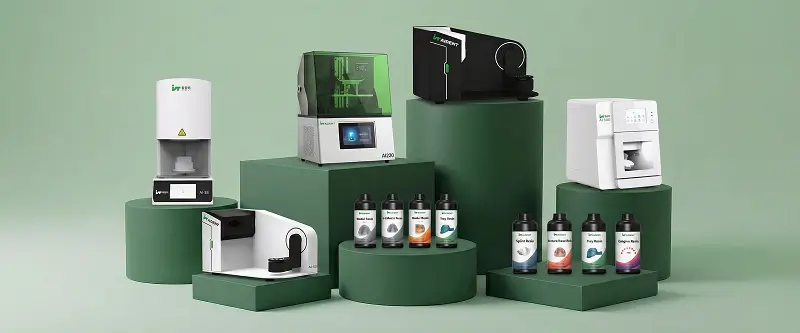
Shenzhen Aident Technology Co., Ltd. operates as a professional manufacturer of digital dentistry solutions, including intraoral scanners, dental lab scanners, 3D printers, and resins.
Relevant facts:
2000 m² in-house production base in Bao'an, Shenzhen
100% independent hardware and software development
R&D team with more than 15 years of scanning technology experience
CE certification and China Class II medical device qualifications
Full OEM/ODM and private-label support
Open-system product design
Direct factory partnership model for international distributors and brands
The AI-30 intraoral scanner and related digital equipment are produced under Aident's own quality and development control.
FAQ
Can a trading company provide the same quality as a manufacturer?
Sometimes the product itself can be similar if it comes from a good factory. However, consistency, customization, software support, and long-term parts availability are usually stronger with a direct manufacturer.
Is the price always lower with a manufacturer?
Factory-direct pricing often offers better value, but the biggest advantages are usually quality control, support, and partnership stability rather than price alone.
How can I confirm CE certificates are real?
Ask for the full certificate and Declaration of Conformity. Verify that the company name and product model match, and cross-check with official databases when possible.
Does Aident work with distributors and OEM clients?
Yes. Aident supports international distributors, importers, and private-label/OEM partners with factory-direct cooperation.
What is the first step to evaluate Aident as a manufacturer?
Share your company background, target market, and whether you need standard products or OEM customization. Aident can then provide technical details, sample options, and commercial terms.
Next Step
Choosing between a dental scanner manufacturer and a trading company is fundamentally a decision about control, consistency, and long-term risk. For professional buyers building a sustainable product line or distribution business, working directly with a capable manufacturer is usually the stronger strategy.
Want to work directly with a dental scanner manufacturer?
Contact Aident Technology:
Inquiry form: https://www.aident3d.com/inquiry
WhatsApp: +86 19311417410
Email: dongjiahao@aident.cc
Please mention "Manufacturer / OEM / Distributor" in your message and briefly describe your business model and target markets. We will respond with company credentials, product information, and partnership options.