Digital dentistry is no longer optional. Clinics and laboratories that successfully adopt intraoral scanners, lab scanners, and 3D printing gain shorter delivery times, higher accuracy, and better margins. Those that fail often waste capital, frustrate teams, and return to old methods within 12–18 months.
Below is a clear comparison of common failure patterns versus proven success factors, illustrated with a real laboratory outcome.
Common Reasons Digital Transformation Fails
Buying isolated equipment instead of a workflow
Many clinics purchase only a scanner or only a printer. Without seamless file transfer, design capability, and material compatibility, the system creates new bottlenecks instead of removing old ones.
Closed or high-subscription ecosystems
Locked software, annual fees, and limited export formats increase long-term cost and reduce flexibility. Teams feel trapped and resist full adoption.
Ignoring training and change management
New technology is introduced without clear protocols or adequate hands-on training. Staff continue using traditional methods "just in case," and utilization stays low.
No measurable KPIs before and after
Without baseline data on delivery time, remake rate, and output, management cannot prove ROI. The project is judged by feelings rather than numbers and is eventually abandoned.
Choosing complexity over reliability
Over-featured machines that are difficult to maintain or calibrate lead to downtime and loss of confidence.
These failures are expensive: capital tied up, team morale damaged, and competitive position weakened.
What Successful Digital Transformation Looks Like
Successful cases share several consistent characteristics:
A complete Scan → Design → Print chain rather than single devices
Fully open file formats (STL / PLY / OBJ) and compatibility with existing CAD software
Simple daily operation and short learning curve
Clear before-and-after metrics
Reliable hardware with low maintenance burden
Materials matched to the printer for dimensional stability
Real Success Case: Shenzhen Dental Laboratory
In August 2025 a mid-sized Shenzhen dental laboratory installed the Aident Ai220 large-format dental 3D printer together with high-precision low-warpage model resin. They already had digital design capability and added the printer to close the production loop.
Results after three months:
| Metric | Before | After | Change |
|---|---|---|---|
| Daily model output | ~30+ | 70+ | 2.5× capacity |
| Average delivery cycle | 3–5 days | 1.5–2 days | ~50–60% shorter |
| Precision-related remakes | 1–2 per 10 models | Near zero | Dramatically reduced |
| On-time delivery | Under pressure | 100% | Fully recovered |
| Customer satisfaction | ~75% | 98% | Strong improvement |
| Client impact | 2 clinics lost | Both returned + 5 new | Net growth |
The technical supervisor stated that model accuracy became the biggest improvement: "Previously 1–2 out of 10 models needed rework. Now we can print 100 models with virtually no precision issues." New staff could operate the system independently after one day of training. Monthly maintenance dropped to under one hour. Labor cost related to model production fell by about 20%.
Key success factors in this case:
Large, stable build volume for real batch production
Open system that fitted existing design software
High-accuracy, low-warpage model resin
Simple operation and quick staff adoption
Clear measurement of output, cycle time, and complaint rate
Side-by-Side Comparison
| Factor | Failed Approach | Successful Approach |
|---|---|---|
| Scope | Single device | Complete Scan → Design → Print chain |
| Software & files | Closed / high subscription | Fully open STL/PLY/OBJ |
| Learning curve | Complex, long training | 1-day independent operation possible |
| Measurement | No baseline KPIs | Tracked output, delivery time, remakes |
| Maintenance | Frequent downtime | Low monthly maintenance |
| Result | Low utilization, abandoned project | 2.5× capacity, 50%+ shorter delivery |
Practical Recommendations for Clinics and Labs
Start with the biggest bottleneck (delivery time, remake rate, or chairside temporary production).
Choose open-architecture equipment that works with your current CAD software.
Pair scanners and printers from the beginning so the workflow is complete.
Set simple KPIs and measure them monthly.
Invest in short, practical training rather than lengthy theoretical courses.
Select resins proven for dimensional stability on the chosen printer.
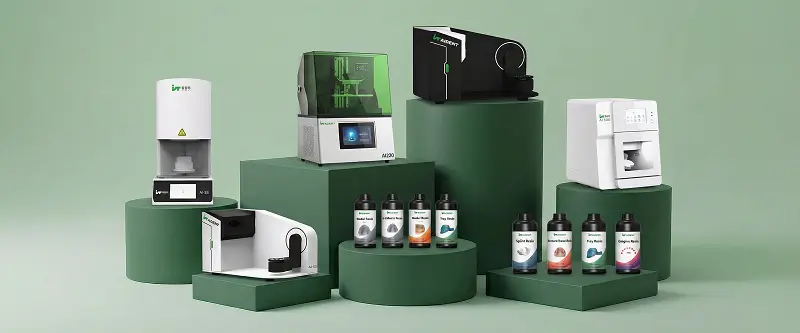
The Aident Approach
Aident focuses on a complete, open digital solution:
AI-30 Intraoral Scanner - ≤10 μm, 198 g, powder-free, open files
High-precision lab scanners (<0.006 mm)
Ai-C60 / Ai220 dental 3D printers - <0.03 mm accuracy, auto-leveling, open resin system
Matching high-precision and biocompatible resins
The goal is not to sell isolated machines, but to help clinics and laboratories achieve measurable improvements in speed, accuracy, and profitability.
Ready to Avoid the Failure Path?
If your digital projects have stalled or you are planning the next investment, a clear workflow-focused approach can make the difference between wasted budget and real competitive advantage.
Request a productivity consultation, equipment recommendation, or live demonstration.
WhatsApp: +86 19311417410
Email: dongjiahao@aident.cc
Inquiry form: https://www.aident3d.com/inquiry
Successful digital transformation is not about owning the most expensive technology - it is about choosing a reliable, open, and measurable system that your team will actually use every day.