FDM (Fused Deposition Modeling) and resin-based 3D printing (SLA, DLP, and LCD) are two of the most widely used additive manufacturing technologies. Both can produce three-dimensional objects from digital models, but they differ fundamentally in principle, print quality, materials, cost, and suitability for different applications - especially in dentistry.
FDM 3D Printers
Working Principle
FDM printers heat thermoplastic filament (such as PLA, ABS, PETG, or nylon) until it melts, then extrude the molten material through a nozzle. The material is deposited layer by layer onto the build platform, where it cools and solidifies to form the object.
Typical Applications
Educational use and basic prototyping
Simple functional parts, jigs, and fixtures
Low-cost visual models and decorative items
Home or small-workshop production of non-critical parts
Advantages
Wide range of affordable filament materials
Relatively simple operation and lower equipment cost
Easy cleanup in most cases
Larger build volumes available at accessible prices
Limitations
Visible layer lines and lower surface smoothness
Limited fine-detail resolution compared with resin systems
Weaker interlayer bonding in some orientations
Potential odor or emissions depending on the filament
FDM is practical for many general and educational uses, but it rarely meets the accuracy and surface-quality requirements of professional dental models, surgical guides, or temporary restorations.
Resin 3D Printers (SLA / DLP / LCD)
Working Principle
Resin printers use liquid photopolymer (photosensitive resin) that solidifies when exposed to UV light of a specific wavelength (typically 385–405 nm).
SLA uses a laser to trace each layer point by point.
DLP projects a complete layer image with a digital projector.
LCD (the technology used in most modern dental printers, including Aident systems) shines UV LEDs through a high-resolution LCD screen that acts as a mask, curing an entire layer at once.
After each layer cures, the build platform moves, and the process repeats until the part is complete.
Typical Applications
High-precision dental models, orthodontic setups, and clear-aligner models
Biocompatible surgical guides for implant placement
Temporary crowns and bridges
Castable patterns for frameworks
Jewelry, detailed prototypes, and any application requiring smooth surfaces and fine detail
Advantages
Superior surface finish and high resolution
Excellent dimensional accuracy (professional dental LCD systems commonly achieve ±0.03 mm)
Strong interlayer bonding
Fast production of detailed small-to-medium parts when using optimized resins and printers
Quiet operation
Considerations
Requires careful handling of uncured resin (gloves, ventilation, proper cleaning)
Post-processing is necessary: cleaning (IPA or water-washable resins), support removal, and UV post-curing
Consumable costs (resin and, on LCD systems, occasional screen replacement) are higher than basic filament
Build volume is generally smaller than large FDM machines
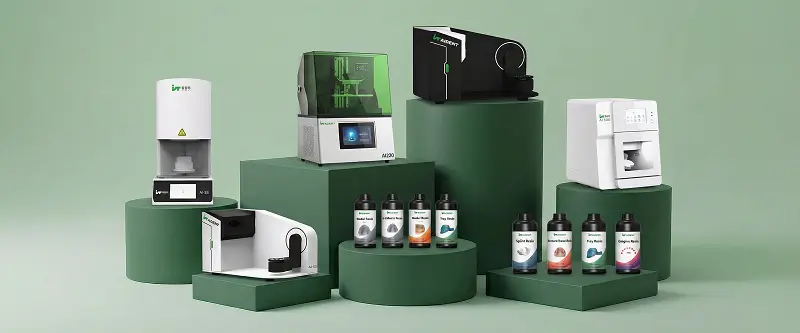
Modern professional LCD dental printers, such as Aident's Ai-C60 and Ai220, are specifically engineered to minimize these drawbacks for clinic and laboratory use through uniform light sources, auto-leveling, intelligent temperature control, and matched high-performance resins.
Core Differences at a Glance
| Aspect | FDM | Resin (SLA/DLP/LCD) |
|---|---|---|
| Material | Thermoplastic filament | Liquid photopolymer resin |
| Surface Quality | Visible layer lines, rougher | Smooth, high detail |
| Accuracy | Moderate | High (especially professional dental systems) |
| Speed (detailed parts) | Generally slower for fine features | Faster for high-detail small/medium parts |
| Ease of Use | Simpler for beginners | Requires more care with resin handling |
| Post-Processing | Minimal | Cleaning + UV post-curing required |
| Cost of Entry & Running | Lower | Higher (but justified for precision work) |
| Best for Dentistry | Limited (jigs, basic models) | Primary choice for models, guides, temporaries |
Which Technology Is Better for Dental Applications?
For oral medicine and dental laboratories, resin-based (especially modern LCD) printers are the clear preference. They deliver the accuracy, surface quality, and material performance needed for diagnostic models, implant surgical guides, temporary restorations, and orthodontic appliances. When paired with application-specific dental resins (high-precision model, biocompatible guide, temporary, castable, water-washable, or gingiva resins), the results support efficient digital workflows from intraoral or laboratory scan to finished printed part.
Aident3D specializes in professional LCD dental 3D printers and matched resins designed exactly for these clinical and laboratory needs, offering an open system that integrates smoothly with scanners and CAD software.
Ready to choose the right 3D printing technology for your dental practice or laboratory?
Explore Aident's high-precision LCD printers (Ai-C60 and Ai220), dental resins, and complete Scan → Design → Print solutions at https://www.aident3d.com/.
Request technical specifications, sample parameters, or a quotation:
WhatsApp +86 19311417410 | Email dongjiahao@aident.cc
Understanding the fundamental differences between FDM and resin technologies helps clinics and labs invest in the system that truly improves accuracy, productivity, and patient outcomes in digital dentistry.