Introduction: Where Is Intraoral Scanner Technology Heading?
Dental intraoral scanners have transformed how dental professionals capture digital impressions. Instead of relying exclusively on conventional impression materials, dentists can use optical scanning systems to create three-dimensional representations of teeth and surrounding oral structures.
However, the next stage of development involves more than capturing digital impressions faster. Manufacturers are working to improve scanning reliability, simplify clinical workflows, integrate artificial intelligence (AI), support more complex restorative procedures and connect digital data across dental practices and laboratories.
These developments could change how clinics evaluate equipment, collaborate with dental laboratories and manage digital treatment workflows.
For dentists, dental laboratory owners and equipment distributors, understanding these trends is important when evaluating new technology and planning future investments.
This guide examines the major directions shaping intraoral scanner technology, the opportunities they create and the limitations buyers should consider before choosing a system.
1. AI-Assisted Scanning Will Become More Important
Artificial intelligence is increasingly relevant to digital dentistry, particularly in image processing, scan-data analysis and workflow automation.
Traditional intraoral scanning depends on capturing multiple optical images and combining them into a three-dimensional model. The software must process incoming data, align overlapping surfaces and reconstruct a usable digital representation.
AI-assisted features may help make parts of this process more efficient.
Potential applications of AI in intraoral scanners
Real-time scan-quality assessment
Software may identify missing areas, incomplete surface capture or potential data inconsistencies while the operator is scanning. Earlier identification of problems could reduce the need to repeat parts of a scan.
Intelligent data processing
Advanced algorithms may help distinguish useful surface information from artifacts and improve the handling of difficult scanning conditions. The actual benefit depends on the scanner's optical system, software implementation and clinical environment.
Automated workflow assistance
AI-based guidance could help operators follow suitable scanning paths, identify areas requiring additional attention and standardize routine procedures.
Support for clinical communication
Some systems combine scan data with visualization and patient communication features. These tools can help clinicians explain findings, but diagnostic functions must be evaluated separately from basic scanning performance.
What should buyers evaluate?
The presence of an AI feature does not automatically mean that a scanner is more accurate or clinically effective.
Buyers should ask whether the feature has been independently evaluated, whether it works in the intended clinical application and whether it reduces measurable workflow problems.
For dental equipment distributors, the most useful question is not simply whether a scanner uses AI, but which specific task the technology improves and what evidence supports that claim.
2. Wireless Intraoral Scanners Will Continue to Evolve
Wireless intraoral scanners offer greater freedom of movement than conventional tethered systems. They can reduce cable-related restrictions around the dental chair and may simplify equipment positioning.
As wireless technology develops, manufacturers are likely to continue improving connectivity, battery management, charging systems and integration with clinic infrastructure.
Why wireless technology matters
Greater mobility: Operators can move the scanning handpiece without managing a connecting cable.
Flexible room configuration: Wireless systems may simplify equipment placement in clinics with different treatment-room layouts.
Improved ergonomics: A well-designed wireless handpiece can provide a more convenient scanning experience.
Flexible deployment: Wireless connectivity may support different workstation arrangements, depending on the system architecture.
However, wireless connectivity is only one part of the user experience.
Battery life, charging time, connection stability, software performance, handpiece weight and the availability of backup power all affect practical usability.
A wireless scanner should also be evaluated for how reliably it transfers data under the clinic's normal operating conditions.
Will wireless scanners replace wired systems?
Not necessarily.
Wireless systems may appeal to clinics that prioritize mobility and flexible room layouts. Wired systems may remain attractive when buyers prioritize continuous operation, straightforward connectivity or a particular price point.
The best choice depends on workflow requirements rather than whether the product uses the newest connection technology.
3. Full-Arch Accuracy Will Remain a Major Technology Challenge
Scanning a single tooth or a short restoration span is different from capturing an entire dental arch.
During full-arch scanning, small alignment errors can accumulate as the system combines successive images. The effect can become particularly important in complex implant-supported restorations, where accurate spatial relationships between implant positions are essential.
Future scanner development is therefore likely to focus not only on local surface detail but also on maintaining reliable accuracy across larger scanning areas.
Technologies supporting full-arch workflows
Potential developments include:
Improved image registration and three-dimensional reconstruction algorithms
More effective detection of inconsistent or low-quality scan data
Better scanning guidance for long-span restorations
Integration with implant-specific scanning protocols
Complementary photogrammetry workflows for selected implant applications
Intraoral photogrammetry is attracting attention because it offers another approach to capturing implant positions in full-arch cases.
A 2026 review published in the Journal of Dentistry examined intraoral photogrammetry and reported promising results, while emphasizing the need for further research. Other studies also show that performance varies across systems and measurement conditions.
These findings support a cautious conclusion: newer scanning technologies may improve specific workflows, but no single method should be assumed to outperform every alternative in every clinical situation.
What should clinics look for?
When evaluating a scanner for full-arch or implant work, examine:
Independent trueness and precision results for the intended application.
Performance across the full arch, rather than only short-span restorations.
The scanning protocol and scan-body requirements.
Compatibility with implant libraries and downstream CAD software.
The frequency of rescanning, manual correction and workflow interruptions.
A scanner that performs well for routine restorative dentistry may not automatically be the best option for every complex implant case.
4. Multimodal Data Integration Will Support More Connected Digital Dentistry
Intraoral scanners generate valuable surface data, but a digital treatment workflow may require additional information.
Depending on the clinical application, dentists may also use cone-beam computed tomography (CBCT), facial scanning, occlusal analysis, photographs and patient records.
Integrating these datasets can support a more comprehensive digital planning process.
How data integration can help
Implant planning
In suitable workflows, intraoral surface data can be combined with CBCT information to support implant planning. Accurate alignment and appropriate clinical verification remain essential.
Orthodontic planning
Digital dental models may be combined with photographs and other patient records to support treatment planning and monitoring.
Restorative dentistry
Intraoral scan data can be transferred into CAD/CAM systems for designing restorations and preparing manufacturing files.
Patient monitoring
Repeated scans may help clinicians compare changes over time, provided that the scanning protocol and comparison methods are appropriate.
Why interoperability matters
A digital workflow becomes less useful when data cannot be transferred easily between systems.
Before purchasing an intraoral scanner, clinics should verify supported export formats, software compatibility, licensing conditions, cloud requirements and the availability of the data needed by their laboratory partners.
Open file export can improve flexibility, but buyers should confirm that the exported data retain the necessary information for the intended workflow.
5. Cloud-Based Workflows May Improve Clinic-Laboratory Collaboration
Cloud-based platforms can allow dental practices and laboratories to exchange case files, review progress and organize digital workflows remotely.
Instead of relying entirely on local storage and manual file transfer, compatible systems may support centralized case management and collaboration across multiple locations.
Potential advantages of cloud integration
Faster exchange of digital impression files
Easier access to shared case information
More convenient collaboration between clinicians and technicians
Centralized workflow visibility
Flexible access to compatible software and services
Cloud functionality may be particularly useful for multi-location dental groups, laboratories receiving cases from multiple clinics and distributors supporting customers across different regions.
However, cloud-based workflows also introduce practical considerations.
Clinics should evaluate data security, access controls, storage location, backup policies, subscription fees, internet reliability and applicable privacy requirements.
They should also determine whether the scanner can continue operating effectively when cloud services or network connectivity are temporarily unavailable.
Cloud integration should solve a real workflow problem rather than add complexity without measurable benefit.
6. Ergonomics and User Experience Will Remain Competitive Priorities
Even an advanced scanner can become inefficient if it is uncomfortable to hold or difficult to operate.
Handpiece weight, tip dimensions, field of view, cable management, user-interface design and scanning feedback all affect daily usability.
As intraoral scanning becomes more common, manufacturers will continue to face pressure to make systems easier to use across different clinical environments.
What may improve?
Lighter and better-balanced handpieces
Improved weight distribution may reduce operator fatigue during repeated scanning procedures.
More practical scanner tips
Tip size and shape influence access to posterior teeth and other difficult-to-reach areas. Buyers should consider both visibility and maneuverability.
More intuitive software
Clearer scanning guidance, easier recovery from interrupted scans and more accessible case-management tools may help simplify daily operation.
Simplified maintenance
Tip handling, reprocessing requirements, calibration procedures and maintenance access can affect long-term ownership costs.
These improvements should be evaluated through practical demonstrations rather than product specifications alone.
A scanner that feels comfortable in a short demonstration may perform differently during a full day of clinical work.
7. Faster Scanning Will Matter Less Without Reliable Results
Scanning speed is an important purchasing consideration, but it does not tell the whole story.
A system may capture data quickly under favorable conditions yet require additional scanning or manual correction in a difficult case.
For clinics, the more meaningful measure is often total workflow time.
This includes:
Preparing the scanner and patient
Capturing the required data
Correcting incomplete or inconsistent areas
Reviewing the digital impression
Exporting or submitting the case
Repeating steps when necessary
Future scanner development is likely to place greater emphasis on making the entire workflow predictable, not simply maximizing acquisition speed.
When comparing scanners, clinics should evaluate scanning time alongside data quality, usability, repeatability and the amount of correction required.
8. More Accessible Pricing Will Expand Digital Dentistry Adoption
As more manufacturers enter the intraoral scanner market, clinics have access to a wider range of equipment and pricing options.
This creates opportunities for practices that want to introduce digital impressions without making the largest possible initial investment.
However, a lower purchase price does not automatically mean a lower total cost of ownership.
Buyers should consider the complete cost of using a scanner over its expected service life.
Relevant costs include:
Initial equipment price
Software subscriptions and licensing
Computer or workstation requirements
Scanner-tip replacement and reprocessing
Training and onboarding
Maintenance and warranty coverage
Technical support and potential downtime
A less expensive scanner may be appropriate for routine restorative or orthodontic workflows when it meets the relevant requirements. A clinic handling complex implant cases may prioritize different performance characteristics.
The goal is to select the system that offers the best balance of clinical suitability, reliability, support and overall cost.
9. Intraoral Scanners Will Become More Integrated into Complete Digital Workflows
An intraoral scanner is most useful when it works effectively with the rest of the digital dentistry system.
A typical connected workflow may involve:
Capturing digital impressions in the clinic.
Transferring the data to a laboratory or compatible design platform.
Designing a restoration, appliance or model.
Manufacturing the required component using suitable milling or 3D printing technology.
Reviewing the finished product and completing the clinical workflow.
As scanning, design and manufacturing systems become better integrated, clinics and laboratories may be able to reduce certain handoffs and simplify case management.
For dental laboratories, scanner compatibility and data quality can influence the efficiency of downstream CAD/CAM production.
For clinics, reliable digital communication can reduce avoidable delays caused by incomplete files or incompatible software.
The greatest benefit comes from improving the entire process rather than optimizing one device in isolation.
10. How to Choose an Intraoral Scanner for Future Needs
For clinics, laboratories and distributors, selecting an intraoral scanner requires a structured evaluation.
The following checklist can help buyers compare different systems.
| Evaluation criterion | Questions to ask |
|---|---|
| Accuracy | Is there independent evidence for the intended clinical application? |
| Scanning performance | How does the system perform on routine cases and longer scanning spans? |
| Ergonomics | Is the handpiece comfortable and easy to maneuver? |
| Connectivity | Is wired or wireless operation more appropriate for the clinic? |
| Software | Does it integrate with the required CAD/CAM systems? |
| File access | Can the clinic export and share the necessary data? |
| AI functions | What specific tasks do the features improve, and what evidence supports them? |
| Maintenance | What are the tip, calibration and service requirements? |
| Support | Are training, warranty coverage and technical assistance available? |
| Total cost | What are the initial and ongoing costs over the expected ownership period? |
Distributors and OEM/ODM buyers should also evaluate manufacturing capability, quality-control documentation, regulatory requirements, product consistency, spare-parts availability and after-sales support.
These factors can be especially important when supporting customers across multiple markets.
11. What These Trends Mean for Aident3D and Its Partners
For dental equipment buyers, the evolution of intraoral scanning creates an opportunity to evaluate equipment as part of a broader digital dentistry strategy.
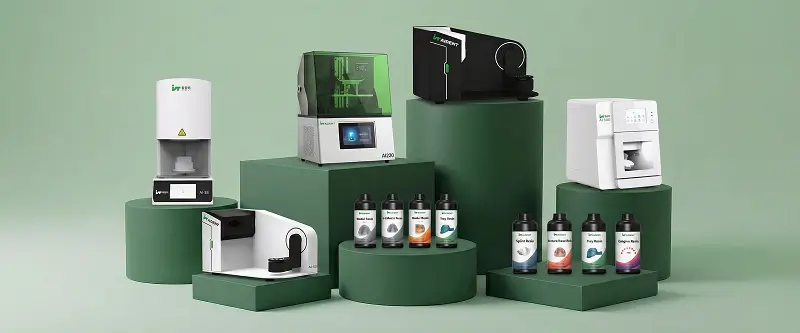
Aident3D supplies dental scanning systems, dental 3D printers and dental 3D printing resins. These product categories can be relevant to clinics, laboratories and distributors developing or expanding digital workflows.
When evaluating a scanner or planning a new equipment portfolio, buyers should consider how the scanning system fits into their existing software, laboratory partnerships and manufacturing requirements.
A practical evaluation process includes:
Defining the clinical or laboratory applications that matter most.
Confirming the scanner's specifications and independently supported performance.
Verifying software compatibility and data-export requirements.
Evaluating training, warranty and technical support.
Comparing the total cost of ownership against the expected workflow benefits.
For distributors, a well-defined product portfolio and reliable technical support can be as important as individual device specifications.
Explore Aident3D's dental scanning solutions and evaluate whether the available equipment fits your intended applications.
For broader digital production requirements, you can also explore dental 3D printers and dental 3D printing resins.
Frequently Asked Questions
What is the future of dental intraoral scanner technology?
Future development is likely to focus on AI-assisted data processing, improved scanning reliability, wireless usability, full-arch applications, software interoperability and integration with broader digital dentistry workflows. The clinical value of each development depends on the specific system and application.
Will AI replace dentists when using intraoral scanners?
No. AI-assisted tools may help process scan data, identify potential quality issues or support selected clinical workflows, but they do not replace professional judgment, clinical examination or responsibility for diagnosis and treatment.
Are wireless intraoral scanners better than wired scanners?
Not necessarily. Wireless scanners offer greater mobility, while wired systems may offer advantages for certain operating environments. Accuracy, ergonomics, software performance, connectivity reliability and total cost should be evaluated separately.
Are intraoral scanners accurate enough for full-arch implant cases?
Performance varies by scanner, scanning protocol and clinical conditions. Full-arch implant cases require particular attention to cumulative errors and implant-position accuracy. Buyers should review independent evidence for the intended application and consider whether complementary photogrammetry is appropriate.
Will intraoral scanners become cheaper?
Greater market competition may increase the range of available price points, but future prices cannot be predicted with certainty. Buyers should compare total cost of ownership rather than purchase price alone.
What should dental clinics look for when buying an intraoral scanner?
Clinics should evaluate accuracy for their intended applications, scanning performance, ergonomics, software compatibility, file access, maintenance requirements, technical support and overall cost.
Can intraoral scanners work with dental 3D printers?
Yes, within a compatible digital workflow. Scan data can be transferred to suitable design software, and the resulting manufacturing files can be used to produce selected dental models or other components using compatible 3D printers and materials. The scanner itself does not directly guarantee that a printed product will meet its intended requirements.
Conclusion: The Future Is About Better Digital Workflows
The future of dental intraoral scanner technology will not be determined by one feature alone.
AI-assisted processing, wireless connectivity, improved ergonomics, full-arch scanning methods and better data integration may all contribute to more capable digital dentistry systems.
However, technological progress must be evaluated against practical outcomes. Accuracy, reliability, interoperability, ease of use and long-term ownership costs remain central to purchasing decisions.
For dental clinics, the priority is to choose a scanner that supports their clinical needs. For laboratories, it is to ensure that digital impressions integrate smoothly with design and manufacturing. For distributors, it is to select equipment and suppliers that can support customers over the long term.
Looking for dental scanning solutions for your clinic, laboratory or distribution business? Contact Aident3D to discuss product specifications, software compatibility and potential equipment partnerships.
Explore Aident3D | Contact Aident3D