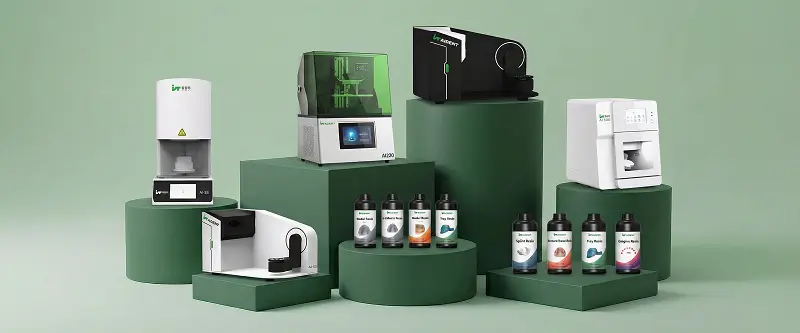
One of the most practical ways to select equipment is to match the machine to your real workload. Learning how to choose a dental 3D printer based on daily production volume prevents both under-buying (constant bottlenecks) and over-buying (unused capacity and higher costs).
This dental 3D printer capacity guide breaks down common volume ranges and shows which type of machine typically fits each level. The goal is to answer the question many clinics and labs ask: what size dental 3D printer do I need for my daily volume?
Why Daily Production Volume Matters More Than Spec Sheets
Print speed and accuracy numbers look impressive on paper, but the real constraint is how many usable models, guides, or restorations you need to finish each day. A machine that is perfect for a clinic producing 8–12 units may create serious delays in a lab running 60+ models. Conversely, a large production printer is often inefficient and more expensive than necessary for low-volume same-day work.
Matching the printer to actual daily output is the most reliable way to choose a 3D printer by daily model output.
Volume-Based Selection Framework
| Daily Production Volume | Typical Users | Recommended Printer Category | Key Requirements |
|---|---|---|---|
| Low (under 15 models or units) | Small clinics, solo practices, same-day focus | Compact chairside printers | Small footprint, simple operation, fast single-unit times |
| Medium (15–40 models) | Growing clinics, small labs | Mid-size open or validated systems | Balanced platform size and reliability |
| High (40–80+ models) | Production orthodontic and restorative labs | Large-platform laboratory printers | High nest density, consistent accuracy across large plates |
| Very high (100+ models or multi-shift) | Industrial-scale aligner or centralized labs | Industrial or multi-machine setups | Automation, continuous operation, fleet management |
Low Volume: Best Dental 3D Printer for Low Volume Clinics
For clinics or practices producing fewer than 15 models or restorations per day, the priority is ease of use and clinical speed rather than maximum platform size. A best dental 3D printer for low volume clinics should be:
Compact and lightweight so it fits near the chair or in a small room
Fast enough for single crowns and small batches
Simple to operate with minimal calibration
Capable of supporting same-day workflows
In this range, compact open chairside machines are often the most practical choice. The Aident Ai-C60, for example, offers a 12 kg body, factory-calibrated platform, approximately 25-minute full-arch prints, and a built-in curing light. These features align well with low-to-moderate daily clinical volume where the machine is used intermittently throughout the day rather than running continuous large batches.
Medium Volume: Balanced Capacity Needs
When daily output reaches 15–40 models, clinics and small labs usually need more nesting capacity without moving to full industrial equipment. At this level, look for:
Build volumes that can handle several full-arch models per run
Reliable accuracy and temperature control
Open or flexible resin options to control material cost
Reasonable training and maintenance demands
Both mid-size open systems and certain validated ecosystem printers can work well here. The decision often comes down to whether the team prefers maximum material flexibility or a more guided, validated workflow.
High Volume: Dental 3D Printer for High Volume Labs
Labs consistently producing 40–80 or more models per day require a different class of machine. A true dental 3D printer for high volume labs must deliver:
Large build volume for high nest density (6–8+ full-arch models per plate is common)
Uniform curing across the entire platform
Consistent dimensional accuracy batch after batch
Low downtime and straightforward daily operation
The Aident Ai220 is designed for this category. Its 220 × 125 × 150 mm build volume, AI LED parallel light source, and ±0.03 mm accuracy class support higher daily throughput. In one documented laboratory case, daily model output increased from 30+ to 70+, with batch sizes rising from 2–3 to 6–8 full-arch models per run. Results vary by workflow and resin, but the platform size and light uniformity are clearly oriented toward production-volume work rather than occasional chairside use.
Very High Volume and Specialized Needs
Labs running multi-shift operations or industrial-scale aligner model production often move beyond single desktop machines. In these cases, industrial systems, multi-printer fleets, or specialized direct-print platforms become relevant. Daily volume in the hundreds usually requires dedicated production planning, automation features, and robust post-processing capacity.
Practical Steps to Match Printer to Your Volume
Track your actual average and peak daily output for at least two weeks (models, guides, temporaries, etc.).
Calculate how many parts you need per plate to meet turnaround targets without excessive overtime.
Decide whether your work is primarily clinical same-day, mixed, or pure laboratory production.
Evaluate total cost of ownership, including resin, labor, failed prints, and support-not only the machine price.
Test real geometries from your scanner and CAD software whenever possible.
Summary: Choosing by Daily Production Volume
The most effective way to answer how to choose a dental 3D printer based on your daily production volume is to start with real numbers rather than maximum specifications.
Low daily volume → prioritize compact size, simple operation, and clinical speed (chairside-oriented machines).
Medium volume → look for balanced platform size and reliability.
High volume → focus on large build volume, nesting efficiency, and consistent batch accuracy (laboratory production machines such as the Ai220 class).
Very high volume → consider industrial systems or multi-machine setups.
Matching capacity to actual daily demand reduces both production bottlenecks and unnecessary capital expense. Once volume is clearly defined, other factors such as resin openness, software integration, and local support become easier to evaluate.
If you share your approximate average and peak daily model or restoration count, primary applications, and whether the work is mainly chairside or laboratory-based, a more precise category recommendation can be refined.