Selecting the right resin 3D printer (SLA, DLP, or LCD) depends on your specific application, required accuracy, production volume, budget, and material needs. Here is a clear comparison and practical buying guide.
1. Core Technical Differences
SLA (Stereolithography – Laser-based)
Principle: A UV laser scans and cures the resin point by point, layer by layer.
Strengths: Flexible build sizes, mature technology, suitable for larger parts or certain industrial applications.
Limitations: Generally slower than area-curing technologies; surface quality and fine detail usually trail modern DLP/LCD systems.
Best for: Larger industrial prototypes, automotive or aerospace models where size flexibility matters more than ultra-fine detail.
DLP (Digital Light Processing)
Principle: A UV projector exposes an entire layer at once.
Strengths: Fast printing speed, excellent accuracy and surface quality, efficient resin usage in many designs.
Limitations: Build volume is typically more limited by projector resolution and peeling forces.
Best for: Dental applications (models, surgical guides, orthodontic appliances), product development, and research where speed + precision are both important.
LCD (LCD Screen / MSLA)
Principle: An LCD screen masks UV light to cure an entire layer simultaneously (similar concept to DLP but using an LCD panel instead of a projector).
Strengths: High resolution, small pixel size, significantly lower equipment cost, and wide market availability.
Limitations: Light intensity is generally lower than industrial DLP systems, so print speed can be slower depending on the machine and resin.
Best for: Jewelry (high-detail wax patterns), education, small high-precision models, and cost-sensitive dental or prototyping work.
2. Key Factors When Choosing a Resin 3D Printer
| Factor | Recommendation |
|---|---|
| Build Size | Large parts → SLA preferred. Small-to-medium high-detail parts (dental, jewelry) → DLP or LCD. |
| Accuracy & Detail | DLP and LCD usually outperform traditional SLA in fine surface detail and resolution. |
| Print Speed | DLP is typically the fastest due to full-layer exposure. LCD is slower but much more affordable. |
| Material Compatibility | Open systems that support third-party resins offer greater flexibility (flexible, high-temp, biocompatible, etc.). |
| Software & Post-Processing | Easy-to-use slicing software and support for automated wash/cure stations improve overall efficiency. |
3. Typical Application Scenarios
Dental: Models, surgical guides, aligners, and temporary restorations demand high accuracy and biocompatible resins. Both DLP and LCD systems are widely used and can support high daily output.
Product Prototyping: Engineers use tough or engineering resins for rapid design verification, replacing weeks of outsourced work.
Education & Research: Compact, affordable LCD or DLP machines are ideal for teaching and experimental use.
Jewelry: High-resolution LCD or DLP printers excel at producing detailed casting patterns.
4. Resin Selection Tips
Always request the Material Safety Data Sheet (MSDS) and follow proper handling procedures.
Match the resin to the application:
– Dental models → low-shrinkage, dimensionally stable resins
– Surgical guides → certified biocompatible and tough resins
– Jewelry patterns → high-detail, clean-burnout castable resins
5. Additional Buying Advice
Choose manufacturers that invest heavily in R&D, testing, and quality control.
Strong after-sales support, training, and responsive service significantly improve long-term experience.
Evaluate total cost of ownership (machine + resin + post-processing + maintenance), not just the sticker price.
Aident3D Recommendation for Dental Users
For most dental clinics and laboratories, modern high-resolution LCD or DLP systems offer the best balance of precision, speed, cost, and ease of use.
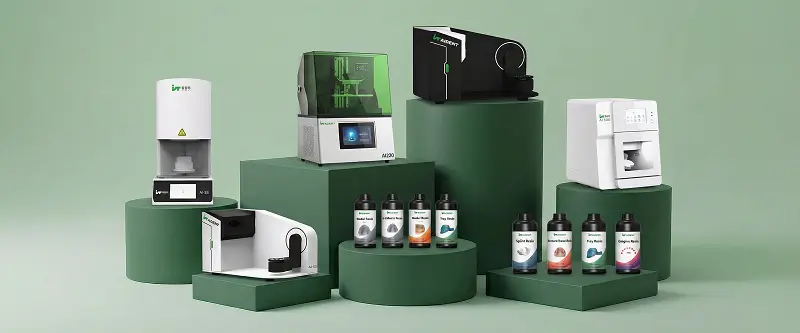
At Aident3D (https://www.aident3d.com/), we specialize in professional dental 3D printers (optimized LCD/DLP platforms), high-accuracy intraoral and laboratory scanners, and a complete range of dental resins for models, surgical guides, temporary restorations, and more. Our open systems and validated workflows help clinics and labs achieve reliable, high-quality results with strong return on investment.
Ready to choose the right resin 3D printer for your dental practice or lab?