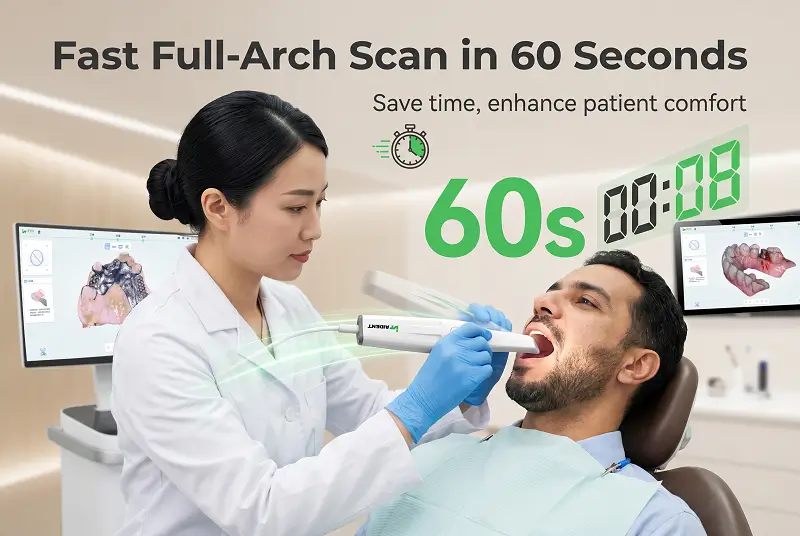
Intra‑Oral Scanner: A Quiet Evolutionary Journey
The birth of intra‑oral scanners represents a quiet revolution that has reshaped dental care. Evolving from early conceptual ideas to an indispensable "smart assistant" in modern dental practice, this technology bears the deep footprint of countless global researchers and enterprises.
Embryonic Stage: Pioneers' Explorations
In the 1970s, French doctor FRANÇOIS DURET blazed a trail by conceiving the possibility of optical impression for dentistry, sowing the first seed for intra‑oral scanners. In 1984, he produced the first digital dental crown using a patented optoelectronic scanner.
In 1985, Sirona launched its chair‑side CEREC 1 system. Though capable of fabricating restorations, it suffered from immature CAD software, and occlusal adjustments still needed to be performed inside patients' mouths. The upgraded CEREC system in 1987 solved data‑transmission challenges and enabled digital collaboration between labs and clinics. However, its high price put it out of reach for all but a small number of high‑end dental practices.
Growth Phase: Leaps in Technology
At the start of the 21st century, intra‑oral scanning entered rapid growth as manufacturers raced in technological competition. The launch of the TRIOS series in 2011 marked a milestone. Acting as an industry disruptor, it delivered a complete scan‑to‑manufacture workflow. Its open‑platform strategy quickly made it the core of the digital‑dentistry ecosystem and drew broad‑based industry participation.
In 2007, ALIGN Technology acquired CADENT and brought iTero under its umbrella. iTero and Invisalign formed a powerful partnership: iTero accurately captured dental‑arch data, while Invisalign delivered orthodontic treatment plans. Their combined ecosystem generated far‑reaching impact beyond any standalone product. Cumulative sales of over 100 000 units stand as solid proof of their market success.
Competitive Era: Fierce Industry Rivalry
As markets matured, the intra‑oral‑scanner sector turned into a highly competitive arena with diverse brands showcasing their strengths.
In 2012, 3M launched its intra‑oral scanner featuring an open secure cloud platform that expanded options for dentists and lab technicians. Sirona's CEREC OMNICAM won an iF Design Award for its ergonomic design. Other notable players included Carestream's CS 3600, Planmeca's PLANSCAN, Condor's compact scanners, Dental Wings' multi‑language platform, and Dentsys3D's high‑precision imaging. Each brought distinctive strengths, enriching the intra‑oral‑scanner marketplace.
Rise of Chinese Innovators: Emerging New‑Generation Players
Chinese enterprises have emerged as strong late‑comers in this global competition.
Back in 2004, Shining 3D dedicated itself to high‑precision 3D‑vision technology, laying solid groundwork for domestic intra‑oral‑scanner R&D. In 2013, it partnered with Professor Sun Yuchun's team from Peking University School of Stomatology to boost intra‑oral‑scanning accuracy amid the early wave of dental digitalization.
Its first‑generation intra‑oral scanner debuted in 2018. While innovative, it still required powder dusting and lacked true‑color rendering. After formally entering the intra‑oral‑scanner market in 2019, Shining 3D leveraged its long‑standing 3D‑vision expertise to release the AORALSCAN series with industrial‑grade precision.
Continuous R&D drove major technical upgrades: powder‑free scanning eliminated cumbersome workflow steps, and true‑color visualization delivered rich diagnostic details for clinicians.
Released in 2022, AORALSCAN 3 delivers 20‑frames‑per‑second scanning speed, single‑tooth accuracy ≤ 0.01 mm, an ergonomic compact handpiece, intelligent algorithms and supporting application software. AORALSCAN 3I integrates near‑infrared imaging to help dentists detect caries at an early stage.
The Growth Chronicle of Intra‑Oral Scanners
From conceptual origins to today's diverse market landscape, the evolution of intra‑oral scanners is a story of global collaborative innovation. While they have not fully replaced conventional physical impressions, they have become a cornerstone of modern dental treatment. This "smart assistant" will keep advancing, bringing more precise and comfortable clinical experiences to patients worldwide.