When moving into digital dentistry, one of the first equipment decisions is whether to invest in an intraoral scanner, a desktop (laboratory) scanner, or both. Although both devices create 3D digital models, they are designed for completely different stages of the workflow and solve different problems.
Understanding the distinction will help you avoid buying the wrong tool and build a more efficient digital process.
What Is an Intraoral Scanner?
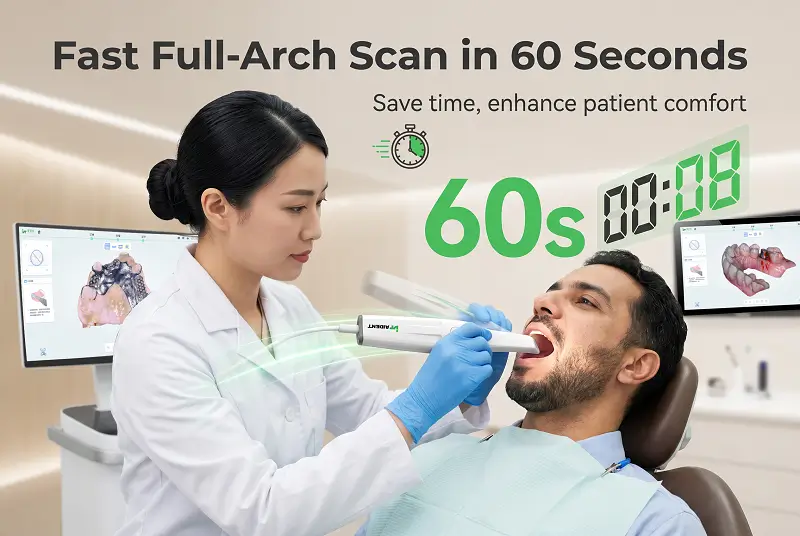
An intraoral scanner is a handheld device used chairside to capture a direct digital impression of the patient's teeth and soft tissue. The clinician or assistant scans inside the mouth, views the 3D model in real time, and can immediately check margins, contacts, and completeness.
Best for:
Replacing traditional impressions
Crowns, bridges, implants, veneers, and orthodontic records
Same-day or rapid digital workflows
Improving patient comfort
Modern examples include Aident's AI-30 (≤10 μm accuracy, powder-free, intelligent anti-fog, lightweight, 0–25 mm depth of field) and AI50 (≤7 μm accuracy, even lighter, 38 fps). Both export open STL/PLY/OBJ files compatible with major CAD software.
What Is a Desktop Scanner?
A desktop scanner (also called a laboratory or extraoral scanner) is a stationary device used outside the mouth. It digitizes physical objects such as:
Stone or printed models
Traditional impressions
Dies, wax-ups, and implant models with scan bodies
These scanners operate under controlled conditions and are optimized for high precision on non-moving objects.
Best for:
Digitizing existing physical models or impressions
Complex laboratory work requiring maximum detail
Clinics or labs that still receive a high volume of analog cases
Archiving models digitally
Key Differences at a Glance
| Factor | Intraoral Scanner | Desktop Scanner |
|---|---|---|
| Where it is used | Chairside, inside the mouth | Laboratory or back-office |
| What it scans | Patient's oral situation | Models, impressions, dies |
| Primary user | Dentist or clinical assistant | Lab technician or trained staff |
| Patient involvement | Yes | No |
| Main clinical benefit | Eliminates physical impressions | Digitizes existing physical work |
| Speed | Very fast for clinical scans | Depends on object complexity |
| Typical role | Data capture at the source | Data capture from analog objects |
Which One Do You Actually Need?
You primarily need an Intraoral Scanner if:
You want to stop using traditional impression materials for most restorative and orthodontic cases
Improving patient comfort and reducing chair time are priorities
You want to send digital files directly to the lab or design chairside
You are building a modern digital workflow from the patient onward
You primarily need a Desktop Scanner if:
Your laboratory still receives many physical impressions or models
You need to digitize existing casts for design, analysis, or archival purposes
You perform complex prosthetic or implant work that benefits from ultra-precise model scanning
You operate a mixed analog-digital laboratory
You may need both if:
Your clinic is transitioning but still handles some traditional impressions
You have an in-house lab and want full flexibility
You want to accept digital files from other clinics while continuing to process physical models
How the Two Scanners Work Together
In a complete digital workflow the devices complement each other:
The intraoral scanner captures the primary digital impression directly from the patient.
The desktop scanner is used whenever a physical model or impression still needs to enter the digital chain.
Both types of files feed into the same CAD software for design.
Manufacturing proceeds via milling or 3D printing.
Many successful digital practices start with a high-quality intraoral scanner and add a desktop scanner later as their volume of mixed cases grows.
Decision Checklist
Ask yourself these questions:
Do I want to eliminate trays and impression material for most patients? → Intraoral scanner
Do I still receive or pour a large number of physical models? → Desktop scanner
Is patient comfort and appointment efficiency a top priority? → Intraoral scanner
Do I need maximum precision on complex laboratory objects? → Desktop scanner
Am I building a fully open digital workflow (Scan → Design → Print)? → Start with an open-system intraoral scanner and add a desktop scanner if needed
Conclusion
An intraoral scanner and a desktop scanner are not competing products - they serve different purposes. The intraoral scanner brings digital dentistry to the chairside and replaces traditional impressions for most daily cases. The desktop scanner digitizes physical objects with high precision in the laboratory environment.
For the majority of clinics looking to modernize, the intraoral scanner delivers the greater immediate impact on patient experience, efficiency, and workflow. A desktop scanner becomes valuable as digital volume increases or when mixed analog cases remain common.
Aident provides both solutions: high-performance open-system intraoral scanners (AI-30 and AI50) and laboratory scanning options, allowing clinics and labs to build a flexible, future-ready digital workflow.
Still unsure which scanner fits your situation?
Explore Aident's intraoral and desktop scanning solutions at https://www.aident3d.com/, or request a personalized recommendation and quotation via our inquiry page.