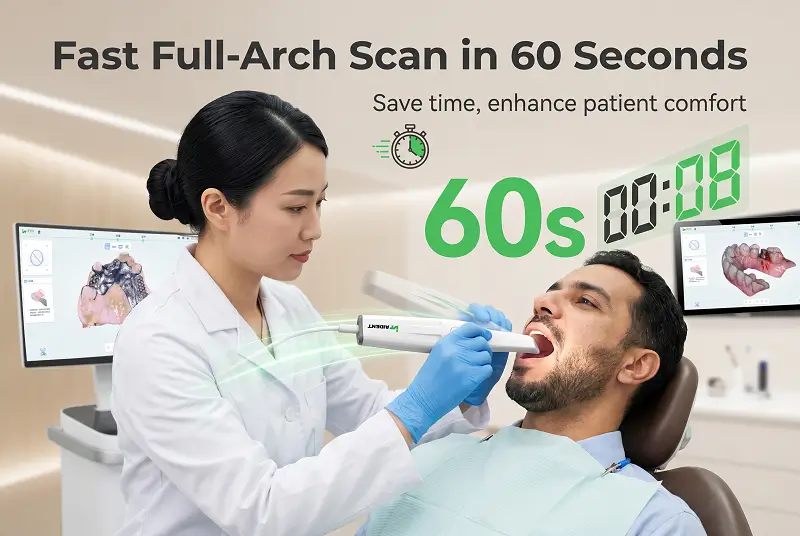
Night guards (occlusal splints / bruxism appliances) are one of the most common and practical applications of intraoral scanning. Digital fabrication is significantly more efficient, accurate, and predictable than traditional methods.
Traditional Process Pain Points
Silicone impression → stone model pouring → manual lab pressing or milling → chairside adjustment. The workflow is long, carries risk of distortion, and often results in inconsistent fit.
Complete Digital Workflow
1. Intraoral Scanning
Capture complete upper and lower arches, including buccal/lingual surfaces and gingival margins.
Record centric relation (CR) bite, not habitual occlusion - especially important when the splint is intended to reorganize occlusion.
Ensure sharp cusp and fossa detail; these anatomical landmarks form the foundation for retention and occlusal contacts.
If the patient has an existing successful night guard, scan it as a reference for design replication.
2. Software Design (exocad / 3Shape Dental System)
Import the scan data and verify the occlusal relationship.
Select splint type: hard, soft, stabilization, or relaxation (anterior-only contact).
Define coverage (full-arch or partial-arch).
Set uniform thickness (typically 2–4 mm on the occlusal surface).
Design occlusal contacts:
– Stabilization splints require even cusp-fossa contacts.
– Relaxation splints usually provide contact only on the anterior teeth.
Adjust border extension and retention form.
Export the final design as an STL file.
3. Manufacturing Options
3D Printing - Flexible resin for soft guards or rigid resin for hard guards. Fast, cost-effective, and ideal for same-day or next-day delivery.
Milling - PMMA disc milling produces the highest precision and durability for hard splints.
Thermoforming - 3D-print a model first, then use conventional vacuum-forming for soft guards.
4. Delivery and Adjustment
Check seating and retention.
Fine-tune occlusal contact points.
Verify border extension and patient comfort.
Key Advantages of the Digital Approach
Scan data is archived permanently - if the guard is lost or broken, a new one can be manufactured without re-scanning the patient.
Precise digital control of occlusal contacts dramatically reduces chairside adjustment time.
3D printing enables rapid turnaround (same day or next day in many clinics).
Successful previous designs can be easily duplicated or slightly modified.
Why Open-System Scanning Makes This Workflow Seamless
The Aident AI-30 Intraoral Scanner captures high-accuracy, powder-free full-arch data with clear anatomical detail. Its open STL/PLY export works directly with exocad, 3Shape Dental System, and major 3D printers - including Aident's own dental 3D printers - creating a complete in-house or lab-based digital night-guard pipeline.
Clinics that adopt this workflow report faster delivery, better fit, higher patient satisfaction, and the ability to offer night guards as a profitable, high-volume service.
Ready to digitize your night-guard fabrication?
Explore the Aident AI-30 Intraoral Scanner and complete Scan → Design → Print solution at https://www.aident3d.com/. Contact us today for a quote, sample workflow, or technical support tailored to occlusal splint production.