Light-curing (photopolymerization) 3D printing is a high-precision additive manufacturing technology that uses photosensitive resins cured by specific wavelengths of light. The process works by slicing a 3D digital model into thin two-dimensional layers. A light source selectively cures the liquid resin layer by layer; exposed areas solidify while unexposed resin remains liquid. Through successive layer accumulation, the final part is formed.
This technology offers high material utilization (approaching 100% in many cases), excellent dimensional accuracy, and superior surface quality. It is widely used in jewelry, dentistry, industrial design, product prototyping, and collectible models.
Core Challenges of Light-Curing 3D Printing
1. Material Performance Limitations
Photopolymer resins must meet strict physical and chemical requirements, including low volatility, suitable viscosity, good stability, fast curing speed, and low shrinkage. Excessively high viscosity reduces flow and can affect accuracy, while high shrinkage may cause warping or cracking.
After curing, the material needs adequate strength, hardness, and thermal stability for the intended application (for example, dental models require dimensional stability, while functional parts may need higher heat resistance).
Safety and environmental performance are also critical. Resins and finished parts should have low odor and meet biocompatibility or other regulatory standards when used in medical or dental applications.
2. Difficulty of Material Development
Photopolymer resins typically consist of prepolymers, reactive diluents, photoinitiators, and additives. Achieving the right balance between curing speed, mechanical properties, and safety requires precise formulation. Increasing photoinitiator concentration can speed curing but may reduce toughness.
Different application fields have very different requirements:
Dental applications need biocompatible, dimensionally stable resins
Industrial uses often demand higher strength or chemical resistance
General consumer applications prioritize cost and ease of use
Long-term stability (resistance to yellowing, embrittlement, or property degradation during storage or use) remains an ongoing challenge for some formulations.
3. Technology Optimization Directions
Development of new resins with lower viscosity, higher toughness, better biocompatibility, or enhanced functional properties (including composite systems with nanoparticles)
Process improvements such as dynamic light intensity control and multi-wavelength curing to increase efficiency and reduce residual stress
Better post-processing methods (washing, post-curing, and surface finishing) to improve final mechanical performance and surface quality
4. Cost and Scalability Considerations
High-performance photopolymer resins are generally more expensive than common FDM filaments. Printers also require regular maintenance of resin tanks, cleaning solvents, and controlled environmental conditions, which adds to operating costs.
While light-curing technology excels at high-precision, small-to-medium batch production, its speed is still lower than traditional mass-production methods such as injection molding for large volumes.
Summary
Light-curing 3D printing stands out for its accuracy, surface quality, and design freedom, making it a valuable tool in high-precision fields including dentistry. The main constraints continue to center on material performance, formulation complexity, long-term stability, and cost. Progress in materials science, process control, and post-processing will further expand its practical applications.
Aident3D Solutions for Dental Light-Curing Applications
At Aident3D (https://www.aident3d.com/), we focus on practical light-curing solutions tailored for dental clinics and laboratories:
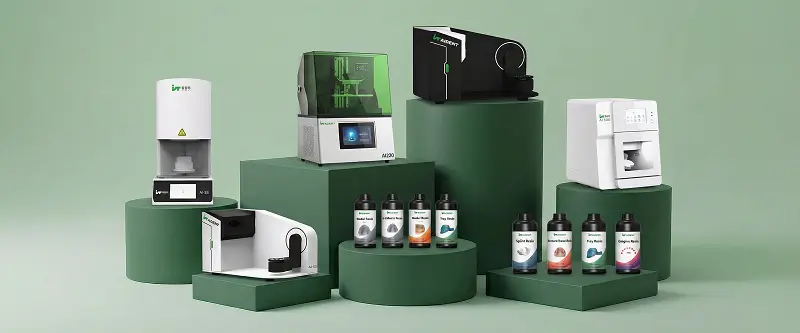
High-accuracy intraoral and laboratory 3D scanners
Professional dental 3D printers optimized for precision and reliability
A range of high-performance dental resins for models, surgical guides, temporary restorations, and related applications
Our systems are designed to deliver consistent accuracy, good material performance, and efficient digital workflows for everyday clinical and laboratory use.
Ready to apply light-curing 3D printing in your dental practice or lab?
Explore our solutions:
https://www.aident3d.com/dental-3d-printer/
https://www.aident3d.com/dental-3d-printer/dental-3d-resin/
https://www.aident3d.com/3d-scanner/
Contact us for technical advice or material recommendations:
https://www.aident3d.com/contact-us