Recent studies and clinical evaluations indicate that 3D printing offers meaningful advantages over traditional milling in several important areas for dental crown fabrication - particularly in cost efficiency, material utilization, dimensional accuracy, and workflow speed. While permanent high-strength ceramic crowns are still most commonly produced by milling or pressing in current clinical practice, 3D printing has already become a highly effective solution for temporary crowns and is rapidly advancing for longer-term restorative applications.
1. Cost Efficiency and Material Utilization
Limitations of traditional milling
Milling starts with a solid block of ceramic or composite and removes material to create the crown. This subtractive process generates significant waste. Equipment costs are high, and single-unit production can be time-consuming, which increases overall expense - especially for highly customized cases.
Advantages of 3D printing
Additive manufacturing builds the crown layer by layer, using only the material required for the final shape. Material waste is minimal. Automated digital workflows also reduce labor input and shorten production time, making 3D printing particularly cost-effective for small-batch, patient-specific temporary and provisional restorations.
2. Dimensional Accuracy and Fit
Milling accuracy can be affected by tool wear, machine vibration, and tool-path limitations, which may lead to minor deviations in margins or internal fit.
3D printing constructs the restoration directly from the digital design with high layer resolution (often in the range of 25–100 microns). Studies have shown that well-calibrated resin 3D printing can achieve excellent dimensional consistency and good marginal adaptation, reducing the need for extensive chairside adjustments - especially valuable for temporary crowns.
3. Mechanical Performance and Fracture Resistance
Early resin materials were sometimes considered more brittle due to layer-by-layer construction. However, modern temporary crown resins and hybrid materials have significantly improved interlayer bonding and overall toughness through optimized formulations and curing processes.
Current high-performance temporary crown resins demonstrate good flexural strength and fracture resistance suitable for short-to-medium term clinical use. Research continues to advance permanent printable ceramic and hybrid materials, with promising results in controlled studies.
4. Biocompatibility and Clinical Safety
Validated dental resins used for temporary crowns and related applications undergo biocompatibility testing. When properly post-processed, they show good surface quality, low plaque accumulation potential, and stability under simulated oral conditions. Proper material selection and validated printing/post-curing protocols are essential for clinical safety.
5. Broader Applications of 3D Printing in Dentistry
Beyond crowns, 3D printing is already well established across the digital dental workflow:
High-accuracy anatomical models and diagnostic casts
Implant surgical guides
Orthodontic models for clear aligners and retainers
Temporary bridges, try-ins, and denture components
As materials (including nano-ceramic and high-toughness resins) and printer technologies continue to improve, the range of clinically accepted printable restorations is expected to expand further.
Summary
3D printing delivers clear benefits in material efficiency, production speed, customization, and digital workflow integration. It is already an excellent and widely adopted solution for temporary crowns and related applications. While traditional milling remains the dominant method for many permanent high-strength ceramic crowns today, ongoing advances in printable materials and processes are steadily increasing the clinical viability of 3D-printed restorations.
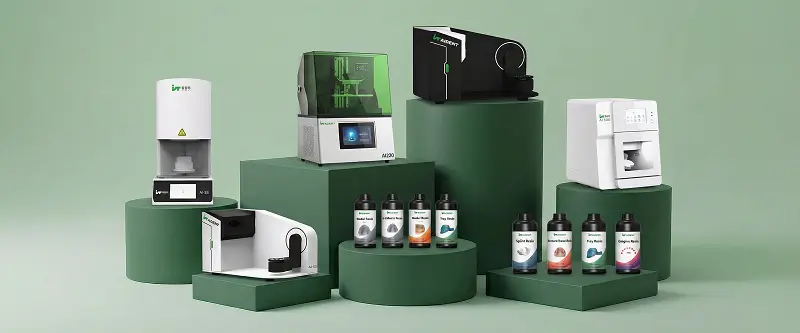
At Aident3D (https://www.aident3d.com/), we provide practical solutions that help clinics and laboratories take full advantage of these benefits:
High-accuracy intraoral and laboratory scanners
Professional dental 3D printers optimized for speed and precision
High-performance temporary crown & bridge resins, model resins, and surgical guide resins
Our open systems support efficient digital workflows for temporary restorations, models, and guides with reliable clinical performance.
Ready to improve your temporary crown and digital restorative workflow with 3D printing?
Explore our solutions:
https://www.aident3d.com/dental-3d-printer/
https://www.aident3d.com/dental-3d-printer/dental-3d-resin/
Contact us for material recommendations or workflow consultation:
https://www.aident3d.com/contact-us