After choosing an intraoral scanner, many clinics assume "scan complete = job done." In reality, the factor that determines whether you can deliver a same-day restoration is not the scanner itself-it is the CAD design software. The scanner simply converts the physical situation into a digital model. The design software is the midfield engine that turns that model into a millable or printable restoration. Its efficiency, level of automation, and learning curve decide whether you finish design in 8 minutes or are still adjusting contacts after 30 minutes.
This article compares the three mainstream dental CAD platforms-CEREC, exocad, and 3Shape-across design speed, AI automation, learning curve, openness, and long-term cost. Data reflects typical operator performance in 2026 clinical and lab environments.
Part 1 | Core Architecture: Closed, Open, and Semi-Open
The three platforms follow fundamentally different philosophies.
CEREC (Dentsply Sirona) is the classic closed ecosystem: Primescan + CEREC software + Primemill + SpeedFire, all developed in-house. Design philosophy: sacrifice flexibility for maximum workflow integration and speed.
exocad DentalCAD is the open-architecture standard. It sells only software and connects to 150+ scanners, mills, and 3D printers. Philosophy: maximum freedom and modularity, at the cost of a steeper learning curve.
3Shape Dental System / TRIOS Design Studio takes a semi-open route. Scanner and design software are proprietary; milling and printing remain open to third parties. Often called the "Apple of dental software"-powerful, polished, and premium-priced.
| Dimension | CEREC | exocad | 3Shape |
|---|---|---|---|
| System architecture | Closed | Fully open | Semi-open |
| Hardware binding | Sirona only | 150+ partners | TRIOS ecosystem preferred |
| Licensing | Bundled with hardware | Perpetual / subscription / monthly | Annual subscription |
| Global footprint | ~68% chairside share | 75,000+ licenses (2026) | Not publicly disclosed |
Part 2 | Design Efficiency: Minutes from Import to Export for a Single Crown
Design time is the most direct variable for same-day dentistry.
CEREC: AI Biogeneric engine routinely finishes a standard single crown in 3–4 minutes (including margin verification, AI proposal, and contact optimization). Complex cases: 8–12 minutes. Approximately 70% of routine cases accept the initial AI proposal with minimal changes.
exocad: Wizard mode typically takes 10–15 minutes for a routine single crown. Expert mode offers far more adjustable parameters, so complex cases can actually be faster once the operator is experienced. AI Design (introduced in DentalCAD 3.2) provides an initial proposal but still requires more manual refinement.
3Shape: AI Crown technology brings routine single-crown design to 5–8 minutes. Guided step-by-step workflows reduce errors, but implant and multi-unit cases commonly stretch to 15–20 minutes.
| Scenario | CEREC | exocad | 3Shape |
|---|---|---|---|
| Routine single crown | 3–4 min | 10–15 min | 5–8 min |
| Complex single / multi-unit | 8–12 min | 15–25 min* | 15–20 min |
| 3-unit bridge | 10–15 min | 20–30 min | 15–25 min |
| Screw-retained implant crown | Limited | Strong (Implant module) | Strong (guided) |
*exocad's advantage on complex cases appears mainly in expert mode with experienced users.
Part 3 | AI Automation: How Reliable Are Margin Detection and Initial Proposals?
All three platforms invest heavily in AI, yet "AI proposal" and "AI you can trust" remain different things. Key metrics are automatic margin-line accuracy and initial morphology acceptance rate.
CEREC leads in automation maturity. The 2026 version adds real-time confidence color coding (green >95%, yellow 85–95%, red <85% needs rescan). Margin recognition acceptance is reported around 85%; rescan frequency has dropped significantly. Predictive occlusion analysis and material-specific minimum thickness rules further reduce chairside adjustments.
exocad launched AI Design more recently (credit-based). Single-crown proposals are available but still require more manual fine-tuning than CEREC. TruSmile photo/video visualization is a distinctive strength for patient communication. Core algorithms claim very high seating accuracy.
3Shape improved AI Crown accuracy in 2026. Guided workflows plus AI produce high usable rates on routine crowns; implant and complex restorations still need substantial manual correction. AI functions more as an advanced starting point than a finished answer.
Takeaways:
CEREC offers the highest AI automation-ideal for high-speed chairside single crowns-but remains locked to approved materials and parameters.
exocad's AI is younger, yet the open architecture lets you choose any block, mill, or printer. Freedom comes with more manual work.
3Shape balances speed and guided usability, at the highest ongoing subscription cost and without a proprietary mill.
Part 4 | Learning Curve: Time from Zero to Independent Production
CEREC: Flattest curve. Streamlined interface + strong AI. Most operators reach independent routine single-crown design in about 1 week. Training is usually provided by dealers (2–3 days intensive). Ceiling is lower for highly complex cases.
exocad: Steepest curve. Wizard mode allows routine crowns in ~2 weeks; full mastery of expert mode and advanced modules often takes 6–12 months. Modular licensing lets teams buy and learn features progressively.
3Shape: Intermediate. Guided workflows enable independent routine work in 2–4 weeks. Full Dental System proficiency still requires several months.
| Stage | CEREC | exocad | 3Shape |
|---|---|---|---|
| Independent routine single crown | ~1 week | ~2 weeks | 2–4 weeks |
| Confident complex cases | 1–3 months | 6–12 months | 3–6 months |
| Training resources | Dealer + official | Offline centers + community | Online library + academy |
Part 5 | Cost & Openness: Perpetual, Subscription, and Bundled Economics (USD)
Pricing models differ dramatically; five-year total cost of ownership can diverge more than expected. Figures are approximate 2026 market references (converted at roughly 7.2 CNY/USD) and should be confirmed with local authorized dealers.
CEREC: Software is bundled. Full system (scanner + mill + furnace + software) typically $35,000–$49,000. Annual CEREC Club / maintenance roughly $2,100–$4,200. You purchase entry into a complete closed ecosystem.
exocad: Flexible options-perpetual Core license from approximately $6,000 (includes first-year updates; subsequent annual updates ~$930), annual Flex subscription (first year ~$3,500, subsequent ~$1,170), or new monthly plans starting around $180/month. Modules (implant, full denture, etc.) purchased as needed. After stopping payments you retain the last version you paid for.
3Shape: Mandatory annual subscription. Initial outlay approximately $5,000–$8,000 (dongle + first year); ongoing annual fees $2,500–$5,000. Software access ends if payments stop.
| Cost Item | CEREC | exocad | 3Shape |
|---|---|---|---|
| Initial software/system | Bundled ($35k–$49k full system) | Perpetual from ~$6,000 or monthly from ~$180 | ~$5,000–$8,000 (incl. year 1) |
| Annual maintenance/subscription | $2,100–$4,200 | ~$930 (optional after year 1) | $2,500–$5,000 (mandatory) |
| 5-year software-related cost | $10,500–$21,000 (excl. hardware) | ~$7,800–$9,700 (perpetual path) | $15,000–$33,000 |
| Usable after stopping payment | Limited (hardware-bound) | Yes (last version) | No |
Openness creates hidden material savings. Closed CEREC workflows restrict you to approved blocks (often higher cost). Fully open systems such as exocad allow any compatible material and machine, frequently reducing material spend 20–30%. 3Shape sits in between.
Final Recommendation
One sentence summary:
CEREC wins on raw speed and seamless same-day chairside integration.
exocad wins on freedom, modularity, and lowest long-term controllable cost.
3Shape wins on guided experience and depth in implant/orthodontic workflows.
Choose according to your case mix, team skill level, and preferred ecosystem.
Important caveat: Even the best AI proposal is only a starting point. The step from "proposal" to "ready-to-mill/print" still depends on the clinician's or technician's judgment. Software is a tool; design quality lives with the operator.
For clinics and labs that value openness
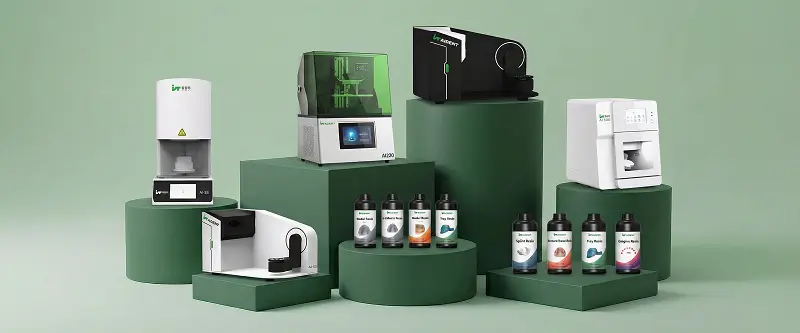
Aident's AI-30 intraoral scanner and Ai-C60 chairside 3D printer are purpose-built for open workflows. They export clean STL/PLY/OBJ files that import directly into exocad, 3Shape, or any other major CAD platform-no proprietary lock-in, no mandatory software subscriptions for core functions, and full compatibility with the design software you already use or plan to adopt. Pair an open scanner and printer with the CAD platform that best matches your speed, complexity, and cost targets, and you keep maximum flexibility while controlling total cost of ownership.
Explore the complete open digital workflow (scan → design in your preferred CAD → print) at aident3d.com. Contact us for current pricing, compatibility confirmation, or a personalized ROI discussion.