Aesthetic restorations demand more than technical precision-they require clear communication of the final result and the ability to preview changes before any irreversible preparation. Traditional wax-ups and temporary restorations often fall short in accuracy, time efficiency, and patient engagement. In 2026, the integration of digital smile design with 3D scanning and 3D printing has become the most reliable way to deliver predictable, patient-approved aesthetic outcomes.
This article explains how digital smile design and additive manufacturing work together, the clinical advantages of the combined approach, and a practical workflow that clinics can implement.
The Limitations of Traditional Aesthetic Planning
Conventional aesthetic workflows typically involve:
Physical impressions and stone models
Hand-waxed diagnostic wax-ups
Manual fabrication of temporary restorations
Limited ability for the patient to visualize the final result in their own mouth
These steps introduce opportunities for error, prolong treatment time, and make it difficult for patients to fully understand or approve the proposed changes. Remakes and chairside adjustments are common, increasing both cost and patient dissatisfaction.
Role of Digital Smile Design
Digital smile design software allows clinicians to:
Analyze facial and dental aesthetics using photographs and 3D scan data
Virtually design tooth shape, size, proportion, and smile line
Present realistic simulations to the patient for discussion and approval
Transfer the approved design directly into CAD software for restoration design
When the starting point is a high-accuracy intraoral scan (≤10 μm) with true-color information, the digital smile design becomes far more precise and clinically relevant. Open file formats (STL / PLY / OBJ) ensure seamless transfer between scanning, smile design, and CAD platforms.
Role of 3D Printing in Aesthetic Cases
Once the smile design is approved, 3D printing turns the virtual plan into physical reality:
Diagnostic models and try-in restorations – Printed with high-stability model or try-in resins so the patient can evaluate aesthetics, phonetics, and occlusion in the mouth
Temporary crowns, veneers, and bridges – Fabricated quickly with aesthetic temporary resins for immediate provisionalization
Preparation guides and reduction guides – Printed to help the clinician achieve the exact tooth reduction required by the approved design
Final verification models – Used for quality control before definitive restorations are delivered
Modern dental 3D printers with high dimensional accuracy (typically within ±0.03 mm) and open resin compatibility make these components reliable and repeatable.
The Integrated Digital Workflow for Aesthetic Restorations
A practical sequence looks like this:
Scan – Capture a precise, powder-free, true-color intraoral scan of the current situation.
Digital Smile Design – Import the scan data and facial photographs into smile design software. Create and refine the proposed aesthetic outcome with the patient.
Design Transfer – Export the approved smile design into CAD software for detailed restoration design.
3D Print – Produce try-in restorations, temporary restorations, or preparation guides on a dental 3D printer.
Clinical Evaluation & Finalization – Seat the printed try-in or temporary, gather patient feedback, make any final adjustments, and proceed to definitive restorations.
Because the entire process is digital and additive, the original approved design remains consistent from visualization through to final delivery.
Clinical and Practice Benefits
Higher Patient Acceptance
Patients who can see and physically try the proposed smile are significantly more likely to approve treatment. Real-time visualization and printed try-ins build confidence and reduce hesitation.
Improved Predictability
Accurate scan data combined with printed guides and temporaries helps the clinician deliver results that closely match the approved digital design, reducing chairside adjustments and remakes.
Faster Treatment Timelines
In many cases, try-ins and temporaries can be printed and delivered the same day or next day, shortening the overall aesthetic treatment timeline.
Better Communication with the Laboratory
Digital files and printed verification models provide clear, unambiguous information to the laboratory, minimizing misinterpretation.
Reduced Material and Time Waste
Precise additive manufacturing and fewer remakes lower both material consumption and valuable chair time.
Practical Tips for Successful Implementation
Begin with high-quality, complete intraoral scans-pay special attention to incisal edges, gingival margins, and occlusal relationships.
Involve the patient early in the smile design process and document their preferences.
Use printed try-ins whenever possible; they provide far more reliable feedback than screen simulations alone.
Choose open-system scanners and printers so you retain full flexibility in software and materials.
Select resins specifically indicated for try-ins and temporary restorations to ensure adequate strength and aesthetics.
Establish a clear approval protocol so that the printed try-in becomes the agreed reference for the final restorations.
How an Open Digital Ecosystem Supports Aesthetic Excellence
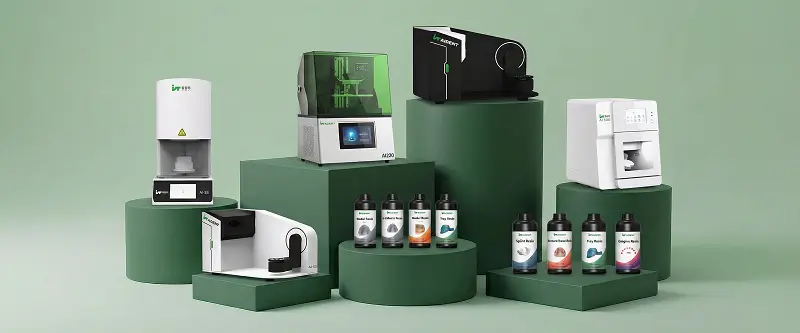
An open workflow is particularly valuable in aesthetic dentistry. High-accuracy intraoral scanners such as the Aident AI-30 provide the precise, true-color starting data. Compatible dental 3D printers (Ai-C60 or Ai220) and matched resins then enable rapid production of try-ins, temporaries, and guides. Because all data remains in standard open formats, clinics can use their preferred smile design and CAD software without restriction.
This combination supports both fully in-house aesthetic workflows and efficient collaboration with external design or manufacturing partners.
Conclusion
The combination of digital smile design and 3D printing has elevated aesthetic dentistry from a largely subjective process to a more predictable, patient-centered, and efficient digital workflow. Accurate scanning forms the foundation; virtual design enables clear communication; and additive manufacturing delivers physical try-ins and temporaries that close the loop between planning and clinical reality.
Clinics that master this integrated approach typically achieve higher case acceptance, fewer adjustments, and more consistent aesthetic results.
Ready to integrate digital smile design and 3D printing into your aesthetic workflow?
Explore Aident's complete open digital dentistry solutions-AI-30 Intraoral Scanner, dental 3D printers, and specialized resins-at Aident3D.com. Request a quote, book a live demonstration, or contact us via WhatsApp +86 19311417410 or email dongjiahao@aident.cc.