Two of the most widely used 3D printing technologies are SLA (Stereolithography) and FDM (Fused Deposition Modeling). Each has distinct working principles, strengths, and ideal applications. Here is a clear comparison to help you understand them quickly.
1. SLA – Stereolithography (Light-Curing Technology)
Working Principle
SLA uses a ultraviolet (UV) laser or light source to selectively cure liquid photopolymer resin. The light triggers a polymerization reaction that solidifies the resin layer by layer, building a solid three-dimensional object.
Basic Process
A UV light source emits a controlled beam of specific wavelength
The beam traces the cross-section of each layer on the surface of the liquid resin
Exposed resin solidifies while unexposed resin remains liquid
The build platform moves, and the next layer is cured on top of the previous one
This process repeats until the full part is completed
Key Characteristics
High dimensional accuracy and excellent surface finish
Capable of reproducing fine details and complex geometries
Ideal for applications that demand precision and smooth surfaces
Typical Applications
High-precision models, jewelry patterns, dental models, surgical guides, temporary restorations, and detailed prototypes.
2. FDM – Fused Deposition Modeling (Material Extrusion)
Working Principle
FDM heats thermoplastic filament (such as PLA or ABS) until it melts, then extrudes the molten material through a nozzle. The material is deposited layer by layer onto a build platform, where it cools and solidifies to form the final object.
Basic Process
The 3D model is sliced into layers and toolpaths
Filament is fed into a heated extruder and melted
The nozzle moves according to the programmed path and deposits material
Layers are stacked sequentially to build the part
Support structures are removed after printing if needed
Optional post-processing (sanding, painting, etc.) improves surface quality
Key Characteristics
Relatively low equipment cost and simple operation
Wide range of affordable thermoplastic materials
Good for functional prototypes and larger parts
Surface quality and fine detail are generally lower than SLA
Typical Applications
Education, concept models, functional prototypes, fixtures, and general-purpose or hobbyist manufacturing.
Quick Comparison Summary
| Aspect | SLA (Stereolithography) | FDM (Fused Deposition Modeling) |
|---|---|---|
| Material | Liquid photopolymer resin | Thermoplastic filament (PLA, ABS, etc.) |
| Accuracy & Detail | High | Moderate |
| Surface Finish | Smooth | Visible layer lines |
| Equipment Cost | Higher | Lower |
| Best For | Precision parts, dental, jewelry | Prototypes, education, functional parts |
Which Technology Is Better for Dentistry?
In dental applications, SLA, DLP, and LCD (all light-curing / resin-based technologies) are strongly preferred. They deliver the high accuracy, smooth surfaces, and fine detail required for dental models, surgical guides, temporary crowns, and orthodontic appliances. FDM is rarely used for clinical dental production due to its lower resolution and surface quality.
Aident3D Dental 3D Printing Solutions
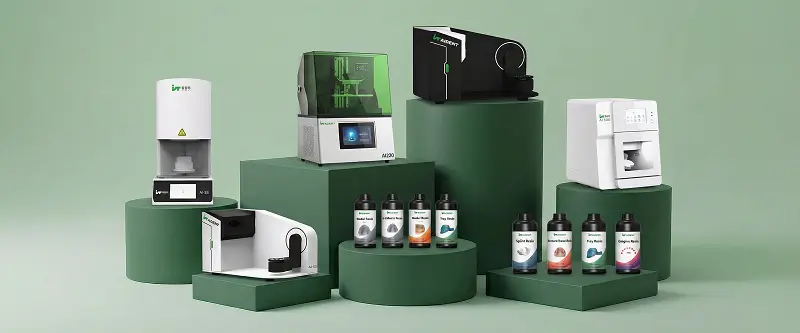
At Aident3D (https://www.aident3d.com/), we specialize in high-precision light-curing (resin) 3D printing solutions designed for dental clinics and laboratories:
Professional dental 3D printers (LCD/DLP platforms)
High-accuracy intraoral and laboratory scanners
A full range of dental resins for models, surgical guides, temporary restorations, and more
Our systems help you achieve reliable accuracy and efficient digital workflows.
Want to choose the right 3D printing technology for your dental needs?
Explore our solutions:
https://www.aident3d.com/dental-3d-printer/
https://www.aident3d.com/3d-scanner/
https://www.aident3d.com/dental-3d-printer/dental-3d-resin/
Contact us for expert advice:
https://www.aident3d.com/contact-us