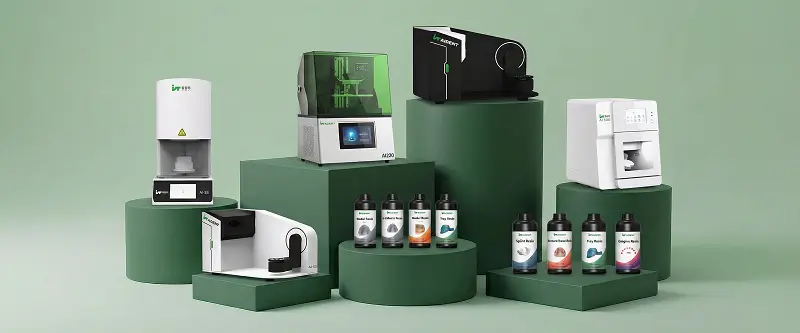
Photosensitive resin (also called UV resin or photopolymer resin) is a liquid material specially formulated for light-curing 3D printing technologies such as SLA, DLP, and LCD. It consists of polymer monomers, oligomers (prepolymers), and photoinitiators (light-sensitive agents). When exposed to ultraviolet light of a specific wavelength-commonly 385–405 nm-the photoinitiators trigger a rapid polymerization reaction, causing the liquid resin to solidify layer by layer into a solid three-dimensional object.
These resins are valued for their ability to produce high-detail parts with smooth surfaces, good dimensional accuracy, and relatively fast curing. In dentistry they are the dominant material for creating diagnostic models, surgical guides, temporary restorations, orthodontic setups, and castable patterns.
Basic Composition and Working Principle
Monomers and oligomers form the main structure of the cured material and determine mechanical properties.
Photoinitiators absorb UV light and start the cross-linking reaction.
Additives control viscosity, color, flexibility, heat resistance, biocompatibility, and odor.
During printing, only the areas exposed to the controlled UV light cure; the remaining liquid resin can be reused, giving the process very high material efficiency.
Common Classifications of Photosensitive Resins
Resins can be grouped in several practical ways. For dental professionals the most useful classification is by application and performance requirements:
1. By Target Technology / Equipment
Industrial SLA resins - low-viscosity formulations optimized for large-format laser systems; high strength and durability.
Desktop SLA resins - tuned for smaller laser-based machines; balance of speed, detail, and ease of use.
DLP / LCD resins - formulated for projector or LCD-screen systems; fast layer curing, high resolution, and good compatibility with modern dental printers (including Aident Ai-C60 and Ai220).
2. By Performance and Application (Most Relevant for Dentistry)
High-precision model resins (e.g., Aident Model UV / HP Series / Model V2.0)
Excellent accuracy, low warpage (<0.4%), matte surface, high hardness. Used for diagnostic models, crown & bridge models, orthodontic setups, and clear-aligner models.
Biocompatible surgical guide resins
Rigid, precise, and suitable for short-term mucosal contact and sterilization. Designed for implant surgical guides that require accurate positioning and angulation.
Temporary crown and bridge (provisional) resins
Combine strength, aesthetics, and biocompatibility for short-term intraoral use. Support same-day or chairside restorations.
Castable / high-temperature resistant resins (e.g., Aident TF series)
Clean burnout with low ash residue and heat resistance (typically 120–150°C range). Ideal for lost-wax casting of frameworks and investment processes.
Water-washable resins
Clean with water instead of (or with reduced) IPA, lower odor, and convenient post-processing-popular in high-volume laboratories.
Flexible / gingiva resins
Soft, elastic materials that mimic natural gum tissue (realistic color and Shore A flexibility). Used for hybrid hard/soft tissue models and patient communication.
Tough / engineering resins
Higher impact resistance and elongation for functional prototypes or jigs (less common as primary dental clinical materials).
3. Other Specialty Categories
Ceramic-filled resins (for high-strength or aesthetic parts after additional processing)
Try-in resins (for verifying fit, occlusion, and aesthetics before final restorations)
Why Classification Matters in Dental Practice
Choosing the wrong resin type can lead to excessive warpage, poor surface quality, inadequate strength, or biocompatibility issues. Application-matched dental resins, when paired with a properly calibrated printer and correct post-curing protocol, deliver reliable accuracy, faster turnaround, and fewer remakes.
Aident3D develops and supplies a focused range of high-performance dental photopolymer resins specifically optimized for professional LCD dental printers. These materials support a complete digital workflow-from intraoral or laboratory scanning through design to precise printed models, guides, and restorations-while remaining compatible with many open-system machines.
Looking for the right photosensitive resin for your dental models, surgical guides, or temporary restorations?
Explore Aident's high-precision model, biocompatible guide, temporary, castable, water-washable, and gingiva resins at https://www.aident3d.com/.
Request technical data sheets, recommended print parameters, or a quotation:
WhatsApp +86 19311417410 | Email dongjiahao@aident.cc
Understanding what photosensitive resin is and selecting the correct classification for each clinical or laboratory need is one of the most effective steps toward higher accuracy and productivity in digital dentistry.