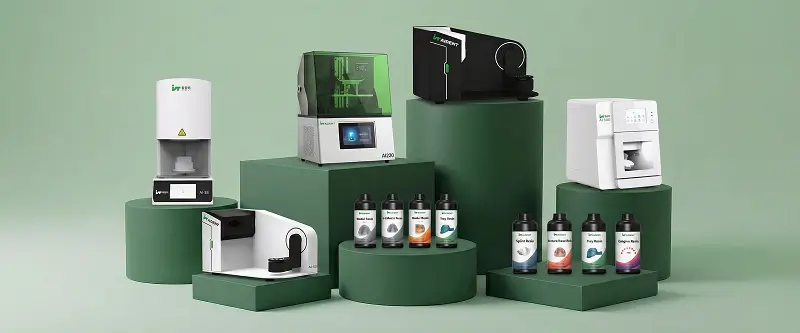
A dental 3D printer is a specialized additive manufacturing machine designed to produce dental models, surgical guides, temporary crowns, orthodontic appliances, custom trays and other prosthetic components directly from digital STL or similar files.
Unlike general industrial 3D printers, dental systems prioritize micron-level accuracy (typically ±0.03–0.05 mm), biocompatible or castable resins, open or semi-open material systems, and workflows that integrate with intraoral scanners and CAD software such as exocad or 3Shape.
In short: it turns a digital scan into a physical dental part layer by layer, usually within 15–90 minutes depending on the object and technology.
How Does a Dental 3D Printer Work?
Most modern dental 3D printers use photopolymerization technology (LCD or DLP). The basic process is:
Digital file preparation – An intraoral or desktop scan is designed in CAD software and exported as an STL (or similar) file.
Slicing – Specialized software slices the 3D model into thin layers (usually 25–100 μm).
Printing – A light source (LED array or projector) cures liquid resin layer by layer on a build platform that rises or lowers.
Post-processing – The printed part is washed (usually in alcohol or dedicated cleaner), dried, and fully cured under UV light.
Key technical differences that matter in daily practice:
| Technology | Light Source | Typical Strengths in Dentistry | Common Limitations |
|---|---|---|---|
| LCD | LED + LCD mask | High resolution, good cost-performance, large build platforms available | Peel force management needed for large models |
| DLP | Digital projector | Fast single-layer exposure, excellent for small precise parts | Build volume often smaller; projector life & cost |
| SLA (laser) | UV laser | Very high surface quality | Generally slower and higher cost for dental volume production |
Professional dental printers add features that general machines lack: intelligent temperature control, auto-leveling, resin profiles optimized for dental materials, and open-system flexibility so labs are not locked into one brand of resin.
What Can a Dental 3D Printer Actually Produce?
| Application | Typical Use Case | Accuracy Requirement | Notes |
|---|---|---|---|
| Study / working models | Diagnosis, treatment planning, patient communication | ±0.05 mm or better | Highest daily volume in most labs |
| Surgical guides | Implant placement | ±0.03–0.05 mm + biocompatibility | Must withstand autoclave or chemical sterilization |
| Temporary crowns & bridges | Same-day or interim restorations | Good marginal fit + strength | Often printed chairside |
| Orthodontic models & appliances | Aligners, retainers, indirect bonding trays | Dimensional stability | Large platforms preferred |
| Custom impression trays | Precise border control | Rigidity + low shrinkage | Reduces traditional tray inventory |
| Castable patterns | Lost-wax casting of crowns/bridges | Clean burnout | Wax-like or castable resins |
| Gingiva masks & soft-tissue models | Implant planning aesthetics | Soft durometer options | Improves communication with clinician |
A single well-chosen dental 3D printer can cover 80–90 % of these indications when paired with the correct resins.
Key Performance Factors That Separate Professional Dental Printers from Hobby Machines
Accuracy & trueness – Measured on full-arch models and surgical guides under continuous production, not single sample prints. Leading systems publish ±0.03 mm.
Build volume vs real productivity – A large platform only helps if temperature control and peel forces allow consistent multi-model runs.
Resin ecosystem – Open systems give labs freedom; closed systems create long-term consumable cost lock-in.
Post-processing integration – Built-in curing lights or easy wash stations reduce total cycle time.
Software & workflow fit – Native support for common dental CAD outputs and simple parameter presets for different applications.
Medical-device compliance – CE (MDR) and relevant national registrations matter for regulated markets.
Dental Lab vs Chairside: Two Different Use Cases
Dental laboratory printers prioritize larger build platforms, higher daily throughput and material flexibility. Typical example from Aident's range: the Ai220 with 220 × 125 × 150 mm build volume, AI LED parallel light source, intelligent constant-temperature control and ±0.03 mm accuracy. Designed for continuous model and guide production.
Chairside / clinic printers prioritize speed, small footprint and simplicity. Example: Aident Ai-C60 – approximately 12 kg, compact dimensions, ±0.03 mm accuracy, designed for same-day models and temporary restorations next to the dental chair.
Many practices and labs now run both: chairside for urgent cases and lab printers for volume work.
Why Accuracy Numbers Alone Are Not Enough
Many manufacturers advertise impressive accuracy figures. In real lab conditions the following factors often determine success more than the brochure number:
Thermal stability of the resin during long print jobs
Consistency of light intensity across the entire platform
Mechanical rigidity of the Z-axis and build plate
Validated post-curing protocol for each resin
This is why specialized dental manufacturers (those who also develop scanners and resins) usually deliver more predictable results than general industrial 3D printer companies that simply re-label machines for dentistry.
How to Choose a Dental 3D Printer – Practical Checklist
Define your main applications and daily volume.
Decide whether you need an open or closed resin system.
Verify published accuracy with multi-model production data if possible.
Check certification status for your target markets.
Evaluate total cost of ownership (machine + resin + labor + remakes).
Confirm after-sales response times and spare-parts availability.
Test real files from your own workflow before final purchase.
Aident's Approach as a Specialized Manufacturer
Aident Technology (Shenzhen) develops dental 3D printers as part of a complete digital workflow that also includes intraoral scanners, desktop lab scanners and dedicated resins. Core design principles:
Open system architecture
±0.03 mm accuracy class
Parallel light sources and constant-temperature control for consistent results
Pre-set parameter profiles for common dental applications
Full OEM/ODM capability for distributors and brand partners
The goal is not simply to sell a machine, but to give labs and clinics a reliable, integrable production tool.
Frequently Asked Questions
Q: What is the difference between a dental 3D printer and a regular 3D printer?
A: Dental printers are optimized for micron-level accuracy, biocompatible or castable resins, open dental workflows, and continuous production of small-to-medium precision parts. General printers prioritize larger industrial objects or hobby use.
Q: How accurate do dental 3D printers need to be?
A: For most restorative and orthodontic models ±0.05 mm is acceptable. Surgical guides and high-precision restorative work benefit from ±0.03 mm systems when the entire process (scan → design → print → post-cure) is controlled.
Q: How long does it take to print a full-arch model?
A: Depending on layer height, resin and machine, typically 20–60 minutes on modern dental LCD/DLP systems.
Q: Can one printer handle both models and surgical guides?
A: Yes, provided the machine supports the required resins and maintains accuracy across different geometries. Many labs successfully run mixed production on a single platform.
Q: Do I need special software?
A: Most dental printers accept standard STL files. Dedicated slicing software with dental presets improves reliability and speed.
Q: Is post-processing complicated?
A: Wash + dry + UV cure is standard. Modern systems and resins have simplified this step; some chairside units integrate curing lights.
Next Step
If you are evaluating a dental 3D printer for your laboratory, clinic or distribution network, the most useful next action is to match your specific volume and application mix with real machine specifications and resin options.
Request technical details or a quotation → https://www.aident3d.com/inquiry
Or explore the current product range:
3D Printers for Dental Applications
Dental Lab 3D Printer
3D Printer for Dental Models
Aident Technology – specialized dental 3D printer manufacturer focused on accurate, open-system solutions for labs and clinics worldwide.