

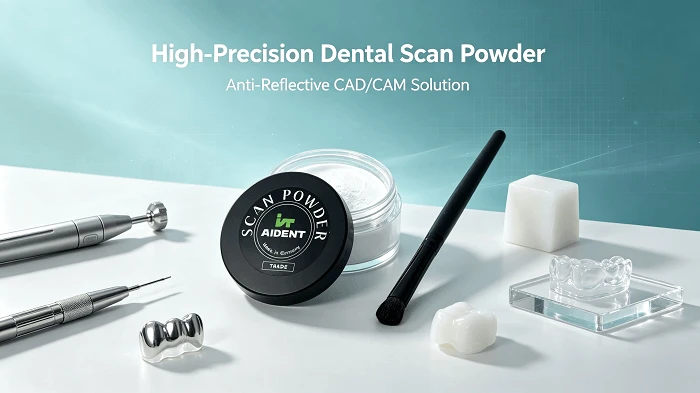
Introduction: Why Scanning Accuracy Still Limits Digital Dentistry
Digital dentistry has moved far beyond early adoption. Intraoral scanners and laboratory scanners are now routine in clinics and labs worldwide. Yet reflective surfaces continue to undermine results. Polished enamel, saliva films, zirconia frameworks, and gold crowns frequently generate glare that leaves gaps in the digital model. Technicians then face incomplete data, repeated scans, or time-consuming manual corrections.
Lab owners and clinical techs face these bottlenecks daily. Incomplete captures stretch turnaround times and erode margins on high-volume crown-and-bridge work. Dental Scan Powder solves the core optical problem by creating a controlled matte surface that scanners can read cleanly. When applied correctly, it raises first-scan success rates and stabilizes the full digital chain from capture through CAD design and manufacturing. This guide covers what the material is, how it works, where it delivers the most value, and how procurement teams can source reliable supply.
What Is Dental Scan Powder and How Does It Function?
1 Definition
Dental Scan Powder is an ultra-fine antireflective powder made specifically for optical scanning in dentistry. A thin, even layer applied to prepared teeth, abutments, models, or dies reduces specular reflection and improves surface readability for both intraoral and laboratory scanners.
Professionals also call it dental scanning powder, scanning powder for intraoral scanners, or CAD/CAM dental powder. Quality grades focus on consistent particle size, minimal impact on fine margins, and compatibility with structured-light and laser systems. Many labs now treat it as a practical biocompatible intraoral scanning powder alternative to older aerosol sprays.
2 Optical Principle and Application
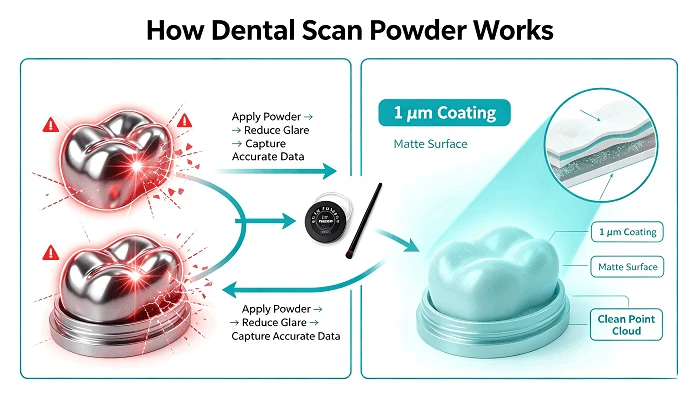
Scanners need diffuse light return. Polished or wet surfaces create specular (mirror-like) reflection that produces bright spots and data voids. The powder converts those surfaces into a uniform matte field through diffuse scattering.
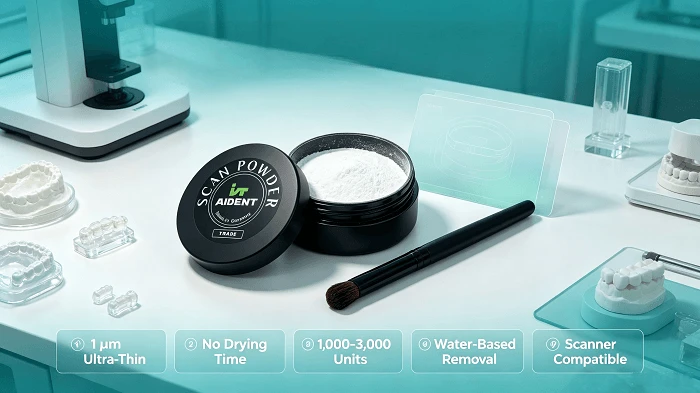
Applying the powder requires just a light, even dusting across the target zone. Fine particles scatter incoming light evenly, giving the scanner stable optical contrast while keeping geometry almost unchanged. After the scan, residual powder is usually removed with air or a gentle rinse. High-grade versions keep effective coating thickness in the 5–10 microns (μm) range so critical margin detail stays intact. Coatings thicker than about 20 μm can begin to compromise margin accuracy, which is why particle control and application technique matter.
Why Clinics and Labs Rely on Dental Scan Powder
1 Better Intraoral Capture
Intraoral scanners perform best on dry, low-reflectance surfaces. Enamel, polished ceramics, and residual moisture often defeat that requirement. A thin layer of scanning powder restores optical contrast and helps capture preparation margins, soft-tissue contours, and implant components more completely on the first try.
2 Fewer Artifacts and Less Rework
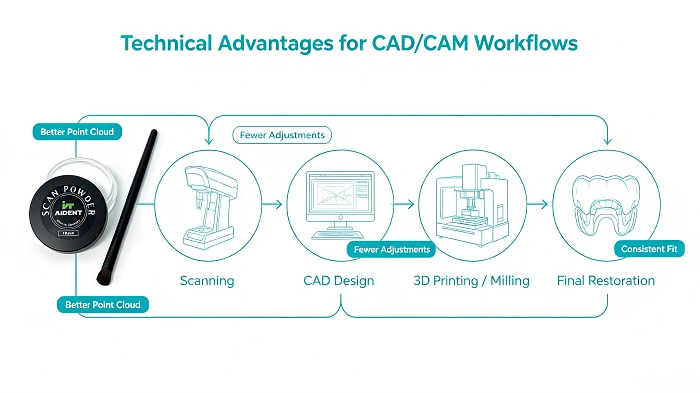
Incomplete or noisy scans force technicians to interpret missing areas or request new data. Either scenario erodes lab profitability and stretches turn-around schedules. Standardized use of a reliable powder cuts scan artifacts, especially on zirconia and metal frameworks. Labs that adopt it consistently see fewer remakes and tighter daily schedules.
3 Cleaner CAD/CAM Flow
Clean scan data shortens the path from acquisition to finished restoration. Design software receives meshes with fewer voids, margin detection improves, and milling or printing encounters fewer dimensional surprises. In high-volume environments the reliability compounds into measurable daily throughput gains.
Features That Separate High-Quality Dental Scan Powder
1 Controlled Ultra-Fine Particle Size
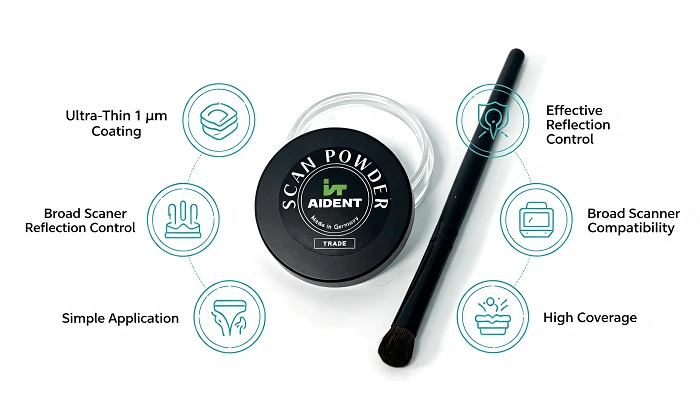
Particle size distribution controls both coverage uniformity and the risk of hiding fine anatomy. Professional powders typically stay well below 10 μm. That range supports even distribution while keeping the coating thin enough to protect preparation margins and surface texture.
2 Consistent Matte Performance
The main optical job is turning specular reflection into diffuse scattering. Effective powders deliver a reliable non-reflective surface across enamel, ceramics, metals, and model materials under normal clinic and lab lighting.
3 Practical Handling and Clean-Up
Chairside and laboratory users need material that applies evenly with low technique sensitivity and rinses or blows off cleanly. Residue that interferes with the next step is a common complaint with lower-grade products.
4 Formulation Consistency and Safety Profile
Batch-to-batch stability depends on controlled raw materials and documented manufacturing. For clinical use, biocompatibility considerations and appropriate regulatory alignment are expected when choosing a supplier.
4. Where Dental Scan Powder Is Used
1 Intraoral Applications for Dental Scanning Powder
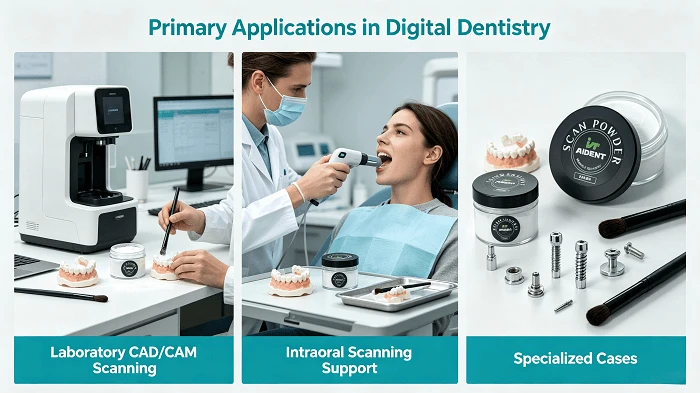
Clinics reach for the powder when scanning preparations for crowns, bridges, veneers, and implant work-especially when reflective ceramics or residual moisture are present. The goal is a complete digital impression without a second scan.
2 Laboratory Model and Die Work
Technicians apply it to stone models, printed models, dies, and existing restorations that must be digitized. It proves especially useful on highly polished frameworks and complex multi-unit cases.
3 CAD/CAM System Integration
Clean surface data supports common design platforms and manufacturing workflows. Accurate capture reduces design corrections and helps maintain tighter tolerances in both milling and additive production.
Dental Scan Powder vs Traditional Scan Spray
| Feature | Dental Scan Powder | Traditional Scan Spray |
|---|---|---|
| Application method | Controlled powder coating | Aerosol spray |
| Layer thickness precision | Typically held at 5–10 microns (μm) with proper technique | More variable; often thicker and less uniform |
| Optical consistency | High when particle size is controlled | Depends heavily on spray distance and angle |
| Material consumption | Low waste | Higher overspray and waste |
| Storage and logistics | Stable, easy to ship internationally | Aerosol restrictions and pressure considerations |
| Technique sensitivity | Operator-dependent (requires practice) | High risk of over-application |
The thinner, more controllable coating of a well-formulated powder is a practical advantage for technicians who must protect margin integrity while still achieving optical contrast. Many teams now view powder as the preferred dental CAD/CAM anti-reflective spray alternative for both performance and logistics reasons.
How to Source High-Quality Dental Scan Powder (OEM & Wholesale)
1 Manufacturing Experience
Favor suppliers with a documented track record in dental materials and active export relationships. Feedback from working laboratories and distributors reveals long-term performance more clearly than marketing claims alone.
2 Quality Systems
Look for incoming material controls, process monitoring, and finished-batch verification. Consistency across lots is essential for laboratories that cannot absorb variable scanning results.
3 OEM and Private-Label Options
Distributors and private-label brands often need custom packaging, branding, and flexible order volumes. An experienced manufacturer can support those requirements without sacrificing core product quality.
4 Supply Reliability
For international buyers, dependable factory capacity and stress-tested logistics are just as critical as product precision. Evaluate inventory practices and shipping experience alongside optical performance.
FAQ
Q: What is Dental Scan Powder primarily used for?
A: It creates a thin, non-reflective surface that improves optical contrast so scanners capture accurate geometry with fewer voids and artifacts.
Q: Is it compatible with most intraoral scanners?
A: Yes. Professional grades work with the majority of structured-light and laser intraoral and laboratory systems. Confirm recommendations with both the scanner manufacturer and the powder supplier.
Q: How does powder compare with traditional scan spray?
A: Powder formulations generally allow tighter control of layer thickness, generate less waste, store more easily, and face fewer transportation restrictions than aerosol products. This makes the spray vs powder for dental scanning decision favor powder for many international labs.
Q: Does it improve overall CAD/CAM efficiency?
A: By reducing incomplete scans and design corrections, it shortens the digital workflow and supports more predictable manufacturing outcomes.
Q: What should buyers look for in a manufacturer?
A: Focus on production experience, quality controls, OEM flexibility, and demonstrated supply reliability. Request samples and technical data before larger volume commitments.

Next Steps for Labs, Clinics, and Distributors
Reliable optical clarity in digital impressions starts with materials that perform consistently under real clinical and laboratory conditions. When evaluating options, prioritize particle-size control, coating-thickness behavior, and supplier transparency on quality systems.
If your laboratory, clinic, or distribution business needs a stable source of high-performance Dental Scan Powder-including OEM or private-label programs-reach out for current specifications, sample evaluation, and volume pricing.
- Request product data sheet and free sample
- Discuss wholesale pricing or OEM requirements
- Speak with a technical specialist about workflow fit
Consistent scanning materials remain one of the simplest ways to cut rework and protect digital accuracy across the full restoration process.


