Orthodontic laboratories face a distinct set of production demands. The majority of their daily work involves high volumes of study models, clear aligner models, retainers, and related appliances. Success depends less on exotic multi-material capabilities and more on consistent batch capacity, dimensional accuracy for thermoforming, surface quality, and low cost per model.
The "best" printer is the one that reliably increases daily output while keeping rework and labor under control.
What Orthodontic Labs Prioritize
Most orthodontic labs evaluate machines against these practical criteria:
Large usable build volume - Ability to nest many full-arch or quadrant models in a single run
Consistent accuracy and surface finish - Critical for accurate thermoforming and minimal chairside adjustment
Batch reliability - Uniform curing across the entire platform so edge models match center models
Speed and turnaround - Ability to meet same-day or next-day delivery without constant overtime
Resin flexibility and cost efficiency - Open systems or affordable validated model resins lower the cost per unit
Ease of operation and maintenance - Reduced training time and downtime for technicians
Direct-print aligner systems exist and are relevant for some workflows, but the majority of orthodontic labs still rely on the traditional model + thermoforming route. This article focuses primarily on that high-volume model production need.
Category Comparison for Orthodontic Production
| Category | Representative Systems | Typical Build Strength | Best Fit for Ortho Labs | Common Considerations |
|---|---|---|---|---|
| Premium MSLA / ecosystem | Formlabs Form 4B class | Good platform size, high reported reliability | Labs wanting polished software and validated materials | Higher total cost of ownership |
| Dental-focused DLP | SprintRay Pro series | Solid mid-to-high volume capacity | Labs already in the SprintRay ecosystem | Platform size and material system vary by kit |
| Large open DLP | Asiga Pro 4K class | Very large platforms | High-volume labs prioritizing material freedom | Higher price and larger footprint |
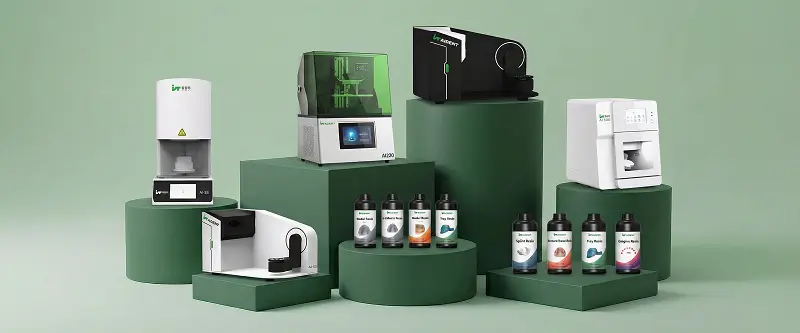
| Production open LCD / parallel light | Aident Ai220 class | 220 × 125 × 150 mm | Labs needing large batch capacity with open files and accessible entry | Less brand recognition in some markets than the above |
| Industrial / specialized | Rapid Shape D-series, HeyGears, LuxCreo (direct-print) | High throughput or direct aligner capability | Very high-volume or direct-print focused operations | Higher investment and specialized workflows |
| Budget large LCD | Various consumer-grade large-format machines | Often large volume at low hardware cost | Pure model testing on tight budgets | Greater need for parameter tuning and variable long-term support |
Note: Direct-print clear aligner systems (such as certain LuxCreo configurations) change the workflow entirely by eliminating thermoforming. They are excellent for labs or clinics committed to that specific path, but they are not interchangeable with traditional model printers.
Where the Aident Ai220 Fits Orthodontic Work
The Aident Ai220 is designed as a laboratory production machine. Relevant specifications include:
Build volume: 220 × 125 × 150 mm
Accuracy: ±0.03 mm
Light source: AI LED parallel light (aimed at uniform illumination across larger platforms)
Intelligent constant temperature control
Open system (STL / CTB)
Weight: 26 kg
Documented applications: dental models, orthodontic appliances, implant guides, and related work
In one publicly documented case from a Shenzhen dental lab that produces orthodontic models among other work:
Daily model output rose from 30+ to 70+
Batch capacity increased from 2–3 full-arch models to 6–8 per run
Delivery cycles shortened from 3–5 days to 1.5–2 days
Precision-related complaints dropped to zero during the observed period
These results are specific to that lab's volume, resins, and workflow. They illustrate what a large-platform open system can deliver when parameters are properly set, but they should be treated as one data point rather than a universal guarantee.
The parallel light source and temperature control are particularly relevant for orthodontic model work, where dimensional consistency across a full plate of models affects thermoforming quality and downstream fit.
Decision Framework for Orthodontic Labs
Measure your current peak demand
How many full-arch or equivalent models do you need to produce on the busiest days?
Calculate required nest density
Determine how many models you need per plate to meet turnaround targets without excessive machine count.
Decide on workflow type
Traditional model + thermoforming vs. direct-print aligners. The equipment choice diverges significantly here.
Evaluate openness vs. validation
Open systems offer resin cost flexibility and easier integration with existing scanners/CAD. Validated ecosystems reduce parameter work but can raise material costs.
Factor in total operating cost
Include resin, post-processing, technician time, failed prints, and support-not only the printer purchase price.
Test with real geometries
Request sample prints of your typical aligner models or study models whenever possible.
Practical Takeaway
There is no single best dental 3D printer for every orthodontic laboratory. The optimal choice depends on daily volume, whether you remain on the model + thermoforming path or move toward direct-print aligners, and how much you value material flexibility versus turnkey validation.
High-volume traditional model production often benefits from large-platform machines that deliver consistent accuracy across many models per plate.
Labs already invested in a major ecosystem may stay within that brand for software and material continuity.
Labs seeking open-file flexibility and strong batch capacity at a more accessible entry point frequently evaluate machines in the Ai220 class alongside better-known Formlabs, SprintRay, and Asiga options.
Direct-print specialist systems should be considered only if that specific workflow is a strategic priority.
For orthodontic labs focused on high-volume, accurate model production with efficient batching, large open-platform printers that maintain dimensional consistency remain a core requirement. Matching the machine's strengths to your actual daily output and resin strategy will produce better results than chasing the highest resolution or the most famous brand name.
If you can share approximate daily model volume, primary applications (aligner models vs. retainers vs. mixed), and whether you plan to stay with thermoforming, a more targeted shortlist can be refined.