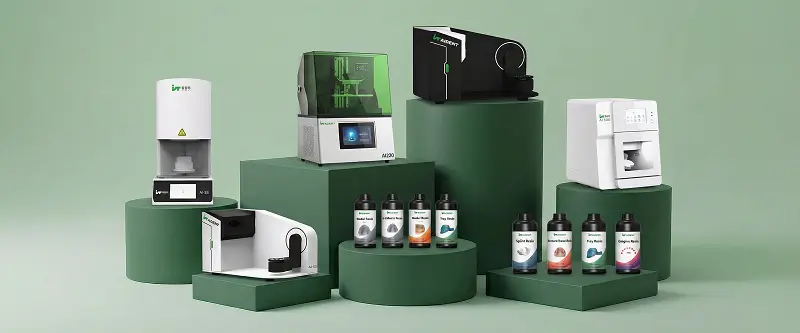
Not every resin 3D printer is suitable for dental work. While both dental and regular (general-purpose or consumer) 3D printers often use light-cured resin technology, they are designed with different priorities. Using a general-purpose machine for clinical or laboratory dental applications can lead to inconsistent results, workflow friction and regulatory issues.
This article explains the practical differences that matter to dental laboratories and clinics.
Why the Distinction Matters
Dental objects - models, surgical guides, temporary restorations, splints and orthodontic appliances - have tight requirements for dimensional accuracy, surface quality, fit and, in many cases, material safety. A printer optimized for hobby prototypes, figurines or general engineering parts is rarely engineered to meet these requirements consistently.
The differences appear in design intent, hardware features, material ecosystems, software, reliability expectations and documentation.
1. Purpose and Design Intent
Regular / general-purpose 3D printers are typically designed for prototyping, hobby use, education or general manufacturing. Priority is often placed on versatility, low entry price or large build volume for non-critical parts.
Dental 3D printers are designed specifically for the production of dental models and appliances. Priority is placed on accuracy, repeatability, surface detail, compatibility with dental resins, and integration into dental digital workflows.
2. Accuracy and Repeatability
Dental applications demand consistent dimensional accuracy across the build platform and from print to print. Small errors in a model or surgical guide can affect fit and clinical usability.
Dental printers are generally engineered and calibrated with these tolerances in mind. Features such as stable motion systems, uniform light distribution and automatic or assisted leveling are common. Regular printers may achieve good results on individual prints but often show greater variation across the platform or over time, which is problematic for dental work.
3. Materials and Biocompatibility
Regular printers usually run general-purpose resins chosen for ease of printing, color or basic mechanical properties. These resins are rarely tested or certified for dental use.
Dental printers are expected to work with resins formulated for specific indications: high-accuracy model resins, surgical-guide resins (often requiring biocompatibility and sterilization compatibility), temporary crown-and-bridge resins, castable resins and flexible materials for gingiva masks or certain appliances. Open-system dental printers give users access to a wider range of validated dental materials.
Using a non-dental resin for an intraoral or surgical application creates both performance and regulatory risk.
4. Software and Dental Workflow Integration
Dental printers are typically supplied with, or designed to work smoothly with, dental-oriented slicing profiles and file-handling practices. They accept standard STL files from dental CAD software and often include presets or guidance for common dental orientations and support strategies.
Regular printers may require more manual parameter development and lack optimized profiles for dental geometries. This increases the learning curve and the risk of failed or inaccurate prints.
5. Hardware Features and Reliability
Dental environments value features that reduce operator-dependent variation and support daily production:
Reliable auto-leveling or calibrated platforms
Temperature control for resin stability
Consistent light engine performance
Robust construction for repeated professional use
Regular printers vary widely. Many consumer models prioritize low cost and are not built for the duty cycle or consistency expected in a laboratory.
6. Regulatory and Documentation Aspects
In most markets, dental 3D printers and the resins used for patient-contact devices fall under medical-device regulations. Professional dental printers are more likely to be supplied with relevant documentation (for example CE marking under MDR for the equipment, and appropriate material certifications for resins).
General-purpose printers usually carry no such documentation and are not intended for regulated dental applications.
7. Cost Structure and Total Cost of Ownership
Regular printers often have a lower purchase price. However, when used for dental work they can generate higher hidden costs through failed prints, inconsistent results, limited material options, higher labor time for parameter tuning, and lack of professional support.
Dental printers typically cost more upfront but are designed to deliver more predictable results, better material flexibility (in open systems), and support structures appropriate for professional users. Total cost of ownership should be evaluated over equipment life, including resins, maintenance, failures and labor.
Side-by-Side Summary Table
| Aspect | Dental 3D Printer | Regular / General-Purpose 3D Printer |
|---|---|---|
| Primary design intent | Dental models, guides, appliances | Prototypes, hobby, general parts |
| Accuracy & repeatability | Optimized for dental tolerances | Variable; often less consistent |
| Resin ecosystem | Dental-specific, often open or validated | General-purpose resins |
| Biocompatibility pathway | Supported with appropriate resins | Generally not intended |
| Software / workflow | Dental CAD and slicing orientation | Generic; more manual tuning |
| Key hardware features | Auto-leveling, temperature control, stability | Varies widely; often basic |
| Regulatory documentation | More likely to include relevant certificates | Usually none for medical/dental use |
| Professional support | Expected for laboratory/clinic users | Limited or community-based |
| Typical purchase price | Higher | Lower |
| Suitability for daily dental production | Designed for this purpose | Generally not recommended |
When a Regular Printer Might Still Be Used
Some laboratories or educational settings use general-purpose resin printers for non-critical models, teaching, or early experimentation. This can be acceptable when:
The objects are not patient-contact devices
Accuracy requirements are modest
The user accepts higher process variability and manual optimization
No regulatory documentation is required
For production of surgical guides, temporary restorations, high-accuracy models or any regulated indication, a dental-specific printer is the appropriate choice.
FAQ
Can I use a regular resin printer with dental resins?
Sometimes the hardware can run the resin, but accuracy, light uniformity, temperature stability and validated parameters may be insufficient. The combination is rarely optimal for professional dental work.
Is resolution (e.g., 4K or 8K) the main difference?
No. Resolution is only one factor. Uniformity of light, mechanical stability, calibration, software and material compatibility often matter more for dental results.
Are dental printers only for laboratories?
No. Many compact dental printers are designed for chairside or small-clinic use as well as laboratory production.
Do dental printers require special training?
Yes. Operators need to understand orientation, support strategies, resin handling, washing, post-curing and basic maintenance. Good manufacturers provide application-oriented training and documentation.
Is an open-system dental printer better than a closed one?
Open systems generally offer greater material choice and flexibility. Closed systems can simplify validation for specific indications. The better choice depends on the user's priorities.
Next Steps
When choosing equipment, match the printer to the actual applications you intend to produce and to the level of consistency and documentation your laboratory or clinic requires. Evaluating real dental sample prints is more informative than comparing specification sheets alone.
If you are comparing dental-specific 3D printers designed for laboratory or chairside use, you can review detailed product information or request technical discussion through the manufacturer's official channels.