Dental 3D printing has become a core part of modern digital dentistry. Clinics and laboratories use it to produce models, surgical guides, temporary restorations, orthodontic appliances, and more - often in hours instead of days. The quality of the final result depends heavily on choosing the right dental 3D printing materials (primarily specialized photopolymer resins).
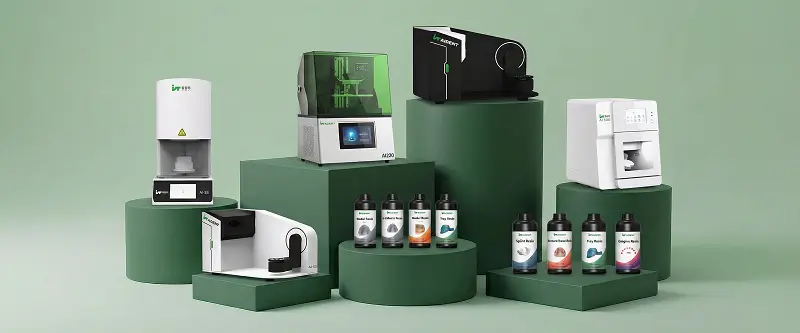
At Aident3D, we focus on open-system, high-performance resins that work seamlessly with our Ai-C60 and Ai220 dental 3D printers (and most open LCD/DLP systems). These materials are formulated for accuracy, dimensional stability, speed, and clinical safety so that the complete Scan → Design → Print workflow delivers predictable results.
Main Categories of Dental 3D Printing Materials
Dental resins are generally grouped by application. Here is a clear breakdown of the most common types and how they are used in practice.
1. High-Precision Model Resins (Diagnostic & Working Models)
These are the workhorses of both clinics and labs.
Typical uses
Diagnostic and study models
Crown & bridge working models
Orthodontic setups and clear-aligner models
Implant planning models
Key requirements
High dimensional accuracy, low shrinkage/warpage, good surface hardness, and stable performance after curing.
Aident recommendation
Model UV / HP Series / Model V2.0 high-precision model resins. These deliver excellent detail reproduction, low warpage (<0.4% in typical use), matte stone-like surface finish, and fast print & cure times. Full-arch models can be produced efficiently on the Ai-C60, supporting same-day or next-day workflows.
2. Biocompatible Surgical Guide Resins
Surgical guides demand high rigidity, transparency (for visual confirmation), and short-term oral biocompatibility.
Typical uses
Implant surgical guides
Gingival and bone reduction guides
Orthodontic bracket placement guides
Key requirements
Rigidity, dimensional stability under autoclave or disinfection, and compliance with biocompatibility standards (ISO 10993 / CE).
Aident offers biocompatible guide resins optimized for rigid, accurate guides that fit well and maintain position during surgery. When paired with the AI-30 intraoral scanner data and open CAD design, the printed guides support predictable implant placement.
3. Temporary / Provisional Crown & Bridge Resins
These materials restore function and aesthetics while the final restoration is being fabricated.
Typical uses
Temporary crowns and bridges
Try-in restorations
Short-term functional provisionals
Key requirements
Good flexural strength, wear resistance, polishability, shade options, and biocompatibility for temporary intraoral use.
Aident provisional / temporary resins are designed for chairside same-day printing. They offer realistic shade options, adequate strength for short-term function, and smooth surfaces after simple post-processing - ideal for the Ai-C60 chairside workflow.
4. Castable / Wax Resins (Lost-Wax Casting & Pressing)
These resins burn out cleanly with very low ash residue, making them suitable for traditional casting or ceramic pressing.
Typical uses
Crowns, bridges, and frameworks for metal casting
Patterns for ceramic pressing
Key requirements
Clean burnout, dimensional accuracy, and consistent performance across batches.
Aident high-temperature / castable (wax) resins are formulated for reliable burnout cycles and precise margins, helping labs reduce casting defects.
5. Specialized Resins
Gingiva / Soft-Tissue Resin - Flexible pink resin that mimics natural gum tissue for realistic hybrid models (especially useful for implant and full-arch cases). Aident's gingiva resin has obtained CE certification.
Tray Resin - For custom impression trays with good strength and dimensional stability.
Orthodontic / Retainer-related resins - For models that withstand thermoforming and for certain appliances.
Matching Materials with the Right Equipment
Material performance is only as good as the printer and process control.
Aident's recommended pairing:
Ai-C60 - High-precision LCD printer ideal for clinics and mid-volume labs (accuracy <0.03 mm, auto-leveling, built-in curing capability, open resin system).
Ai220 - Larger build volume for high-throughput laboratories that need to print multiple models, guides, or retainers in one run.
Because Aident systems are open, validated resins print reliably, and users can also test other high-quality third-party dental resins when needed. Proper temperature control, calibrated exposure settings, and correct post-curing (washing + UV curing) are essential for consistent results.
Why Material Choice Matters in the Full Digital Workflow
| Application | Recommended Material Type | Main Benefit with Aident Workflow |
|---|---|---|
| Diagnostic models | High-precision model resin | Fast, accurate, low warpage |
| Surgical guides | Biocompatible guide resin | Rigid fit + predictable implant positioning |
| Temporary restorations | Provisional resin | Same-day delivery, good aesthetics & strength |
| Clear aligner models | High-stability model resin | Withstands thermoforming with minimal deformation |
| Casting patterns | Castable / wax resin | Clean burnout, precise margins |
| Soft-tissue models | Gingiva resin | Realistic presentation for patients & planning |
When the AI-30 intraoral scanner (powder-free, ≤10 μm, true color) feeds open STL/PLY/OBJ files into CAD and then into an Aident printer running matched resins, clinics and labs typically see:
Shorter turnaround (half a day vs. multi-day traditional cycles)
Lower remake rates
Better patient experience and higher case acceptance
Reduced material waste and shipping costs
Conclusion
The right dental 3D printing materials turn digital designs into clinically useful parts. High-precision model resins, biocompatible surgical guide resins, temporary restoration resins, castable resins, and specialized options such as gingiva resin each serve a specific role. Choosing materials that are validated for accuracy, stability, and safety - and pairing them with a reliable open-system printer - is the practical way to make digital dentistry efficient and profitable.
Aident3D provides a complete, open ecosystem: AI-30 intraoral scanner + Ai-C60/Ai220 printers + matched dental resins + simple software. This allows clinics and laboratories to move confidently from scan to finished model or temporary restoration.
Ready to select the right resins for your workflow or to test the full Scan → Design → Print solution?
Request a quote or technical consultation at Aident3D.com.
WhatsApp: +86 19311417410 | Email: dongjiahao@aident.cc