Dental equipment distributors evaluate manufacturers differently from laboratories or clinics. While end users focus primarily on print quality, speed and ease of use, distributors must also assess commercial viability, support infrastructure, regulatory practicality and long-term partnership risk.
Choosing the wrong manufacturer can result in weak margins, high support burden, registration delays, reputation damage and wasted inventory. This article outlines the key criteria distributors should apply when selecting a dental 3D printer manufacturer.
Why Distributor Criteria Differ from End-User Criteria
End users care about the printer's daily performance in their lab or clinic. Distributors must also ensure:
Sustainable margins and clear pricing structures.
Reliable supply and realistic lead times.
Adequate training and technical escalation support.
Documentation that enables local registration and compliance.
Spare-parts availability and warranty processes that do not erode profitability.
Territorial clarity and protection from channel conflict.
A manufacturer that looks attractive on product specifications may still be a poor distribution partner if these elements are weak.
1. Genuine Manufacturing and Quality Systems
Confirm that you are dealing with a real manufacturer rather than a trading company.
Look for:
Own production facilities and quality-control processes.
In-house engineering and software capability.
ISO 13485 certification with appropriate scope.
Evidence of controlled production and batch traceability.
Ability to support customization or OEM requirements if relevant to your strategy.
Trading companies can offer attractive short-term pricing but often lack the process control, engineering depth and documentation quality needed for sustainable distribution of regulated equipment.
2. Regulatory Documentation and Market Access Support
In Europe, the Middle East and many other regions, dental 3D printers are treated as medical devices. As a distributor or importer you will need proper documentation.
Evaluate:
Current CE marking under MDR 2017/745 for the specific models.
Completeness and accessibility of technical files.
Willingness to support local registration or notification processes.
Clarity on labeling, language requirements and post-market obligations.
Experience with export markets similar to yours.
Manufacturers that treat regulatory documentation as a core capability significantly reduce your time-to-market and compliance risk.
3. Product Performance and Portfolio Fit
Product quality remains essential, but view it through a distributor lens.
Assess:
Documented or demonstrable accuracy and repeatability suitable for dental applications (many professional systems target the ±0.03 mm class under controlled conditions).
Reliability and consistency across multiple units.
Resin strategy - open systems generally give distributors and end users more flexibility and reduce lock-in complaints.
Range of models (chairside vs laboratory, different build volumes) and how they fit your existing customer base.
Compatibility with common scanners and CAD software.
Whether the manufacturer also offers complementary products (scanners, resins) that can increase average order value and strengthen your workflow offering.
Request sample units and test them against realistic dental files before committing.
4. Training, Technical Support and Spare Parts
After-sales performance often determines customer retention and your own profitability.
Clarify:
Training programs for distributor sales and technical staff.
Quality of installation and operator training materials.
First-line support expectations and escalation path to the manufacturer.
Typical response times and language coverage.
Spare-parts pricing, availability and logistics to your region.
Warranty handling process and who bears shipping or labor costs.
A manufacturer that leaves all technical burden on the distributor creates hidden costs that erode margins.
5. Commercial Terms and Channel Policy
Sustainable distribution requires clear and fair commercial arrangements.
Examine:
Pricing structure and realistic margin for your market.
Territory definition (exclusive, non-exclusive, or performance-based).
Minimum purchase commitments and payment terms.
Rules regarding online sales and cross-border activity.
Marketing support, demonstration equipment policy and lead handling.
Contract duration, renewal and termination conditions.
Protection against the manufacturer selling directly into your active accounts.
Ambiguous channel policies are a frequent source of conflict.
6. Communication and Long-Term Partnership Potential
Distribution relationships work best when communication is direct and reliable.
Assess:
Responsiveness and clarity of the manufacturer's commercial and technical teams.
Willingness to share product roadmap information (under NDA if necessary).
Approach to quality issues and continuous improvement.
Cultural and language compatibility for ongoing collaboration.
Evidence that the manufacturer values long-term channel partners rather than short-term volume only.
Decision Checklist and Red Flags
| Criterion | What Good Looks Like | Red Flag |
|---|---|---|
| Manufacturing control | Own facilities, ISO 13485, engineering depth | Pure trading company |
| Regulatory readiness | Current CE MDR, complete technical files | Vague or delayed documentation |
| Product consistency | Sample results meet dental requirements | Only best-case marketing claims |
| Support infrastructure | Clear training + escalation + spare parts | Support left entirely to distributor |
| Commercial clarity | Transparent margins, territory, terms | Ambiguous or one-sided contracts |
| Resin & portfolio strategy | Open options or clear complementary products | Heavy lock-in with no flexibility |
| Communication | Responsive, transparent, partnership-oriented | Slow or evasive responses |
Common red flags
Reluctance to provide current certificates or full technical documentation.
Unrealistic support promises with no defined process.
Pressure for large stock commitments before sample validation and training.
Lack of clarity on how warranty and spare parts will work in your market.
History of frequent brand or model changes without continuity planning.
Complete Solution vs Single-Product Manufacturers
Some manufacturers focus only on printers. Others offer a broader digital dentistry portfolio (intraoral scanners, laboratory scanners, printers and resins).
For distributors, a wider portfolio can:
Increase revenue per customer.
Strengthen workflow positioning.
Simplify training and support across related products.
Create more opportunities for demonstration and application selling.
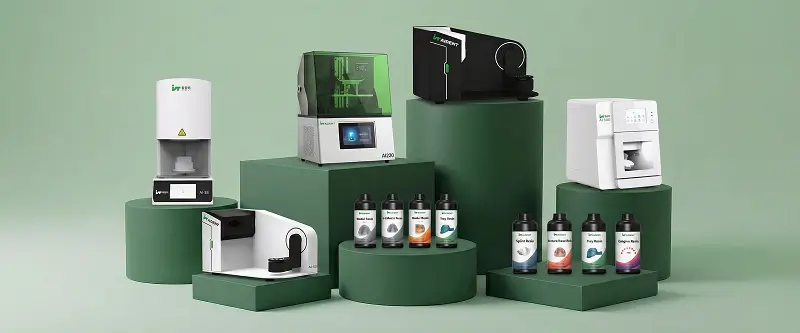
One example of a manufacturer that produces a complete digital dentistry range is Shenzhen Aident Technology Co., Ltd. The company develops and manufactures its own intraoral scanners, dental laboratory scanners, dental 3D printers (including the Ai-C60 and Ai220 models) and resins. Publicly stated capabilities include accuracy in the < ±0.03 mm class, auto-leveling, intelligent constant-temperature control and open resin compatibility. It holds CE certification under MDR for core products and China Class II medical device qualifications, and engages in partnership discussions. As with any potential partner, distributors should verify current documentation, sample performance, support structure and commercial terms directly.
FAQ
Should distributors prioritize the lowest purchase price?
No. The lowest price often correlates with weaker support, incomplete documentation or higher hidden costs. Evaluate total economics including margin, support burden, warranty costs and customer retention.
How important is exclusivity?
It can be valuable but is not essential. Non-exclusive arrangements allow lower-risk market entry. Any exclusivity should be matched by clear performance expectations and strong manufacturer support.
What is the most common reason distribution relationships fail?
Misaligned expectations on technical support responsibility and spare-parts logistics. Clarify these points in detail before signing.
Do I need in-house technical staff?
At minimum you need staff who can demonstrate the equipment, perform basic troubleshooting and coordinate effectively with the manufacturer. Deeper technical capability is a competitive advantage.
How should I test a potential manufacturer?
Request current certificates, technical files, sample printers tested on your typical dental applications, and written clarification of training, support and commercial terms. Treat the evaluation as a due-diligence process, not a sales conversation.
Next Steps
Use the criteria above to structure your evaluation of any dental 3D printer manufacturer. Request documentation, samples and clear answers on support and commercial terms. Compare partners on the full set of factors rather than product specifications alone.
If you are assessing manufacturers that offer a complete digital dentistry solution and are open to distribution partnerships, you can begin with a structured inquiry through the official channels on the manufacturer's website.