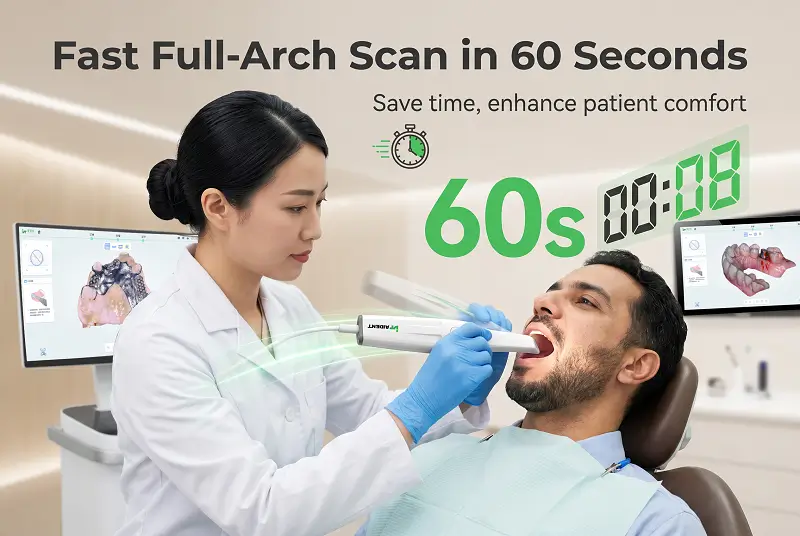
Not all scanner specifications are equally important.
At Aident Technology Co., Ltd., we help clinics and distributors focus on the specifications that actually affect daily performance, patient comfort, and long-term value. Below is a clear guide to the specifications that matter most when buying an intraoral scanner in 2026.
1. Top Specifications That Matter Most
| Rank | Specification | Why It Matters | What to Look For |
|---|---|---|---|
| 1 | Accuracy (Trueness & Precision) | Determines fit of crowns, bridges, implants, and orthodontic appliances | ≤10–20 μm full-arch accuracy is the practical clinical standard |
| 2 | Weight & Ergonomics | Affects operator fatigue during full-arch and multi-case days | Under 200–220 g is significantly more comfortable for long sessions |
| 3 | Scanning Speed / Frame Rate | Impacts chair time and patient experience | ≥30 fps enables fast, smooth scanning |
| 4 | Depth of Field | Reduces the need for precise distance control and rescans | 15–25 mm depth of field makes scanning more forgiving |
| 5 | Powder-Free + True-Color | Improves patient comfort and clinical visualization | Powder-free is now expected; true-color helps communication |
| 6 | Anti-Fog Performance | Prevents interruptions during scanning | Effective built-in heating is essential |
| 7 | Software Usability & Update Policy | Affects learning curve and long-term cost | Easy-to-learn software + lifetime free updates is a major advantage |
| 8 | Open File Formats | Determines lab compatibility and workflow freedom | STL / PLY / OBJ export is the standard for open systems |
| 9 | Tip Size & Design | Influences patient comfort, especially for children and patients with limited opening | Smaller, rounded tips are generally preferred |
| 10 | Total Cost of Ownership | Includes software fees, tips, warranty, and maintenance | Low recurring costs improve long-term ROI |
2. Specifications Explained in Practical Terms
Accuracy
This is the foundation. High accuracy reduces remakes and adjustments. Look for reliable full-arch performance, not just single-unit numbers.
Weight
A difference of 50–100 g is very noticeable after 10–15 scans. Lightweight scanners reduce hand and wrist fatigue.
Scanning Speed
Faster frame rates help maintain tracking and shorten chair time, especially for full-arch and restless patients.
Depth of Field
A larger depth of field means the scanner is more tolerant of distance variation, making it easier for new users and faster overall.
Powder-Free True-Color + Anti-Fog
These features directly improve the daily experience for both the clinician and the patient.
Software & Open System
Even the best hardware is limited by poor software. Easy operation, useful AI tools, lifetime free updates, and open STL/PLY/OBJ export are critical for long-term satisfaction.
3. Specifications That Are Often Overemphasized
Extremely high marketing accuracy claims without full-arch context
Wireless vs wired (convenience vs reliability and weight - both can be valid)
Very large numbers of AI features that are rarely used in daily practice
Fancy colors or secondary functions that do not improve clinical results
Focus first on core scanning performance, ergonomics, software cost model, and openness.
4. How the AI-30 Performs on Key Specifications
| Specification | AI-30 Performance |
|---|---|
| Accuracy | ≤10 μm |
| Weight | Ultra-lightweight (approx. 198 g range depending on configuration) |
| Scanning Speed | ≥30 fps |
| Depth of Field | 20–25 mm |
| Imaging | Powder-free true-color with intelligent anti-fog |
| Software | AIDENT lScan - easy to learn, AI-assisted tools, lifetime free upgrades |
| File Formats | Fully open: STL / PLY / OBJ |
| System | Designed for daily clinical reliability and low total cost of ownership |
5. FAQ from Our Team
Q: What is the single most important specification?
A: Accuracy combined with consistent real-world performance. Without reliable accuracy, other features lose value.
Q: Is weight really that important?
A: Yes. Clinics that scan many cases per day notice the difference in operator comfort very quickly.
Q: Should I prioritize wireless?
A: Wireless offers convenience, but wired systems can be lighter, more stable, and free from battery concerns. Choose according to your workflow priority.
Q: How important are free software updates?
A: Very important. Recurring software fees significantly increase the five-year cost of many scanners.
Q: What should distributors focus on most?
A: A balance of clinical reliability, low total cost of ownership for clinics, healthy margins, and strong manufacturer support.
Final Recommendation
When buying an intraoral scanner, prioritize:
Proven accuracy
Comfortable weight and ergonomics
Fast, stable scanning (speed + depth of field + anti-fog)
Easy software with low or zero recurring fees
Fully open file export
These factors have the greatest impact on daily use, patient experience, and long-term value.
We are Aident Technology Co., Ltd., based in Shenzhen, China. The AI-30 is designed around these practical priorities and is CE-certified for clinical use.
Want a detailed specification comparison or a live demonstration of the AI-30?
Contact us:
Full technical specifications
Live remote demo
Distributor or clinic pricing
OEM / private-label options
WhatsApp: +86 193 1141 7410
Email: dongjiahao@aident.cc