The Impact of the Digital Ecosystem on the Denture Processing Industry
Who would have imagined that the denture processing industry-once entirely dependent on "craftsmanship"-has been completely rewritten by the digital ecosystem? In the past, denture fabrication was synonymous with "slow work produces fine products." Technicians spent hours carving and polishing by hand, a process that was time-consuming, labor-intensive, and frequently led to remakes due to manual errors.
Today, the full penetration of digital technology has transformed every link-from impression taking to final delivery, from quality control to service models-fundamentally redefining the industry.
1. The Most Immediate Impact: Three Core Changes That Eliminate Traditional Processing Pain Points
Intraoral scanning becomes mainstream, model-free production doubles efficiency without compromise One-minute acquisition of micron-level oral data is gradually eliminating traditional plaster impressions. This reduces patient discomfort from bite registration and avoids the risks of model damage or deformation during shipping. After scanning in the clinic, data can be uploaded to the cloud in seconds. The laboratory no longer waits for physical models to arrive, realizing true "data travels, products arrive"-dramatically cutting logistics and time costs.
Digital production lines can mill a single crown in 16 minutes. Under traditional methods, hand-carving a single crown took several hours, with typical delivery cycles of 7–14 days. Now the entire process can be completed in 24–48 hours; single crowns can even achieve same-day scanning, fabrication, and seating. This greatly improves clinic efficiency and patient satisfaction.
Quality shifts from "relying on experience" to "relying on systems," remake rates drop sharply CAD/CAM intelligent design + 3D printing / CNC milling, combined with AI quality inspection, strictly controls restoration errors within 0.1–0.2 mm. This thoroughly solves the problems of uneven precision and poor marginal fit caused by traditional manual waxing, carving, and casting. AI inspection can automatically identify surface defects and dimensional deviations; technicians only need to perform secondary review, significantly reducing human inspection errors while improving efficiency.
Costs become controllable and prices more transparent Digital production not only raises efficiency and quality but also effectively controls costs, making pricing more transparent. 3D printing achieves material utilization rates above 95% and reduces waste by more than 80%, completely changing the high-consumption, high-waste nature of traditional milling. Automation replaces large amounts of manual labor, substantially lowering labor costs-especially advantageous for batch orders.
Digital factories with fully digital production lines have halved the cost of core product categories, greatly improving the cost-performance of domestic zirconia crowns. They also support 24/7 "lights-out" production without continuous human supervision, solving the chronic industry pain of year-end order backlogs and delayed deliveries.
At the same time, industry restructuring accelerates: small manual workshops unable to afford digital equipment, software, and talent investment are gradually being eliminated, while leading digital factories and national cloud factories rapidly capture market share through technological, capacity, and cost advantages. Industry concentration continues to rise.
2. Beyond Production: Digitalization Connects the Entire Industry Chain into an Ecosystem Closed Loop
Today's digital denture processing is no longer merely a technological upgrade of a single production step. It has formed a full-chain collaborative ecosystem of "clinic → design center → factory → patient," breaking the traditional "each fights alone" barriers and enabling efficient upstream–downstream linkage.
Cloud collaboration National digital service platforms enable global remote ordering and real-time data synchronization. Systems intelligently assign orders to the nearest factory based on type and delivery requirements, responding to clinics worldwide 24 hours a day. Even remote clinics can access efficient, precise denture processing services.
Upstream–downstream integration Equipment manufacturers (intraoral scanners, milling machines, 3D printers), material suppliers (zirconia blocks, resins), and software providers (CAD/CAM design software, cloud management systems) are deeply bound, forming a collaborative ecosystem. Digitalization runs through every step-from material procurement and equipment calibration to software upgrades-ensuring smooth production while driving industry standardization.
Service upgrade Traditional laboratories only performed "job shop" processing. Increasingly, digital factories are transforming into one-stop partners that provide clinics with intraoral scanning technical support, remote design optimization, technician training, and chairside restoration solutions. Laboratories are no longer just "behind-the-scenes producers" but have become technical partners to dental clinics, generating not only processing fees but also high-value technical service revenue.
3. Conclusion
The digital ecosystem is no longer an optional choice-it has become the survival line of the denture processing industry. It delivers higher efficiency, more stable quality, and lower costs, while enabling the industry to leave behind the chaos of small-workshop competition and move toward standardized, scaled, and regulated development.
For dental clinics, digital denture processing means shorter delivery cycles and more consistent product quality, effectively improving treatment efficiency and patient reputation.
For laboratories, embracing digitalization means embracing survival and growth opportunities. Enterprises that proactively build digital capabilities and core competitiveness are seizing market advantages, while those that cling to traditional manual methods and refuse to upgrade will ultimately be eliminated by the times.
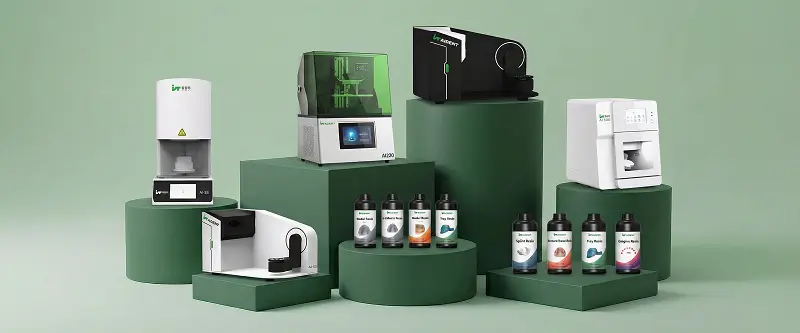
Build your digital competitive edge with a complete, open workflow. Aident Technology provides high-precision intraoral scanners (AI-30, true 10 μm accuracy, powder-free true-color) and dental 3D printers that integrate seamlessly into modern digital laboratory and clinic ecosystems. Open-system compatibility supports efficient data transfer, reduced remakes, and faster turnaround-helping both clinics and labs thrive in the digital era.
Explore our Intraoral Scanners, Dental 3D Printers, and complete Digital Dentistry Solutions.
Request a quote today and join the digital transformation that is redefining the future of denture processing.