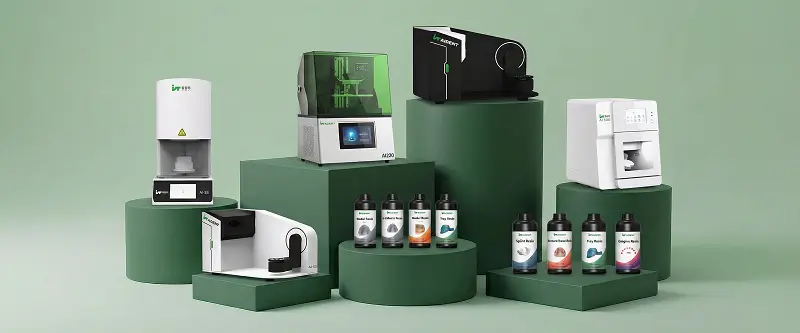
There is no single dental 3D printer that is best for every small laboratory. The right choice depends on your main applications, daily volume, available space, budget and the level of process control your team can maintain. What works well for a high-volume production lab is often oversized and unnecessarily complex for a smaller operation.
This guide focuses on the practical criteria small dental laboratories should use when selecting a 3D printer.
There Is No Universal "Best" – Match the Machine to Your Lab
Marketing lists that declare one model "the best" usually ignore differences in case mix and workflow. A better approach is to define your requirements first, then evaluate printers against those requirements.
What Defines a Small Dental Lab in This Context
For equipment selection purposes, a small dental lab typically has:
Moderate daily volume (for example, a limited number of models, guides or appliances per day rather than continuous high-throughput production)
Limited floor or bench space
A small technical team (often the same people handle design, printing and finishing)
Need for flexibility across several applications rather than extreme specialization
Sensitivity to both initial investment and ongoing material costs
If this describes your situation, prioritize reliability, ease of use, material flexibility and reasonable platform size over maximum throughput.
Key Selection Criteria for Small Laboratories
1. Accuracy and Consistency
Look for demonstrated accuracy suitable for dental models and guides (many professional systems target the ±0.03 mm class under controlled conditions). Consistency across the build platform and from day to day matters more than peak resolution numbers.
2. Appropriate Build Volume
A moderately sized platform that can handle a realistic daily batch is usually better than a very large platform that runs half-empty. Compact or mid-size systems reduce space requirements and can still produce multiple models or guides in one run.
3. Open Resin Compatibility
Open or semi-open systems give small labs more freedom to choose resins according to indication and cost. This flexibility is especially valuable when volume does not justify locking into a single material supplier.
4. Ease of Operation
Features such as reliable auto-leveling and straightforward software reduce the time and skill needed for daily setup. When the same technician handles multiple tasks, simplicity has direct productivity value.
5. Reliable Support and Spare Parts
Small labs rarely have dedicated equipment engineers. Clear training, responsive technical support and reasonable spare-parts availability are essential.
6. Total Cost of Ownership
Consider equipment price, required wash and cure units, resin cost, maintenance and staff time. A moderately priced open-system printer often delivers better long-term economics than a cheaper machine with limited material options or higher failure rates.
Compact vs Larger Platforms
| Lab Situation | Platform Tendency | Reason |
|---|---|---|
| Low-to-moderate daily model/guide volume | Compact or mid-size | Better space efficiency and lower idle capacity |
| Occasional larger batches or mixed applications | Mid-size | Balance between capacity and footprint |
| Rapid growth expected toward higher volume | Consider a more productive mid-to-large platform | Avoid early replacement |
Most small labs are better served by a well-chosen compact or mid-size dental printer than by the largest available machine.
Open Resin Systems vs Closed Systems
For small laboratories, open systems generally offer:
Greater choice of model, guide, temporary and specialty resins
Better ability to control material costs
Flexibility to adapt as new indications are added
Closed systems can simplify validation for a narrow set of applications but reduce long-term options. Unless you have a specific reason to stay within one validated ecosystem, an open approach is usually more practical.
Essential Features That Matter Most
Prioritize:
Proven accuracy on dental geometries
Auto-leveling or simple, reliable calibration
Stable temperature control (where offered)
Good light uniformity across the platform
Straightforward slicing and dental-oriented workflows
Solid documentation and accessible technical support
Secondary features can be evaluated after these fundamentals are satisfied.
Practical Evaluation Approach
List your top applications and realistic daily/weekly volume.
Measure available space and decide on maximum acceptable footprint.
Shortlist dental-specific printers (not general-purpose machines) that match your volume and space.
Request sample prints of your typical objects.
Test software workflow with the people who will actually use it.
Confirm training, support response expectations and spare-parts logistics for your region.
Calculate total cost of ownership for your expected volume.
Only then compare commercial terms.
Next Steps – How to Move Forward
The most suitable printer for a small dental lab is the one that reliably covers your main applications, fits your space and team, and keeps operating costs predictable.
Ready to evaluate options for a small laboratory?
You can request current technical specifications, certificate information, sample print evaluation, or advice on suitable configurations.
Submit your requirements here: https://www.aident3d.com/inquiry
WhatsApp: +86 19311417410
Email: dongjiahao@aident.cc
Please include your main applications, approximate daily volume, available space and target market so the response can be relevant to your situation.
FAQ
Is a compact printer accurate enough for surgical guides?
Many compact professional dental printers can produce accurate guides when the complete process (design, parameters, resin, post-curing) is properly controlled. Always validate with your own files and chosen resin.
Should a small lab buy the cheapest available dental printer?
Not if it compromises accuracy, reliability or material flexibility. Total cost of ownership and consistent results matter more than the lowest purchase price.
Can one printer handle models, guides and temporaries in a small lab?
Yes, provided it supports the necessary resins and the team follows validated parameters for each application. Start with your highest-volume indication and expand once the process is stable.
How important is auto-leveling for a small team?
Very useful. It reduces setup time and variation when the same people handle multiple roles.
Do small labs need a full laboratory-scale system?
Usually not. A well-chosen compact or mid-size dental printer is often the more practical and economical choice.