Immediate implant placement places high demands on accuracy, speed, and predictability. Traditional freehand approaches or delayed protocols often involve multiple visits, higher risk of positional errors, and longer periods without a functional or aesthetic temporary. In 2026, the integration of 3D scanning and 3D printing has become a reliable way for clinics to improve surgical precision, shorten treatment time, and enhance patient satisfaction in immediate implant cases.
This article outlines how digital scanning and printing work together in immediate implantology, the clinical benefits, and how an open digital workflow supports consistent results.
Clinical Challenges in Immediate Implant Placement
Immediate implant procedures require:
Precise three-dimensional positioning relative to the extraction socket and surrounding anatomy
Accurate surgical guidance to protect critical structures
Rapid fabrication of temporary restorations for aesthetics and soft-tissue support
Minimal chair time and fewer appointments to improve patient acceptance
Conventional methods relying on physical impressions, stone models, and manual guide fabrication introduce cumulative errors and delays. Digital technologies address these limitations directly.
Role of 3D Scanning in Immediate Implant Cases
High-accuracy intraoral scanners capture the clinical situation in real time:
Pre-extraction or post-extraction digital impressions with detailed soft-tissue and hard-tissue information
Powder-free true-color scanning that records emergent profiles and adjacent teeth accurately
Fast full-arch or quadrant scans (typically completed in under a minute for many cases)
Open-format export (STL / PLY / OBJ) that integrates with implant planning and CAD software
When scan accuracy reaches ≤10 μm, the digital dataset provides a reliable foundation for virtual implant positioning and surgical guide design. Real-time visualization also allows immediate verification of critical areas before the patient leaves the chair, reducing the need for rescans.
Laboratory scanners can further digitize models or existing restorations when hybrid workflows are preferred.
Role of 3D Printing in Immediate Implantology
Once the digital plan is complete, dental 3D printers produce the physical components needed for surgery and provisionalization:
Surgical guides – Printed with biocompatible, high-precision resin for accurate implant positioning and angulation control
Diagnostic and working models – High-stability model resins for verification and laboratory communication
Temporary crowns and bridges – Aesthetic, functional provisionals that can be delivered on the day of surgery
Custom healing abutments or soft-tissue formers – When indicated for optimized emergence profiles
Modern dental 3D printers with auto-leveling, consistent temperature control, and open resin compatibility deliver dimensional accuracy typically within ±0.03 mm, supporting predictable fit of guides and temporaries.
The Integrated Scan → Design → Print Workflow
A practical digital sequence for immediate implants looks like this:
Scan – Capture the pre-operative or immediate post-extraction situation with an intraoral scanner.
Plan & Design – Import the open scan data into implant planning software and CAD software. Design the surgical guide and temporary restoration.
Print – Fabricate the guide and temporary on a dental 3D printer using appropriate biocompatible and model resins.
Surgery & Delivery – Use the printed guide for precise implant placement and deliver the temporary restoration the same day when clinically appropriate.
Because the entire chain uses the original high-accuracy digital dataset, cumulative error is minimized compared with traditional multi-step analog processes.
Clinical and Practice Benefits
Improved Surgical Precision
Digitally designed and printed surgical guides help control depth, angulation, and position, supporting more predictable implant placement even in immediate extraction sockets.
Reduced Chair Time and Fewer Visits
Pre-operative scanning and printing allow much of the preparatory work to be completed before the surgical appointment. Same-day temporary restorations eliminate additional visits for many patients.
Better Soft-Tissue Management
Accurate temporaries support the soft tissue from day one, contributing to improved aesthetic outcomes and patient comfort.
Lower Risk of Errors and Remakes
High-accuracy scan data and stable printed components reduce the frequency of adjustments and remakes that commonly occur with conventional methods.
Enhanced Patient Experience
Patients appreciate the reduced number of appointments, the comfort of digital scanning versus traditional impressions, and the ability to leave with a temporary restoration on the day of surgery.
Practical Considerations for Implementation
Start with straightforward single-tooth immediate implant cases before progressing to more complex full-arch situations.
Verify scan quality carefully, especially around the extraction site and adjacent teeth.
Use open-system equipment so scan data remains portable across planning software, design platforms, and printers.
Select resins specifically indicated for surgical guides and temporary restorations, and follow validated post-processing protocols.
Maintain clear communication between the clinical and design teams when any part of the workflow is outsourced.
How an Open Digital Ecosystem Supports Immediate Implantology
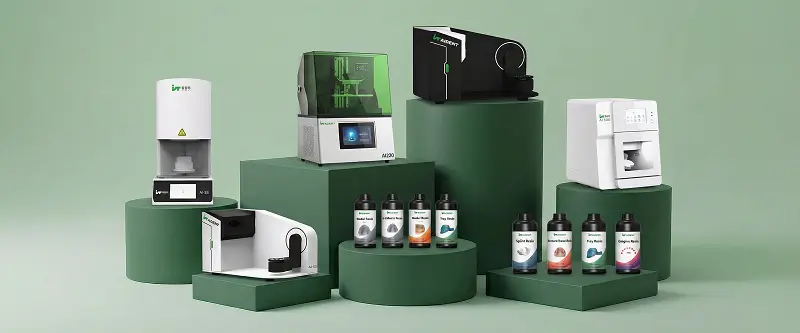
Scanners and printers that operate on open standards (STL / PLY / OBJ) give clinics maximum flexibility. High-accuracy intraoral scanners such as the Aident AI-30 provide the precise starting data, while compatible dental 3D printers (Ai-C60 or Ai220) and matched resins enable reliable in-house production of guides and temporaries. This combination supports both fully in-house digital workflows and hybrid collaboration with external design or manufacturing partners.
Conclusion
The combination of 3D scanning and 3D printing has moved immediate implantology from a technique-sensitive, multi-visit procedure toward a more predictable, efficient, and patient-friendly process. Accurate digital impressions form the foundation; precise 3D-printed guides and temporaries complete the clinical sequence.
Clinics that adopt this integrated digital approach typically achieve better positional control, shorter treatment timelines, and higher patient satisfaction.
Ready to bring digital precision into your immediate implant cases?
Explore Aident's complete digital dentistry solutions-AI-30 Intraoral Scanner, dental 3D printers, and specialized resins-at Aident3D.com. Request a quote, book a demonstration, or contact us via WhatsApp +86 19311417410 or email dongjiahao@aident.cc.