When clinics and laboratories evaluate digital dental equipment, hardware specifications often receive the most attention. Yet the software ecosystem frequently determines long-term cost, flexibility, and daily usability more than any single hardware feature.
In 2026, the market is clearly divided between open systems and more closed or subscription-driven platforms. Aident has deliberately chosen the open path. This article explains the practical differences and why they matter for your practice or laboratory.
The Two Main Ecosystem Models
1. Closed or Semi-Closed Ecosystems
Some premium brands tightly integrate their scanner, design software, manufacturing equipment, and cloud services. While this can create a smooth experience inside their own world, it often comes with limitations:
Restricted or paid file export
Mandatory or high-cost software subscriptions
Limited compatibility with third-party CAD or printers
Higher long-term switching costs
2. Fully Open Ecosystems
Open systems prioritize standard file formats and freedom of choice. Users can select the best CAD software, the most suitable printer, and the most cost-effective materials without being locked into one vendor's platform.
Aident belongs firmly in the second category.
How Aident's Software Ecosystem Works
Aident equipment is built around openness and practicality:
Standard file formats - Direct export of STL, PLY, and OBJ. No proprietary barriers.
Broad CAD compatibility - Seamless work with exocad, 3Shape, and other major design platforms.
Lifetime free software updates - AI-30 owners receive free software upgrades for the life of the device.
No mandatory subscriptions - Core scanning and basic workflow functions do not require ongoing paid plans.
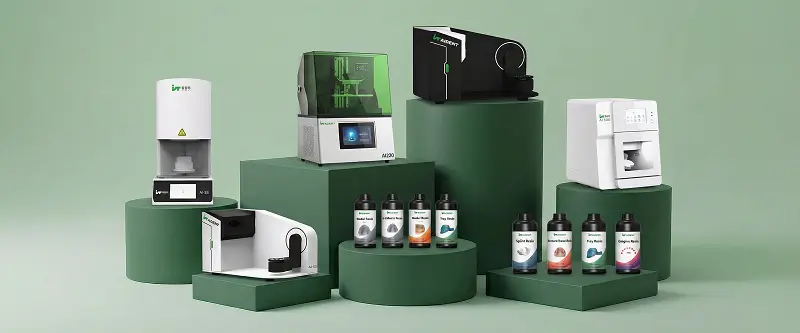
Open 3D printing - Ai-C60 and Ai-220 printers accept standard files and work with a wide range of 405 nm resins, including Aident's own validated materials and many third-party options.
Simple learning curve - AIDENT iScan software is designed so new assistants can become productive in 1–2 days. AI-assisted features (intelligent rescan, margin support) reduce operator dependency.
Side-by-Side Practical Differences
| Aspect | Typical Closed / Semi-Closed Systems | Aident Open Ecosystem |
|---|---|---|
| File Export | Often limited or paid | Free STL / PLY / OBJ |
| CAD Freedom | Prefer or require own software | Works with major third-party CAD |
| Software Subscriptions | Common and recurring | Core functions free; lifetime updates |
| Printer & Resin Flexibility | Often tied to brand materials | Fully open 405 nm compatibility |
| Long-term Cost | Higher due to subscriptions & lock-in | Lower and more predictable |
| Switching Cost | High | Low |
| Workflow Control | Vendor-defined | Clinic or lab defines its own flow |
Why Openness Matters in Daily Practice
Lower total cost of ownership
Avoiding mandatory subscriptions and proprietary material mark-ups keeps running costs predictable.
Future-proof flexibility
You can upgrade individual parts of your workflow (new CAD version, different printer, new resin) without replacing the entire system.
Easier multi-brand environments
Many clinics and labs already use mixed equipment. An open scanner and printer integrate more smoothly.
Faster staff onboarding
Simple, focused software reduces training time and dependency on highly specialized operators.
Better negotiation power
When you are not locked in, you retain the ability to choose the best price and performance for resins, design services, or additional equipment.
Real-World Implications for Clinics and Labs
Clinics that want same-day temporaries can scan with the AI-30, design in their preferred CAD, and print on an Ai-C60 without format conversion or extra fees.
Laboratories can receive open files from any clinic scanner and produce models or surgical guides on the Ai-220 with consistent accuracy.
Growing practices can expand capacity by adding printers or design seats without being forced into a single vendor's pricing structure.
Is a Closed Ecosystem Ever Better?
Closed systems can offer very polished, all-in-one experiences and deep feature integration - especially for users who prefer a single-vendor solution and are comfortable with the associated subscription model. For high-volume specialty workflows that stay entirely inside one brand, this can be attractive.
However, for the majority of general practices and mid-sized laboratories that value cost control, flexibility, and the ability to mix best-of-breed tools, an open ecosystem usually delivers better long-term results.
Conclusion: Freedom vs Lock-In
The software ecosystem is not a secondary detail - it is a strategic decision that affects your costs, workflow freedom, and ability to adapt for years to come.
Aident's approach is clear: deliver high-accuracy hardware (AI-30 scanner at 10 μm, Ai-C60/Ai-220 printers at ±0.03 mm) paired with a genuinely open software environment. No unnecessary barriers, no forced subscriptions for core functions, and full compatibility with the tools you already use or may want to use in the future.
Ready to Experience an Open Digital Workflow?
Next steps:
Request a live demonstration of the AI-30 scanning software and file export process
See how easily files move from scanner to your preferred CAD and then to an Aident printer
Discuss a complete open Scan → Design → Print setup tailored to your clinic or lab
Contact us today:
WhatsApp / Phone: +86 19311417410
Email: dongjiahao@aident.cc
Or leave a message at https://www.aident3d.com/contact-us
Choose an ecosystem that works for you - not one that locks you in.