Permanent restorations remain the gold standard of prosthodontic care. While direct 3D printing of final zirconia or ceramic crowns is an active area of research and early clinical adoption, the majority of high-quality permanent restorations in 2026 still rely on a hybrid digital workflow: accurate intraoral scanning → precise models or patterns → conventional or CAD/CAM final fabrication.
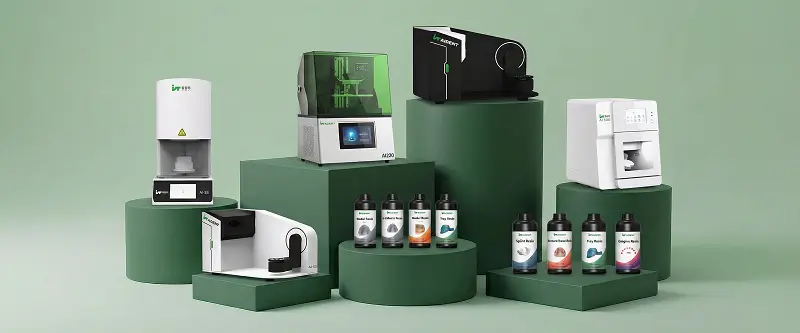
This article examines the current clinical reality, shows where 3D printing already delivers clear value in the permanent restoration pathway, and explains how Aident equipment supports prosthodontists and laboratories today.
Current Status of Direct 3D-Printed Permanent Restorations
Recent studies (including resin-matrix ceramic crowns) have reported promising short-to-medium-term survival rates in selected posterior cases. However, several practical limitations remain for routine permanent use:
Material strength, wear resistance, and long-term color stability are still being validated
Regulatory clearance and insurance acceptance vary by region
Post-processing and characterization requirements can be demanding
Most clinics and labs continue to prefer milled zirconia or pressed ceramics for definitive anterior and high-load restorations
As a result, the strongest and most widely adopted clinical use of 3D printing in prosthodontics today is in the supporting digital chain rather than the final permanent prosthesis itself.
Where 3D Printing Already Adds Clear Clinical Value
1. High-Precision Working Models
Accurate models are the foundation of well-fitting permanent restorations.
Aident High-Precision Model Resin + Ai-C60 / Ai-220 printers deliver ±0.03 mm accuracy and excellent dimensional stability, reducing the risk of fit errors that later appear in the final crown or bridge.
2. Try-In and Verification Prototypes
Printed try-in restorations allow clinicians to evaluate fit, occlusion, and esthetics before committing to the definitive prosthesis. This step significantly reduces remakes of expensive permanent restorations.
3. Temporary Crowns & Bridges (Provisional Stage)
High-quality 3D-printed temporaries (using Aident Temp C&B Resin) protect the preparation, maintain soft-tissue architecture, and allow functional and esthetic evaluation while the permanent restoration is being fabricated.
4. Castable Patterns
Castable / high-temperature resistant resins enable accurate lost-wax patterns for metal or pressed-ceramic permanent restorations, combining digital design precision with traditional final materials.
5. Surgical Guides for Implant-Supported Permanents
When the final restoration is implant-supported, accurate 3D-printed surgical guides (Aident Surgical Guide Resin, CE-certified) improve implant positioning, which directly benefits the long-term success of the permanent prosthesis.
Typical Clinical Workflow Supported by Aident Systems
Intraoral Scan - Aident AI-30 (10 μm accuracy, powder-free, true-color) captures precise preparation and soft-tissue data.
Digital Design - Open STL/PLY/OBJ files imported into the clinician's or lab's preferred CAD software.
3D Printing Support Structures - High-precision models, try-ins, temporaries, or castable patterns printed on Ai-C60 or Ai-220.
Final Permanent Restoration - Fabricated by milling, pressing, or casting using the accurate digital data and printed aids.
Delivery & Follow-up - Better initial fit reduces chairside adjustment time.
Clinical Benefits Observed in Practice
| Stage | Traditional Challenge | Digital + 3D Printing Advantage |
|---|---|---|
| Impression & Model | Distortion, voids, time-consuming | High accuracy, real-time verification |
| Provisional Phase | Multiple visits, variable quality | Same-day high-quality temporaries |
| Fit of Permanent | Higher adjustment / remake rate | Better models and try-ins reduce errors |
| Implant-Supported Cases | Positioning uncertainty | Precise surgical guides improve outcomes |
| Overall Efficiency | Long turnaround | Faster intermediate steps, fewer remakes |
Realistic Expectations for 2026
Direct 3D-printed permanent crowns are advancing rapidly and show encouraging early clinical data in selected indications.
For the majority of prosthodontic cases today, the highest clinical reliability still comes from combining accurate digital scanning and 3D-printed support elements with proven final materials (zirconia, lithium disilicate, etc.).
Clinics and labs that master the digital support workflow already achieve measurable reductions in remakes, adjustment time, and patient visits.
How Aident Fits into the Permanent Restoration Pathway
AI-30 Intraoral Scanner - Reliable, high-accuracy data capture
High-Precision Model Resin & Printers - Accurate working models
Temp C&B Resin - Esthetic and functional temporaries
Surgical Guide Resin - Precise implant positioning for implant-supported permanents
Castable / High-Temp Resins - Digital patterns for traditional final restorations
Fully open system - Compatible with major CAD and final fabrication methods
Conclusion
While direct 3D printing of permanent restorations continues to mature, the greatest clinical impact of 3D printing in prosthodontics right now lies in enabling more accurate, efficient, and predictable pathways to high-quality permanent restorations.
By combining a high-precision intraoral scanner with reliable 3D printing of models, try-ins, temporaries, and guides, prosthodontists and laboratories can significantly improve the quality and efficiency of their permanent restorative work today.
Ready to Optimize Your Permanent Restoration Workflow?
Next steps:
Discuss how the AI-30 + Ai-C60/Ai-220 combination can improve your model and provisional accuracy
Request information on High-Precision Model Resin, Temp C&B Resin, and Surgical Guide Resin
Explore an open digital workflow tailored to your prosthodontic cases
Contact us today:
WhatsApp / Phone: +86 19311417410
Email: dongjiahao@aident.cc
Or leave a message at https://www.aident3d.com/contact-us
Accurate data and reliable intermediate steps remain the foundation of excellent permanent restorations.