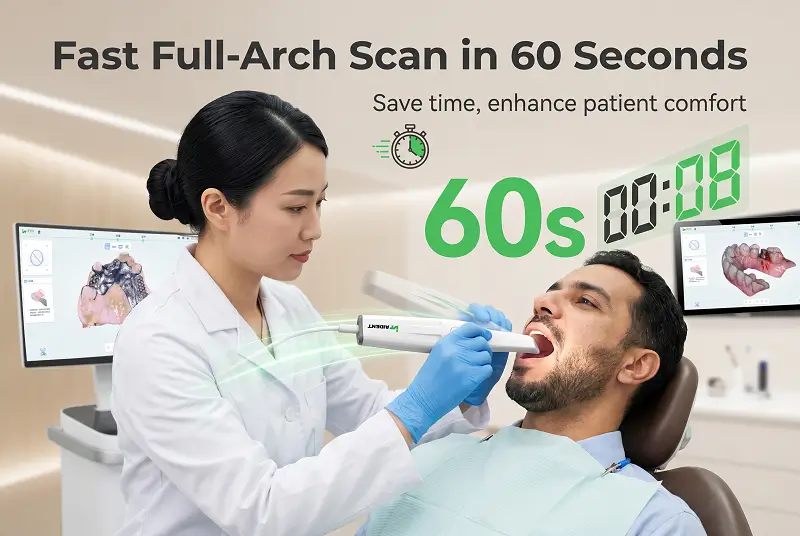
Dental laboratories do not typically scan inside the patient's mouth. That is the job of an intraoral scanner used in the clinic. However, laboratories are deeply affected by the quality of the digital impressions they receive. Clean data, accurate margins, open file formats, and consistent full-arch performance directly influence design time, fit, remake rates, and overall productivity.
This guide explains what laboratories should look for in intraoral scanner data and which characteristics make an intraoral scanner truly "lab-friendly" in 2026.
Quick Answer
The best intraoral scanners for dental laboratories are those that deliver:
High full-arch accuracy and stable margin capture
Native open formats (STL / PLY / OBJ) without restrictions
Minimal artifacts and good data density
Reliable performance on challenging cases (deep margins, implants, full arches)
Consistent results across different operators
Scanners that lock data into closed ecosystems or require extra conversion steps create friction for laboratories.
1. Intraoral Scanner vs Dental Lab Scanner - Clear Distinction
| Type | Where It Is Used | Primary Purpose | Typical Users |
|---|---|---|---|
| Intraoral Scanner | Inside the patient's mouth | Capture digital impressions directly | Clinics, dentists, hygienists |
| Dental Lab Scanner (Desktop) | Laboratory | Scan stone models, impressions, dies, implant analogs | Dental technicians, labs |
Laboratories need both: high-quality data coming from intraoral scanners, and efficient desktop scanners for the physical models and impressions they still receive.
2. What Dental Laboratories Actually Need from Intraoral Scanner Data
When a lab receives a digital impression, the priority is usable, predictable data:
Open and clean file formats
STL, PLY, or OBJ files that open directly in major CAD software (exocad, 3Shape, etc.) without proprietary conversion or fees.
Accurate margins and preparation geometry
Clear, continuous margin lines reduce manual correction time and improve restoration fit.
Stable full-arch performance
Many cases now involve longer spans or full-arch work. Drift or stitching errors create problems downstream.
Good data density and surface quality
Sufficient resolution without excessive noise or holes that require heavy post-processing.
Consistent results
Labs prefer scanners that different clinicians can use with predictable outcomes.
3. Key Criteria for a Lab-Friendly Intraoral Scanner
| Criterion | Why It Matters to Labs |
|---|---|
| Open system (STL/PLY/OBJ) | Avoids lock-in and extra steps |
| Full-arch accuracy | Reduces fit issues on multi-unit and implant cases |
| Margin capture quality | Less manual margin marking and correction |
| Low artifact rate | Faster design start, fewer requests for rescans |
| Powder-free reliable scanning | More consistent clinical data |
| Stable software & export | Predictable file quality over time |
4. How the Aident AI-30 Supports Laboratory Workflows
The Aident AI-30 is designed as an open-system intraoral scanner that prioritizes clean, usable data for downstream laboratory and design processes.
Verified characteristics relevant to labs:
Full-arch accuracy ≤10 μm
Open export formats: STL / PLY / OBJ
Powder-free operation with intelligent anti-fog
Depth of field 0–25 mm (helps with deeper preparations)
True-color rendering for better visual reference
Lifetime free software upgrades
Lightweight handpiece (198 g) that supports stable scanning technique
Because the system is fully open, laboratories can receive standard files and work in their preferred CAD environment without proprietary barriers.
5. The Complementary Role of a High-Performance Lab Scanner
Even as digital impressions increase, most laboratories still handle physical models, impressions, and implant cases that require desktop scanning.
Aident's dental lab scanner line (including models such as the AI-S3) focuses on:
High accuracy (better than 0.006 mm range on relevant models)
Fast full-arch scanning (approximately 10 seconds on tested configurations)
AI-assisted features for efficiency
True-color texture options
Reliable performance for daily high-volume use
A complete digital workflow often combines strong intraoral data from clinics with efficient desktop scanning and design/production inside the lab.
6. Practical Recommendations for Laboratories
Encourage partner clinics to use open-system intraoral scanners.
Provide clear guidelines on preferred file formats and scanning protocols.
Evaluate incoming digital impressions for margin quality and completeness.
Maintain a capable desktop lab scanner for physical models and hybrid cases.
Consider offering training or preferred scanner recommendations to key clinic partners.
FAQ
Do dental labs use intraoral scanners themselves?
Rarely for patient scanning. Labs primarily use desktop scanners. However, the quality of intraoral scanner data they receive has a major impact on their work.
What file format do most labs prefer?
Standard open formats such as STL, PLY, or OBJ that work directly in major CAD software.
Is higher accuracy always better for labs?
Higher and more consistent accuracy reduces adjustments and remakes, especially on multi-unit and implant cases. Extremely high brochure numbers matter less than reliable real-world performance.
Should labs recommend a specific intraoral scanner to clinics?
Many labs do. Recommending an open, reliable, easy-to-use scanner improves the quality of incoming data and reduces back-and-forth communication.
Does Aident offer solutions for both clinics and labs?
Yes. Aident provides intraoral scanners for clinics, high-precision dental lab scanners, dental 3D printers, and resins - supporting a complete Scan → Design → Print workflow.
Next Step
The most lab-friendly intraoral scanners are those that deliver accurate, open, and consistent digital impressions with minimal friction. When clinics and laboratories align on open systems and clear data standards, both sides benefit from faster turnaround and better-fitting restorations.
Interested in evaluating Aident solutions for your laboratory or clinic network?
Inquiry form: https://www.aident3d.com/inquiry
WhatsApp: +86 19311417410
Email: dongjiahao@aident.cc
Tell us whether you are a dental laboratory, a clinic that works closely with labs, or a distributor. We will provide relevant product information on the AI-30 intraoral scanner, dental lab scanners, and complete digital workflow options.