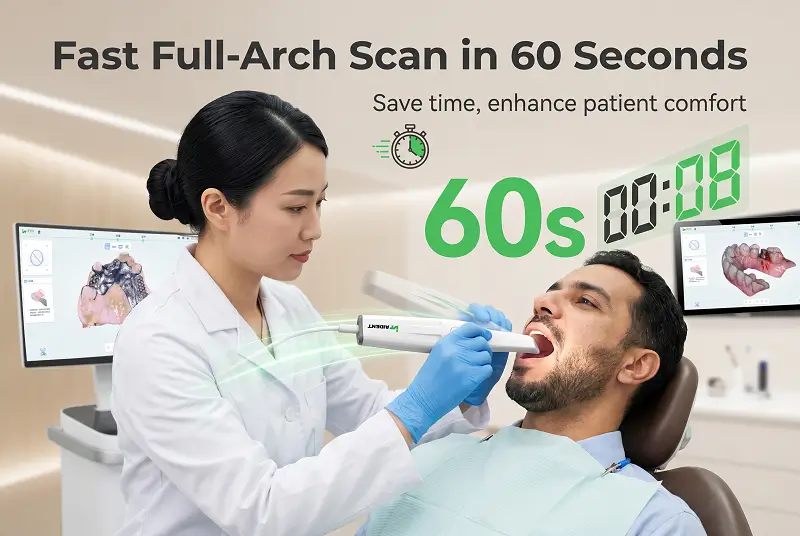
Intraoral scanner accuracy is one of the most discussed - and most misunderstood - topics in digital dentistry. Manufacturers often quote impressive figures such as ≤10 μm or ≤20 μm. Independent studies, however, show that real-world results vary depending on the scanner, the extent of the scan, clinical conditions, and operator technique.
This article explains what accuracy numbers mean, what current evidence shows, and how clinics and laboratories should interpret them in 2026.
Quick Answer
Modern intraoral scanners are highly accurate for single-unit and short-span restorations. Full-arch accuracy is more demanding and typically shows higher deviation than single-tooth scans.
Under controlled conditions, many current systems achieve full-arch trueness in the range of roughly 20–100 μm, which is considered clinically acceptable for a wide range of indications. Manufacturer claims of ≤10 μm usually refer to specific test protocols and should be understood in context.
1. Trueness vs Precision - The Two Components of Accuracy
| Term | Definition | Why It Matters |
|---|---|---|
| Trueness | How close the digital model is to the true geometry of the object | Affects how well the final restoration will fit |
| Precision | How repeatable the scanner is when scanning the same object multiple times | Affects consistency between operators and sessions |
| Accuracy | Combination of trueness and precision | Overall reliability of the digital impression |
A scanner can be very precise (highly repeatable) yet still show some systematic deviation from the true shape. Both values matter clinically.
2. Typical Accuracy Ranges in Current Evidence
Results from recent in-vitro and clinical studies (2024–2026) generally show:
Single-unit / quadrant scans: Often excellent, frequently under 30–50 μm deviation with leading systems.
Full-arch scans: More variable. Many systems fall in the 30–100 μm range for trueness depending on conditions.
Conventional impressions: High-quality traditional impressions can still show very low deviation in controlled tests, sometimes outperforming digital full-arch scans.
All major modern intraoral scanners are considered clinically acceptable for the majority of restorative, implant, and orthodontic applications when used correctly. Differences become more noticeable on long-span and full-arch cases.
3. What Affects Real-World Accuracy?
Several factors influence the final result beyond the scanner's optical hardware:
Scan extent
Full-arch scans accumulate more stitching error than single-tooth or quadrant scans.
Operator technique
Scanning strategy, speed, and consistency have a measurable impact. Experienced operators usually produce better data.
Clinical conditions
Moisture, blood, reflections from metal, patient movement, and deep subgingival margins all increase difficulty.
Software and algorithms
Stitching, filtering, and error-correction algorithms play a major role. Software updates can improve performance over time.
Depth of field and optical design
Larger depth of field and better handling of difficult surfaces reduce the need for constant repositioning and incomplete data.
Calibration and maintenance
Properly maintained scanners perform more consistently.
4. How to Interpret Manufacturer Accuracy Claims
When a manufacturer states "≤10 μm accuracy," it is important to understand the context:
Was the test single-unit or full-arch?
Was it performed on a dry model or in simulated clinical conditions?
Which measurement method and reference system were used?
Is the number trueness, precision, or a combined value?
Brochure numbers are useful for comparison but should not be treated as guaranteed clinical performance in every situation. Independent studies and real-user feedback provide important additional perspective.
5. Clinical Relevance - When Does Accuracy Matter Most?
| Clinical Situation | Accuracy Demand | Notes |
|---|---|---|
| Single crown | Moderate to high | Most modern scanners perform well |
| Short-span bridge | High | Good margin and contact accuracy needed |
| Full-arch / long-span | Higher | Error accumulation becomes more critical |
| Implant cases | High | Scan body geometry and soft tissue matter |
| Orthodontic models | Moderate | Speed and patient comfort often prioritized |
| Same-day restorations | High | Direct impact on fit and adjustments |
For everyday single-unit and short-span work, the differences between current mid-to-high-tier scanners are often smaller than marketing suggests. Full-arch and complex implant cases reveal differences more clearly.
6. Aident AI-30 Accuracy Profile
The Aident AI-30 is specified with full-arch accuracy ≤10 μm under the manufacturer's test conditions. Additional verified characteristics that support accurate data capture include:
Depth of field 0–25 mm
Scanning speed ≥30 fps
Powder-free operation with intelligent anti-fog
Lightweight handpiece (156–198 g) that aids stable handling
Open STL / PLY / OBJ export
These features are designed to help operators capture complete, usable data efficiently in daily clinical conditions.
FAQ
Is 10 μm accuracy realistic in the mouth?
Manufacturer specifications of ≤10 μm are typically achieved under controlled test conditions. Clinical full-arch results are often higher but still within acceptable limits for most indications when technique is good.
Are intraoral scanners more accurate than traditional impressions?
For single units and short spans, digital systems are generally comparable or superior in consistency. For full-arch cases, high-quality conventional impressions can still perform very well in some studies. Digital offers major advantages in speed, patient comfort, and data usability.
Does accuracy improve with software updates?
Yes. Algorithm improvements in stitching and filtering can enhance performance over the life of the device.
How can I get the best accuracy from my scanner?
Follow the recommended scanning strategy, maintain proper isolation, keep the scanner calibrated, and ensure the team is trained. Real-time feedback features help identify and correct incomplete areas immediately.
Should labs and clinics focus on the same accuracy numbers?
Clinics balance accuracy with speed and patient comfort. Laboratories focus heavily on margin quality, data completeness, and consistency for design and manufacturing.
Next Step
Intraoral scanners today are accurate enough for the large majority of restorative, implant, and orthodontic applications. The most important factors are choosing a reliable system, using proper technique, and understanding the difference between ideal test conditions and real clinical performance.
Want to evaluate the accuracy and handling of the Aident AI-30 in practice?
Request detailed specifications, sample data, or a live demonstration:
Inquiry form: https://www.aident3d.com/inquiry
WhatsApp: +86 19311417410
Email: dongjiahao@aident.cc
Tell us your main clinical applications and we will provide relevant technical information for clinics, laboratories, and distribution partners.