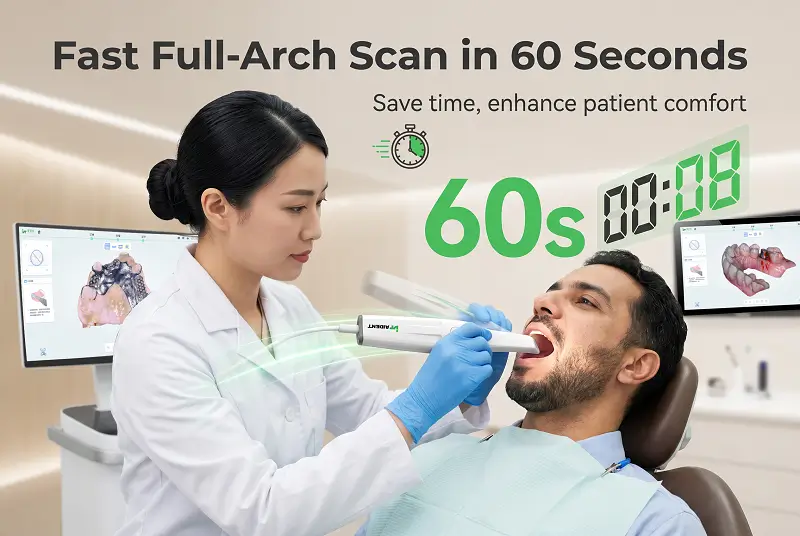
A modern clinical intraoral scanner can typically complete a full-arch scan in 30–60 seconds under normal conditions. High-performance devices with ≥30 frames per second and good depth of field often finish in under one minute. The Aident AI-30 Intraoral Scanner routinely delivers full-arch scans in approximately 20–60 seconds, combining ≥30 fps imaging with an ultra-lightweight handpiece and 0–25 mm depth of field for efficient, comfortable scanning.
Direct Answer
Full-arch scanning speed is measured in real chairside time (not just laboratory claims). In daily practice:
Most mid-to-high-end scanners complete a full arch in 30–90 seconds.
Well-optimized systems with ≥30 fps frequently achieve under 60 seconds.
Premium devices with higher frame rates and large fields of view can reach the 30–45 second range for experienced operators.
These times assume a cooperative patient, proper isolation, and standard technique. Actual results vary with operator skill, patient movement, and clinical conditions.
Realistic Full-Arch Scan Times (2026 Clinical Context)
| Scanner Performance Level | Typical Full-Arch Time | Frame Rate Range | Best Suited For |
|---|---|---|---|
| Entry-level | 60–120+ seconds | 15–25 fps | Simple single-unit cases |
| Clinical mid-to-high | 30–60 seconds | 25–40 fps | Daily restorative & orthodontic work |
| Premium high-end | 30–45 seconds | 50–70+ fps | High-volume clinics seeking maximum speed |
| Aident AI-30 | ≈20–60 seconds | ≥30 fps | Balanced speed, comfort & open workflow |
The Aident AI-30 is designed to sit firmly in the efficient clinical range while keeping the handpiece light (156–198 g) and the system fully open (STL/PLY/OBJ).
What Actually Determines Full-Arch Speed
Several factors influence real scanning time more than the raw fps number alone:
Frame rate (fps) – Higher rates provide smoother real-time feedback and fewer motion artifacts.
Depth of field – 20–25 mm reduces the need for multiple angles and rescans.
Field of view & tip design – Larger effective coverage shortens the path.
Anti-fog performance – Intelligent heating prevents interruptions.
Software intelligence – Real-time missing-area detection and stitching quality.
Operator technique – Consistent scanning path and speed.
Patient factors – Saliva control, mouth opening, and cooperation.
A scanner that claims very high fps but has a heavy handpiece or limited depth of field can still feel slow in practice.
Clinical Benefits of Fast Full-Arch Scanning
Reduced chair time and higher daily case volume
Improved patient comfort (less gagging, shorter mouth opening)
Better data consistency with less motion blur
Smoother transition into same-day design and 3D printing workflows
Speed only delivers value when accuracy and ease of use remain high.
How the Aident AI-30 Achieves Practical Full-Arch Speed
The Aident AI-30 Intraoral Scanner from Shenzhen Aident Technology Co., Ltd. is specified as follows:
Scanning speed: ≥30 frames per second
Full-arch scan time: approximately 20–60 seconds under typical clinical conditions
Weight: 156–198 g
Depth of field: 0–25 mm
Powder-free true-color scanning with intelligent anti-fog heating
Open export: STL / PLY / OBJ
Software: AIDENT lScan (lifetime free upgrades)
This combination allows clinics to complete full-arch scans efficiently while maintaining high patient and operator comfort. After working with distributors and clinics in multiple markets, we observe that balanced speed plus low weight and reliable anti-fog performance often produces higher real-world productivity than chasing the absolute highest frame rate.
Want to see real full-arch scan times with the AI-30?
Contact the Aident factory for demonstration videos, sample data, or a live clinical evaluation.
FAQ
How long does a full-arch scan normally take?
With a clinical-grade scanner, most experienced operators complete a full arch in 30–60 seconds. Entry-level devices may take longer.
Is under 60 seconds realistic for full-arch scanning?
Yes. Many modern scanners, including the Aident AI-30, routinely achieve this range when technique and conditions are good.
Does faster scanning reduce accuracy?
Not when the scanner has sufficient depth of field, good stitching algorithms, and real-time feedback. Excessive speed without proper technique can introduce errors, but balanced systems maintain clinical accuracy.
How does the Aident AI-30 compare on full-arch speed?
It delivers ≥30 fps and typical full-arch times of approximately 20–60 seconds, positioning it as an efficient clinical tool rather than a pure speed-focused premium device.
Can full-arch scans be done in under 30 seconds?
Some high-end systems can approach this with highly experienced operators and ideal conditions. For most clinics, consistent performance in the 30–60 second range is more practical and reliable.
Next Step for Clinics and Distributors
Request:
✓ Real full-arch scan demonstration videos of the AI-30
✓ Detailed specifications and test data
✓ Current distributor pricing
✓ OEM / ODM information
Shenzhen Aident Technology Co., Ltd. is ready to support your evaluation. Reach us through the inquiry form on aident3d.com or via WhatsApp.