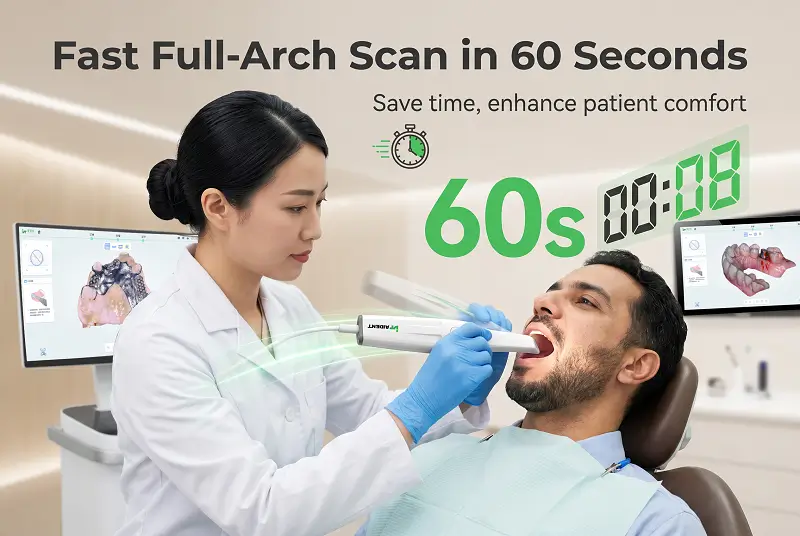
Modern intraoral scanners typically operate at 20–70 frames per second (fps). A clinical-grade speed of ≥30 fps allows most full-arch scans to be completed in under 60 seconds under normal conditions. The Aident AI-30 Intraoral Scanner delivers ≥30 frames per second and routinely completes a full arch in approximately 20–60 seconds, balancing speed, accuracy, and operator comfort for everyday clinic use.
Direct Answer
Scanning speed has two practical meanings:
Frame rate (fps) – how many images the scanner captures and processes every second.
Actual full-arch time – the real chairside time needed to obtain a complete, usable digital model.
Higher fps generally produces smoother real-time visualization and reduces the chance of motion artifacts, but field of view, software stitching, depth of field, and operator technique also strongly influence final scan time.
Typical Scanning Speeds in 2026
| Scanner Category | Typical Frame Rate | Approximate Full-Arch Time | Notes |
|---|---|---|---|
| Entry-level | 15–25 fps | 60–120+ seconds | Adequate for simple single units |
| Mid-to-high clinical | 25–40 fps | 30–60 seconds | Most common range for daily practice |
| Premium / high-end | 50–70+ fps | 30–45 seconds | Faster but often higher cost and ecosystem lock-in |
| Aident AI-30 | ≥30 fps | ≈20–60 seconds | Balanced speed + ultra-lightweight design |
Data from manufacturer specifications and clinical comparisons show that ≥30 fps is sufficient for efficient full-arch scanning in restorative, orthodontic, and implant workflows when paired with good depth of field and anti-fog technology.
Why Scanning Speed Matters Clinically
Patient comfort – shorter time in the mouth reduces gagging and fatigue, especially with children or anxious patients.
Operator efficiency – faster scans free up chair time and allow more cases per day.
Data quality – higher frame rates help the software stitch overlapping images more reliably and reduce motion blur.
Workflow impact – when combined with open STL/PLY/OBJ export, fast scanning supports same-day design and 3D printing.
Speed alone is not enough. A very high fps scanner with poor depth of field or heavy handpiece can still feel slow and tiring in real use.
Key Factors That Affect Real Scan Time
Operator experience and scanning path
Patient cooperation and saliva control
Tip size and field of view
Depth of field (0–25 mm helps reduce repositioning)
Anti-fog performance
Software intelligence (missing-area detection and real-time feedback)
How the Aident AI-30 Delivers Practical Speed
The Aident AI-30 Intraoral Scanner, manufactured by Shenzhen Aident Technology Co., Ltd., is specified as follows:
Scanning speed: ≥30 frames per second
Full-arch scan time: approximately 20–60 seconds under typical clinical conditions
Weight: 156–198 g (one of the lightest professional handpieces)
Depth of field: 0–25 mm
Powder-free true-color imaging with intelligent anti-fog heating
Open export formats: STL / PLY / OBJ
Software: AIDENT lScan with lifetime free upgrades
The combination of solid frame rate, large depth of field, and ultra-light design allows clinics to complete scans quickly without sacrificing comfort for either the patient or the operator.
After supporting distributors and clinics across multiple regions, we consistently see that balanced speed (around 30 fps) plus low handpiece weight and reliable anti-fog performance delivers higher daily productivity than chasing the absolute highest fps number alone.
Want to test the real scanning speed of the AI-30 in your clinic?
Contact the Aident factory for a product demonstration, sample scan videos, or current distributor pricing.
FAQ
Is 30 fps fast enough for a busy clinic?
Yes. ≥30 fps is widely regarded as clinical-grade performance and supports full-arch scans in under one minute for most operators.
Do higher fps scanners always scan faster?
Not necessarily. Field of view, software efficiency, and operator technique often have equal or greater impact on total chairside time.
How long does a full-arch scan take with the Aident AI-30?
Under normal clinical conditions, most users complete a full arch in approximately 20–60 seconds.
Does scanning speed affect accuracy?
Excessive speed without proper technique can increase stitching errors. A well-balanced system (30+ fps + good depth of field + real-time feedback) maintains accuracy while improving efficiency.
Is wireless scanning faster than wired?
Wireless offers more freedom of movement, but actual scan time depends more on fps, field of view, and software than on the cable itself. The AI-30 prioritizes stable high-speed data transfer with a lightweight wired design.
Next Step for Clinics and Distributors
Request:
✓ Detailed AI-30 scanning speed specifications and demonstration videos
✓ Distributor price list
✓ OEM / ODM information
✓ Live product demo or sample data
Shenzhen Aident Technology Co., Ltd. is ready to support your evaluation. Reach us through the inquiry form on aident3d.com or via WhatsApp.