Dental 3D printing has become a key direction in digital dentistry. With advantages in high precision, speed, personalization, and material diversity, it is widely applied in orthodontics, restorative dentistry, and implantology. As major companies continue to invest, the market is expanding rapidly and shows significant long-term growth potential.
1. 3D Printing: A Revolutionary Manufacturing Innovation
Technology Principle and Advantages
3D printing (additive manufacturing) builds physical objects layer by layer from digital models. Unlike traditional subtractive manufacturing that requires molds and generates significant waste, additive manufacturing reduces the need for tooling, lowers material waste, decreases inventory requirements, and improves production efficiency.
Main Technology Categories
Metal 3D printing: Techniques such as Selective Laser Melting (SLM) and Electron Beam Melting (EBM) use metal powders (e.g., titanium, cobalt-chrome) for high-performance medical and industrial parts.
Non-metal 3D printing: Includes Stereolithography (SLA), Digital Light Processing (DLP), LCD/MSLA, and Fused Deposition Modeling (FDM). These use resins, plastics, and ceramics and dominate most dental applications.
2. Global Industry Development and China's Progress
Global Development Stages
1980–1990: Technology research and early patents/prototypes
1990–2010: Commercialization led by companies such as 3D Systems and Stratasys
2010–present: Rapid expansion, mergers & acquisitions, and broader industrial adoption
China's Progress
China started later than Europe and the United States but has narrowed the gap significantly. University research began in the 1990s, followed by technical breakthroughs in SLA and SLS after 2000. Since 2016, the number of companies has grown rapidly, and domestic players have moved from technology accumulation toward commercialization, with applications expanding into aerospace and medical fields.
3. Dental 3D Printing: Precision Medicine in Practice
Technology Approach
Patient oral data is captured through digital scanning. Combined with CAD design and 3D printing, highly customized restorations and appliances are produced. In dentistry, non-metal processes (mainly SLA, DLP, and LCD) dominate, with photopolymer resins accounting for the majority of materials used. Metal powders are applied in selected high-strength cases.
Core Advantages
High precision and excellent marginal fit
Significantly shorter production cycles
True patient-specific customization
Support for multiple material types (resins, metals, ceramics)
4. Typical Application Scenarios
Crowns and bridges: Digital design + 3D printing (especially for temporary restorations and models) improves efficiency and consistency.
Dental models: High-accuracy resin models replace traditional plaster casts, reducing errors and enabling better digital workflows.
Orthodontics and implantology: Clear aligner models, surgical guides, and related appliances improve treatment predictability and patient comfort. 3D-printed surgical guides help clinicians place implants more accurately and reduce surgical risk.
5. Market Size and Growth Potential
According to industry data (SmarTech and related analyses), the global dental additive manufacturing market reached approximately USD 3.5 billion in 2021. Projections indicate the market could grow to around USD 9 billion by 2028, reflecting strong compound annual growth and substantial long-term opportunity.
6. Industry Landscape
International companies such as 3D Systems, Stratasys, and EOS continue to expand their dental portfolios through technology development and strategic moves. Domestic Chinese manufacturers are also accelerating R&D and commercialization, improving equipment precision and speed while helping reduce clinical adoption costs.
7. Challenges and Future Outlook
Current Challenges
Further improvement of material biocompatibility, long-term mechanical performance, and post-processing consistency
Greater standardization of digital workflows
Continued education of clinicians and patients to accelerate adoption
Future Trends
Integration of advanced materials, multi-material printing, and AI-assisted design is expected to make dental 3D printing even more efficient and intelligent, strengthening its role in precision oral healthcare.
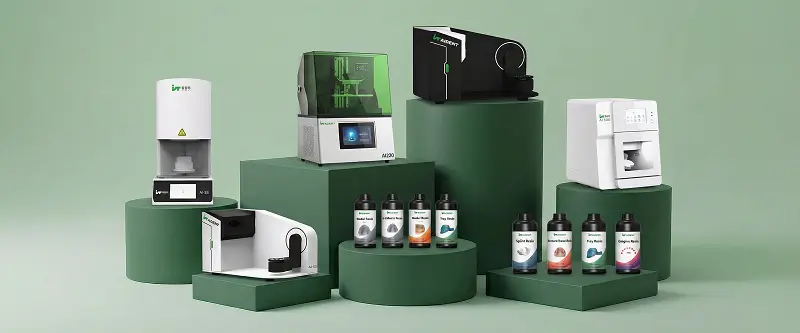
Aident3D Solutions for Digital Dentistry
At Aident3D (https://www.aident3d.com/), we focus on practical, high-performance solutions for clinics and laboratories:
High-accuracy intraoral and laboratory 3D scanners
Professional dental 3D printers optimized for models, surgical guides, and temporary restorations
A complete range of dental photopolymer resins
Our open systems help dental professionals capture the efficiency, precision, and personalization benefits of 3D printing while maintaining strong cost control and workflow reliability.
Ready to explore dental 3D printing solutions for your practice or laboratory?
Visit:
https://www.aident3d.com/dental-3d-printer/
https://www.aident3d.com/3d-scanner/
https://www.aident3d.com/dental-3d-printer/dental-3d-resin/
Contact us for technical consultation or ROI analysis:
https://www.aident3d.com/contact-us
https://www.aident3d.com/inquiry