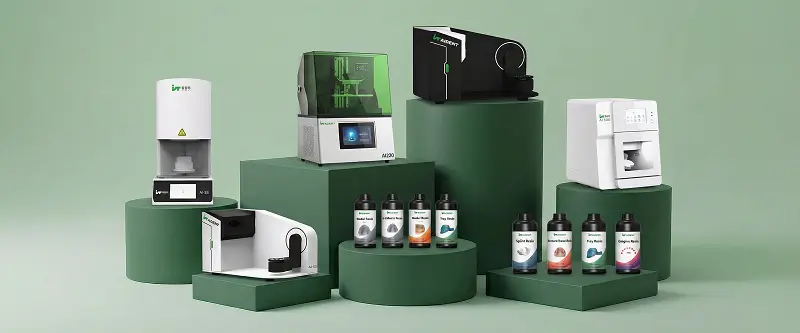
Light-curing 3D printing, also known as vat photopolymerization, is an advanced additive manufacturing process that uses UV light of specific wavelengths to solidify liquid photosensitive resin layer by layer, building precise three-dimensional objects. It is valued for high accuracy, relatively fast production speeds, and near-100% material utilization. In dentistry it has become a mainstream technology for diagnostic models, surgical guides, temporary restorations, orthodontic appliances, and related applications.
Brief Introduction to the Technology
Origins and Development
The technology was first commercialized in 1986 by Charles Hull (the inventor of stereolithography). It remains one of the earliest and most mature 3D printing methods. Over the decades it has evolved from industrial SLA systems into more accessible DLP and LCD platforms widely used in dental clinics and laboratories.
Basic Principle
A digital 3D model is sliced into thin layers. A controlled UV light source (laser in SLA, projector in DLP, or LED + LCD mask in modern LCD systems) selectively cures the liquid resin according to each layer's geometry. After each layer is solidified, the build platform moves, fresh resin covers the surface, and the process repeats until the complete part is formed. Unexposed resin remains liquid and can be reused, resulting in very high material efficiency.
Key Advantages
High precision (commonly in the tens of microns range with optimized systems)
Smooth surface finish that reduces finishing work
Faster production of complex geometries compared with many filament-based methods
Excellent suitability for detailed dental models, guides, and small restorations
Main Application Areas
Consumer and creative: prototypes, jewelry, detailed models
Industrial: high-accuracy functional parts
Medical and dental: patient-specific models, implant surgical guides, temporary crowns and bridges, orthodontic setups, and try-in appliances
Aident3D focuses on professional LCD-based dental 3D printers (Ai-C60 and Ai220) paired with application-specific resins, enabling efficient Scan → Design → Print workflows for clinics and laboratories.
Core Challenges of Light-Curing 3D Printing
Despite its strengths, the technology faces several ongoing development issues, most of which center on the photosensitive resin itself and related process factors.
1. Performance Requirements of Photopolymer Resins
Ideal dental resins must simultaneously deliver:
Low viscosity for reliable recoating and fine detail
Fast curing under 385–405 nm light
Minimal shrinkage and warpage for dimensional accuracy
Adequate mechanical strength, hardness, and (where needed) flexibility
Low odor and non-irritating characteristics for safer lab environments
Biocompatibility when the part contacts mucosa or is used as a surgical guide or temporary restoration
Achieving all of these properties in one formulation remains a technical balancing act.
2. Material Development Challenges
Performance trade-offs: Improving one property (e.g., toughness or heat resistance) can negatively affect curing speed, shrinkage, or printability.
Environmental and safety aspects: Traditional resins may contain components that raise concerns about volatility or long-term handling. The industry continues to move toward lower-odor, water-washable, and more carefully formulated options.
Cost and scalability: High-performance, certified dental resins require rigorous development and quality control, which influences price and availability.
3. Process and Equipment Limitations
Post-processing remains necessary: printed parts usually need thorough cleaning (IPA or water), support removal, and UV post-curing to reach final mechanical properties and biocompatibility.
Light uniformity, screen or optics longevity (especially on LCD systems), and precise temperature control directly affect consistency.
Open-system compatibility and validated parameters are essential for reliable results across different printers and resins.
How Modern Dental Solutions Address These Challenges
Specialized dental resins and matched printers have made significant progress:
High-precision model resins with very low warpage (<0.4% on premium formulations) and fast print times
Biocompatible surgical-guide and temporary resins that meet relevant safety standards
Water-washable and low-odor options that simplify cleaning and improve the working environment
Printers with uniform light sources, auto-leveling, intelligent temperature control, and open-system flexibility
Aident's ecosystem of intraoral scanners, laboratory scanners, LCD dental printers, and application-matched resins is designed precisely to reduce these pain points in everyday clinical and laboratory use.
Summary
Light-curing 3D printing offers outstanding precision, speed, and material efficiency, making it a cornerstone of digital dentistry. Its primary development challenges continue to revolve around optimizing resin performance (accuracy, mechanical properties, biocompatibility, low odor) and improving overall process reliability and sustainability.
Ongoing advances in resin chemistry, printer optics, and integrated digital workflows are steadily overcoming these limitations, enabling more clinics and laboratories to adopt efficient, high-quality Scan → Design → Print processes.
Interested in practical light-curing solutions for dental models, surgical guides, or temporary restorations?
Explore Aident's professional LCD 3D printers and high-performance dental resins at https://www.aident3d.com/.
Request technical data, recommended parameters, or a quotation:
WhatsApp +86 19311417410 | Email dongjiahao@aident.cc
Selecting the right combination of photopolymerization technology and specialized dental materials is one of the most effective ways to improve accuracy, productivity, and clinical outcomes.